CAG flags unutilised funds in Rajasthan local bodies before polls
Source:the-times-of-india ↗
Why It Matters
The audit highlights critical gaps in fiscal decentralisation and fund utilisation within rural and urban local bodies in Rajasthan. For civil services aspirants, understanding the statutory provisions (such as Section 64 of the Rajasthan Panchayati Raj Act and Section 79 of the Rajasthan Municipal Act) and the role of the CAG in assessing propriety and efficiency of expenditure is crucial for polity, governance, and public administration.
Summary
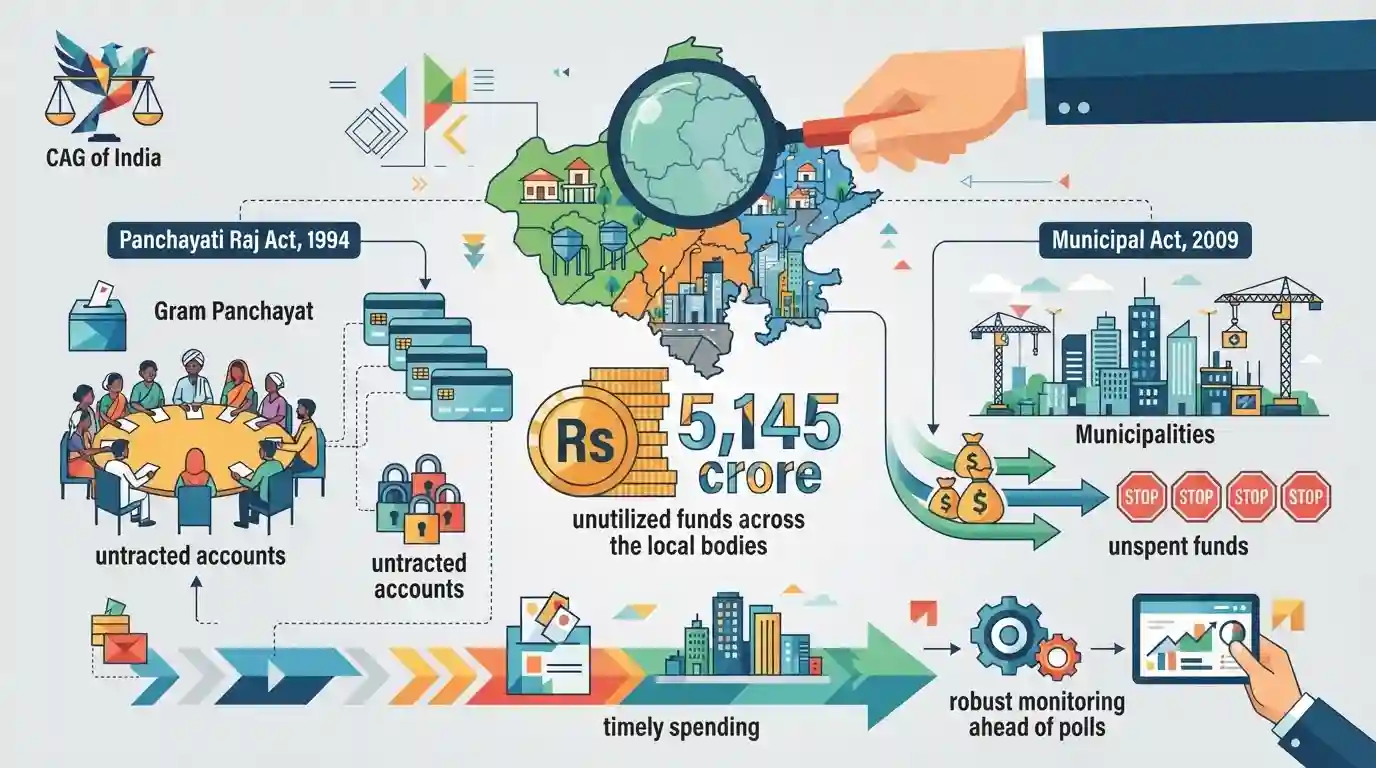
The Comptroller and Auditor General (CAG) of India has flagged significant fiscal planning issues in Rajasthan, noting unutilised local body funds exceeding Rs 5,145 crore across municipal and rural local bodies at the end of FY 2024-25. The audit highlighted a lack of systematic tracking for Gram Panchayat bank accounts and urged the state to implement robust monitoring to ensure that Finance Commission grants and local revenues are spent timely on civic development ahead of the upcoming urban local body polls.
Key Points
- Unutilised Funds in FY 2024-25: The CAG flagged massive idle balances at the end of 2024-25, including Rs 1,514.4 crore in Municipal Funds, Rs 1,718.34 crore in Zila Parishad (ZP) Funds, and Rs 1,912.68 crore in Panchayat Samiti (PS) Funds.
- Systemic Retention: Sizable balances were continuously retained over a five-year period from 2020-21 to 2024-25, indicating deficiencies in expenditure planning for local developmental works.
- Gram Panchayat Tracking Deficits: The audit noted that the status of unutilised funds in Gram Panchayat (GP) bank accounts was not being properly maintained at the PS or ZP level, as GPs maintain accounts locally in scheduled banks.
- Statutory Provisions: Section 64 of the Rajasthan Panchayati Raj Act, 1994, governs the maintenance of GP, PS, and ZP Funds. Section 79 of the Rajasthan Municipal Act, 2009, governs the creation and maintenance of the Municipal Fund.
- Government Response: The Local Self Government Department attributed year-end balances to long tendering processes, project-linked payment schedules, and the receipt of scheme funds towards the end of the financial year.
- CAG Recommendations: Establishing a mechanism for timely local fund utilization, transferring unutilised balances of closed schemes to the revenue head, and strengthening the monitoring of GP bank accounts.
Important Terms
Rajasthan Panchayati Raj Act, 1994

Primary legislation establishing and consolidating the three-tier rural local self-governance system (Gram Panchayat, Panchayat Samiti, Zila Parishad) in Rajasthan under the 73rd Constitutional Amendment.
UPSC context
RPSC RAS GS Paper III: Tests local governance, powers, and schedules of rural institutions.
Rajasthan Municipal Act, 2009
Comprehensive legislation governing urban local bodies in Rajasthan, outlining their organization, direct election procedures, financial administration, and duties under the 74th Constitutional Amendment.
UPSC context
RPSC EO/RO and RAS GS Paper III: Tests urban local self-government framework and provisions.
Comptroller and Auditor General of India
A constitutional office under Article 148 responsible for auditing receipts and expenditures of the Central and State governments, acting as the guardian of the public purse.
UPSC context
RPSC RAS GS Paper III: Tests constitutional bodies, financial accountability, and auditing of local resources.
State Finance Commission
A constitutional body constituted under Articles 243I and 243Y by the Governor every five years to review local financial positions and recommend fiscal transfers.
UPSC context
RPSC RAS GS Paper III: Tests devolution of revenue to rural and urban local bodies.
Local Self Government Department, Rajasthan
The administrative department overseeing urban local bodies (Municipal Corporations, Councils, Municipalities), executing state developmental policies, and managing urban sanitation and infrastructure.
UPSC context
RPSC RAS GS Paper III: Tests administrative mechanisms and public policy implementation for cities.
Zila Parishad
The apex tier of rural local self-governance at the district level, chaired by an elected Zila Pramukh, supervising development planning across rural blocks.
UPSC context
RPSC RAS GS Paper III: Tests the composition, powers, and structural hierarchy of Panchayati Raj.
Panchayat Samiti
The intermediate tier of rural self-governance at the block level, coordinating development activities and administering resources across multiple Gram Panchayats.
UPSC context
RPSC RAS GS Paper III: Tests block-level administrative setup and rural project implementation.
Gram Panchayat
The village-level, primary tier of rural local self-government, consisting of elected ward members led by a Sarpanch to manage local administration.
UPSC context
RPSC RAS GS Paper III: Tests grassroots democratic institutions and village-level policy implementation.
Linked PYQs · 3
Linked PYQs · 3
- 2021RPSC_PRELIMSGS1
Statement (A): The duty of the Comptroller and Auditor General is not only to ensure the validity but also the propriety of expenditure. Reason (R): He is to maintain the Constitution and laws of Parliament in the field of financial administration.
- 2024RPSC_PRELIMSGS1
Which of the following is a matter on which the Finance Committee on 31st December considers? (i) The recommendation between the Union and the States of the net proceeds of the taxes which are to be, or may be, divided between them under Chapter I of Part XII of the Constitution. (ii) The Finance Commission shall govern the grants-in-aid of the revenues of the States. (iii) The resources needed to supplement the Consolidated Fund of a State to supplement the resources of the Panchayats. (iv) Review the present Climate Management Solutions.
- 2018RPSC_PRELIMSGS1
Which of the following Act/Rule provides for joint meetings of Gram Sabhas in Rajasthan?
