CAG Audit Findings on Basic Amenities Deficiencies in Railway Stations
Source:The Hindu ↗
ఇది ఎందుకు ముఖ్యం
The findings serve as a concrete case study for Mains answers on the role of the CAG in ensuring accountability (propriety of expenditure), challenges in India's infrastructure development (Railways), and the efficacy of public service delivery for vulnerable sections (Divyangjan).
సారాంశం
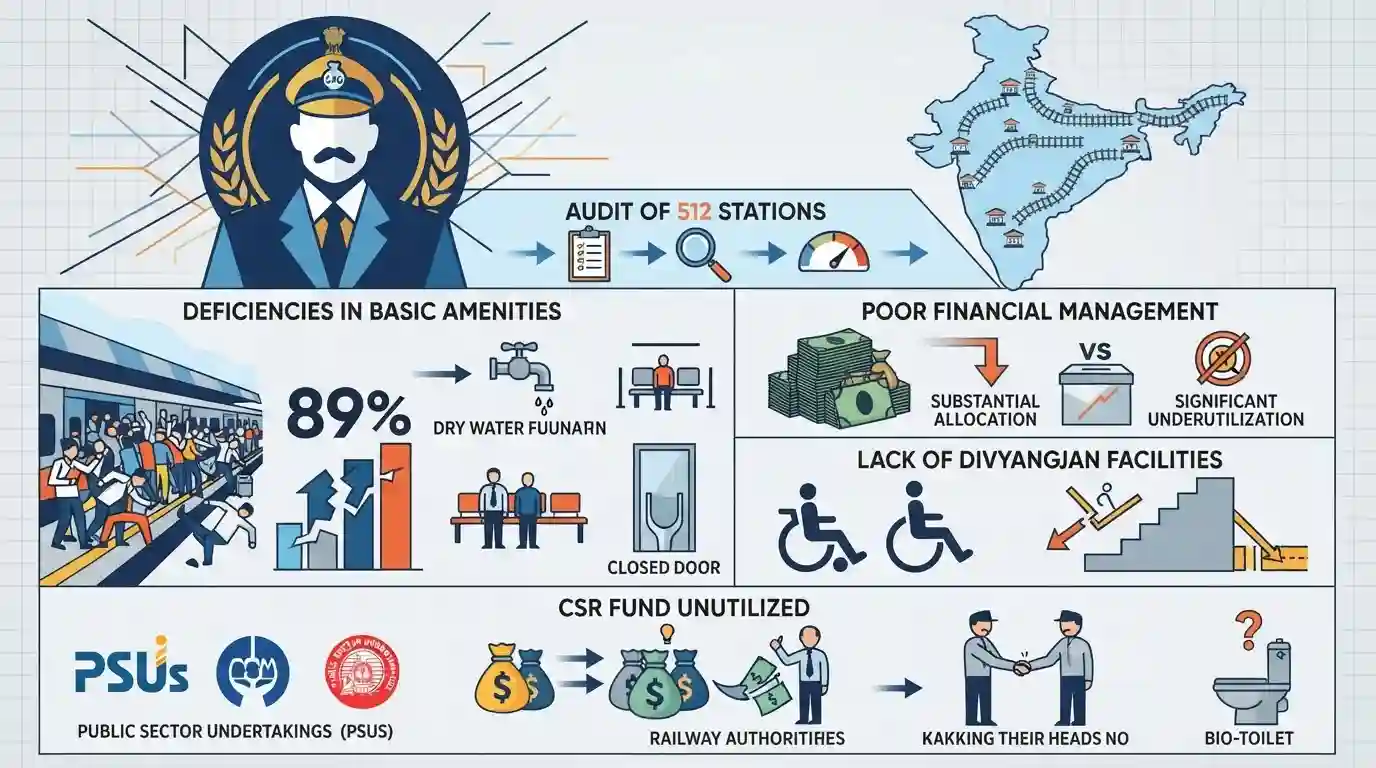
A recent report by the Comptroller and Auditor General (CAG) highlights severe deficiencies in passenger amenities across Indian railway stations. Auditing 512 stations, the CAG found that 89% lacked basic facilities like drinking water, seating, and urinals, despite substantial budget allocations under the 'Customer Amenities' plan head. The report underscores poor financial management, noting significant underutilization of allocated funds. Furthermore, the audit exposed inadequate infrastructure for Divyangjan (persons with disabilities) and the failure of railway authorities to utilize Corporate Social Responsibility (CSR) funds offered by public sector undertakings for essential facilities like bio-toilets. These findings reflect critical gaps in governance, accountability, and infrastructure project execution within the Indian Railways.
ముఖ్య అంశాలు
- A CAG audit of 512 railway stations revealed that 89% failed to provide basic minimum amenities such as waiting halls, drinking water, and seating.
- Despite an allocation of ₹41,123.95 crore for 'Customer Amenities' between 2017-18 and 2021-22, poor fund utilization resulted in persistent infrastructure deficits.
- The audit flagged significant shortcomings in making railway stations accessible for Divyangjan (persons with disabilities).
- Inefficiency and administrative delays led to the non-utilization of CSR funds from NLC and MCL intended for bio-toilets.
ముఖ్యమైన పదాలు
Comptroller and Auditor General (CAG)

The constitutional authority (Article 148) responsible for auditing all receipts and expenditures of the Union and State governments, including public sector enterprises.
UPSC context
GS Paper 2 (Constitutional Bodies). Vital for ensuring executive accountability to Parliament, such as auditing railway infrastructure execution and budget utilization.
Corporate Social Responsibility (CSR)
A statutory requirement under the Companies Act for profitable companies to allocate a percentage of their net profits to social and public welfare initiatives.
UPSC context
GS Paper 2 (Governance). Tests accountability and implementation gaps, such as zonal railways failing to utilize PSU funds for public amenities.
Divyangjan
The official Indian Government term for Persons with Disabilities (PwDs), used to promote dignity and a positive, inclusive approach toward accessibility.
UPSC context
GS Paper 2 (Social Justice). Relevant to assessing inclusive infrastructure policies and compliance with the Rights of Persons with Disabilities Act, 2016.
Neyveli Lignite Corporation (NLC)
A Navratna Central Public Sector Enterprise (CPSE) under the Ministry of Coal, primarily engaged in lignite excavation and power generation.
UPSC context
GS Paper 3 (Infrastructure). Questions may focus on PSU performance, CSR contributions, and inter-agency coordination failures in infrastructure execution.
Mahanadi Coalfields Limited (MCL)
A major coal-producing Miniratna public sector enterprise and subsidiary of Coal India Limited, headquartered in Odisha.
UPSC context
GS Paper 1 (Resources) & GS Paper 2. Important as a case study in governance when its CSR funds for public works are underutilized.
Minimum Essential Amenities (MEA)
Mandatory basic infrastructure standards codified by the Railway Board for stations, including drinking water, seating, latrines, and platform shelters.
UPSC context
GS Paper 3 (Infrastructure). Highlights challenges in public service delivery, passenger safety standards, and effective utilization of capital outlays.
ప్రిలిమ్స్ ఉచ్చు
CAG has the constitutional authority to penalize departments for the non-utilization of allocated funds.
The CAG acts strictly as an auditing body. It conducts propriety audits to expose inefficiency but lacks executive power to penalize departments or enforce compliance.
అనుసంధానమైన స్థిర భావనలు
What is the difference between Regularity Audit and Propriety Audit by the CAG?
- Regularity Audit: Assesses whether expenditure is legally compliant, authorized, and conforms to statutory rules. This is mandatory for the CAG.
- Propriety Audit: Examines the wisdom, faithfulness, and economy of government expenditure to identify wasteful spending. This is discretionary.
What are the core statutory requirements for Corporate Social Responsibility (CSR) in India?
- Applicability criteria: Applies to companies (including PSUs) with net worth ₹500cr+, turnover ₹1000cr+, or net profit ₹5cr+.
- Spending mandate: Companies must spend at least 2% of their average net profits over the preceding three financial years on specified activities.
అంతర-అంశ నమూనాలు
Accessible India & Audit Accountability
The audit exposes execution gaps in the Accessible India Campaign (Sugamya Bharat Abhiyan), linking constitutional audit functions directly to the rights of persons with disabilities.
CSR bridging Infrastructure Deficits
Shows a unique governance convergence where profitable PSUs attempt to deploy statutory CSR funds for railway sanitation, exposing how administrative lethargy thwarts cross-sectoral funding.

Expect a multi-statement Polity question merging CAG's discretionary propriety audit powers with execution gaps in the Accessible India Campaign.
అనుసంధాన PYQలు · 4
అనుసంధాన PYQలు · 4
- 2018MainsGS2
“The Comptroller and Auditor General (CAG) has a very vital role to play.” Explain how this is reflected in the method and terms of his appointment as well as the range of powers he can exercise.
- 2024MainsGS2
“The duty of the Comptroller and Auditor General is not merely to ensure the legality of expenditure but also its propriety.” Comment.
- 2022MainsGS3
Why is Public Private Partnership (PPP) required in infrastructural projects ? Examine the role of PPP model in the redevelopment of Railway Stations in India.
- 2022MainsGS4
In contemporary world, corporate sector's contribution in generating wealth and employment is increasing. In doing so, they are bringing in unprecedented onslaught on the climate, environmental sustainability and living conditions of human beings. In this background, do you find that Corporate Social Responsibility (CSR) is efficient and sufficient enough to fulfill the social roles and responsibilities needed in the corporate world for which the CSR is mandated? Critically examine.
