CAG report reveals NPS fund transfer lapse and deferred liability
Source:the-times-of-india ↗
Why It Matters
The transition of states from NPS back to OPS has substantial financial implications. This CAG audit highlights the fiscal reality of such policy reversals, including deferred liabilities and interest burdens, which are central to discussions on public financial management, state budgeting, and fiscal transparency.
Summary
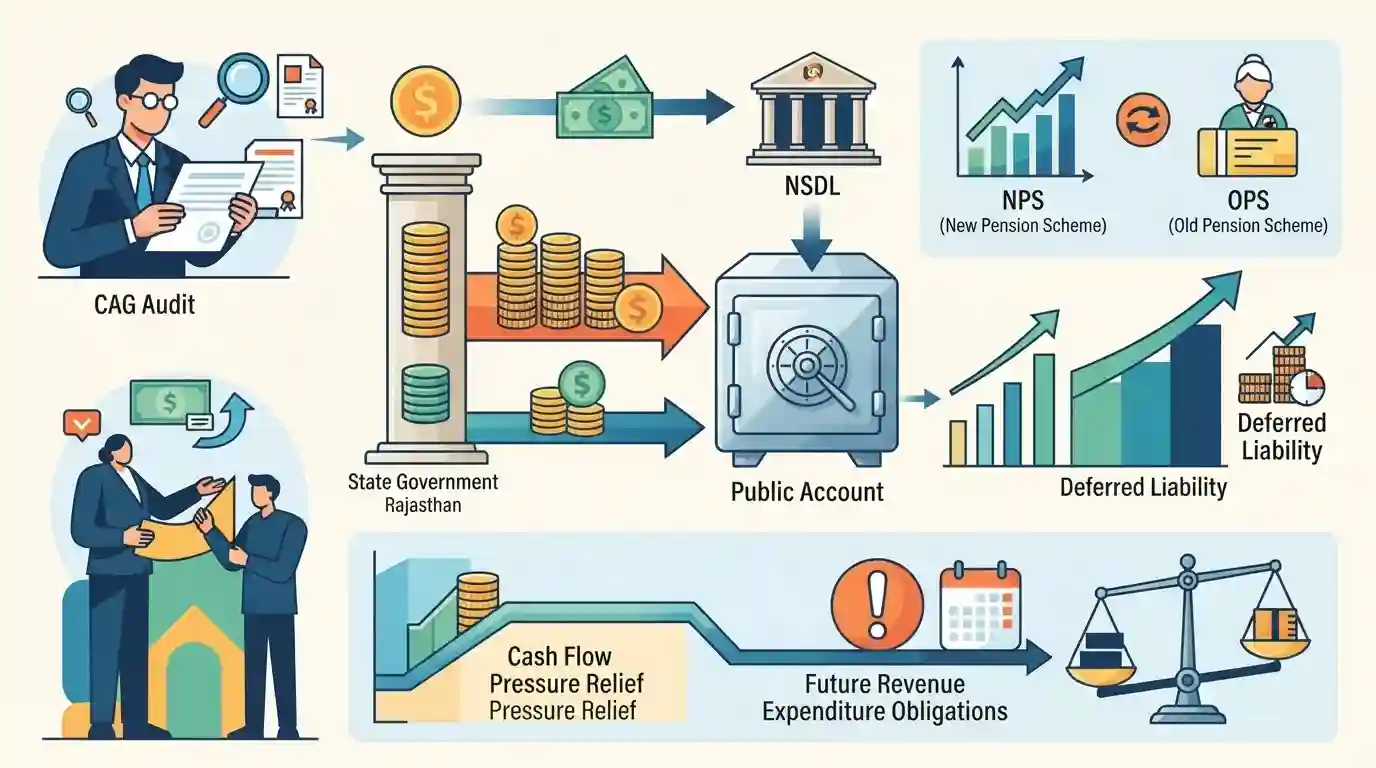
The Comptroller and Auditor General (CAG) of India in its audit report revealed that the Rajasthan government failed to transfer ₹684.47 crore deducted from state employees for the New Pension Scheme (NPS) to the National Securities Depository Ltd (NSDL) even three years after reverting to the Old Pension Scheme (OPS). Combined with the state's matching share of ₹684.47 crore and an avoidable interest burden of ₹49.16 crore, the lapse has resulted in a total deferred liability of ₹1,418.10 crore. The CAG warned that keeping fiduciary retirement funds in the Public Account to ease cash flow pressures is not a genuine fiscal saving as it creates future revenue expenditure obligations.
Key Points
- Rajasthan reverted from the New Pension Scheme (NPS) to the Old Pension Scheme (OPS) on April 1, 2022, affecting 5,25,713 state employees (excluding All India Services officers).
- During the transition, employee contributions of ₹684.47 crore (deducted for Jan–March 2022) were not transferred to NSDL and remained in the state's Public Account till March 2025.
- The state government was also required to make a matching contribution of ₹684.47 crore, bringing the principal deferred liability to ₹1,368.94 crore.
- The delay caused an avoidable interest burden of ₹49.16 crore during 2024–25, which increased the total deferred liability of the state government to ₹1,418.10 crore and hurt employee returns.
- The CAG observed that pension deductions have a fiduciary character. Parking these funds in the Public Account to ease short-term cash flow is not a genuine fiscal saving as it creates implicit future revenue obligations.
Prelims Trap
The PFRDA Act allows state governments to legally reclaim accumulated NPS corpuses to fund their transition back to the Old Pension Scheme.
The PFRDA Act, 2013 has no legal provision for returning accumulated NPS corpuses to states; the funds belong solely to subscribers.
Static Concepts Connected
What are the core targets of the Rajasthan FRBM Act, 2005?
- Enactment year: Enacted in 2005 to institutionalize fiscal discipline, reduce fiscal deficit, and manage Rajasthan's public debt-to-GSDP ratio.
- Fiscal deficit limit: Prescribes keeping the fiscal deficit within 3% of GSDP, subject to conditional relaxations allowed by the Finance Commission.
- Mandatory disclosures: Requires presenting Medium-Term Fiscal Policy and Fiscal Policy Strategy Statements annually before the State Legislative Assembly.
How does the Constitution categorize State accounts audited by the CAG?
- Consolidated Fund: Under Article 266(1), contains all revenues, loans raised, and receipts of the State; requires legislative appropriation for withdrawals.
- Public Account: Under Article 266(2), holds public money other than consolidated funds (e.g., PF, deposits); transactions do not require legislative approval.
- Contingency Fund: Under Article 267(2), placed at the disposal of the Governor to meet unforeseen expenditure pending legislative authorization.
Cross-Topic Patterns
NPS-OPS shift & State Debt
Reverting to OPS swaps defined contributions for defined benefits, lowering short-term state outflows but compounding long-term committed revenue expenditure and raising debt-to-GSDP ratios.
CAG audits & fiscal transparency
Parking employee deductions in Public Accounts to artificially depress fiscal deficits is caught by CAG’s off-budget liability disclosures, ensuring transparency under FRBM.

Statements on Rajasthan FRBM targets combined with CAG's findings on Public Account liabilities are highly probable in state economy papers.
Linked PYQs · 4
Linked PYQs · 4
- 2021RPSC_PRELIMSGS1
Statement (A): The duty of the Comptroller and Auditor General is not only to ensure the validity but also the propriety of expenditure. Reason (R): He is to maintain the Constitution and laws of Parliament in the field of financial administration.
- 2018RPSC_PRELIMSGS1
The process of removing the Comptroller and Auditor General of India from his office is similar to that of which one of the following?
- 2025RPSC_PRELIMSGS1
Consider the following statements regarding Rajasthan’s fiscal deficit: A. The actual fiscal deficit in 2022-23 was 3.76 percent of the state’s Gross Domestic Product. B. This is less than the limit approved by the F.R.B.M. Act, 2005. C. The fiscal deficit in 2022-23 was higher than in 2021-22. Choose the correct option:
- 2023RPSC_PRELIMSGS1
In which year did the Rajasthan government enact the Rajasthan Fiscal Responsibility and Budget Management Act?
