CAG Performance Audit on Green India Mission Implementation Gaps
Source:The Hindu ↗
ఇది ఎందుకు ముఖ్యం
This CAG performance audit offers authoritative empirical evidence of structural and executive lapses in India's flagship climate change mission. It is highly useful for answering Mains questions regarding the bottlenecks in environmental policy implementation, funding constraints in ecological restoration, and the gap between India's international climate pledges (NDCs) and actual domestic progress.
సారాంశం
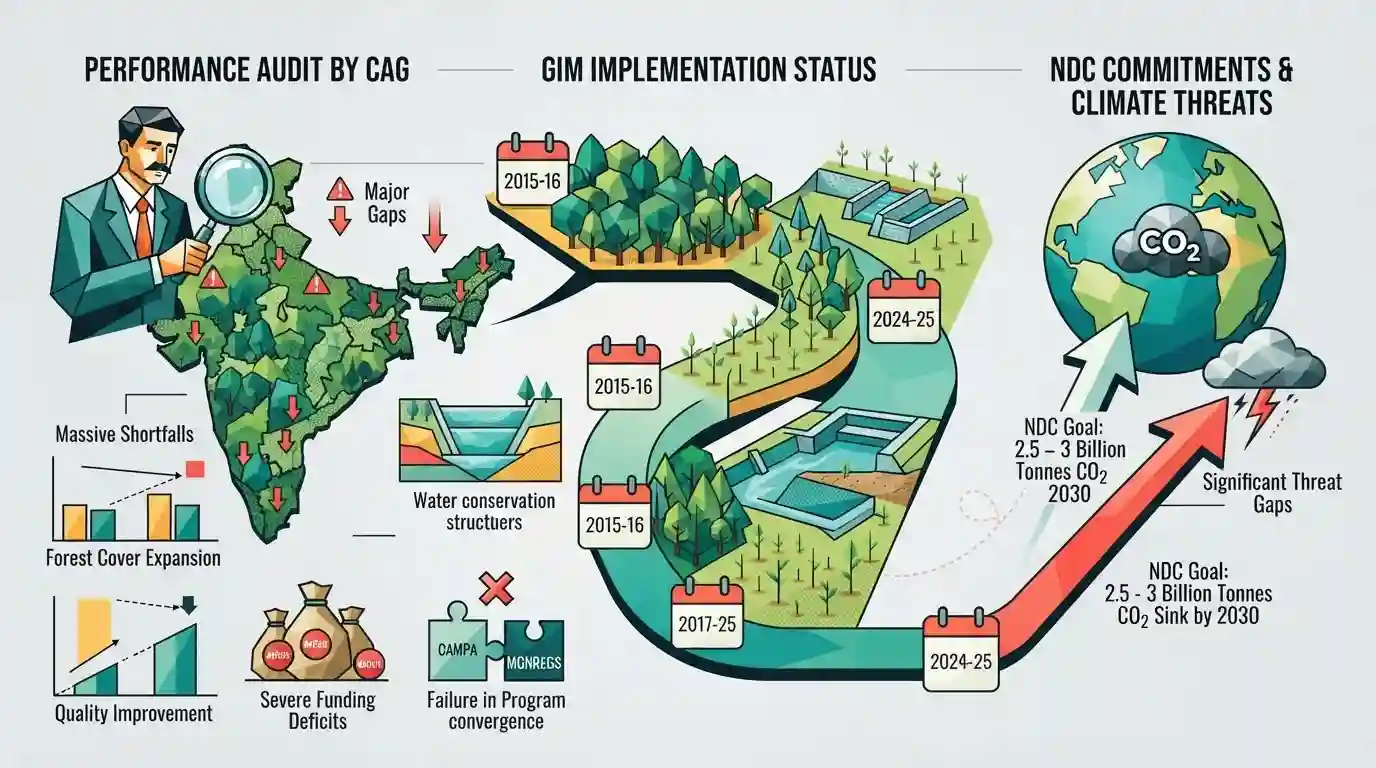
A performance audit by the Comptroller and Auditor General (CAG) has revealed major gaps in the implementation of the Green India Mission (GIM) between 2015-16 and 2024-25. The audit flagged massive shortfalls in targets for both forest cover expansion and quality improvement, alongside severe funding deficits and a critical failure in program convergence (with schemes like CAMPA and MGNREGS). These implementation gaps significantly threaten India's international climate commitments under the Paris Agreement, specifically its NDC goal of creating an additional 2.5 to 3 billion tonnes of CO2 equivalent carbon sink by 2030.
ముఖ్య అంశాలు
- Severe targets shortfall: Quality improvement of forest cover achieved only 0.11384 million hectares against a 1.4 million ha target (91.87% shortfall). Increase in overall forest cover was recorded on only 0.03409 million ha against a 1.4 million ha target (97.57% shortfall).
- Critical funding deficits: The mission failed to secure ₹10,600 crore in proposed funding. Only ₹1,149.14 crore (47.88%) of the approved budgetary support was actually received over the audited 10-year period (2015-16 to 2024-25).
- Programmatic silos: A key failure highlighted by the CAG was the complete lack of effective convergence with related government schemes like CAMPA, MGNREGS, Nagar Van Yojana, and School Nursery Yojana.
- Weak financial controls and monitoring: Eight audited States and UTs did not maintain annual accounts, while others had unaudited accounts or severe discrepancies with subsidiary records.
- Threat to NDC targets: The GIM is a central pillar of India's Nationally Determined Contributions (NDCs) under the Paris Agreement to create an additional carbon sink of 2.5 to 3 billion tonnes of CO2 equivalent by 2030, putting these climate commitments at high risk.
ముఖ్యమైన పదాలు
Green India Mission (GIM)

A key central mission aimed at protecting, restoring, and enhancing India's forest cover, ecosystem services, biodiversity, and carbon sequestration capacity while boosting forest-based livelihoods.
UPSC context
GS Paper 3 (Environment & Conservation); evaluates governmental efforts in achieving forestry targets, climate mitigation, and sustainable livelihoods.
National Action Plan on Climate Change (NAPCC)
Launched in 2008, India's comprehensive national strategy to address climate change through eight core missions focusing on solar energy, energy efficiency, sustainable habitat, water, forestry, and agriculture.
UPSC context
GS Paper 3 (Environment & Climate Change); assesses India's mitigation and adaptation policies, policy structure, and international climate commitments.
Compensatory Afforestation Fund Management and Planning Authority (CAMPA)
A statutory authority established under the Compensatory Afforestation Fund Act, 2016, to manage funds collected from entities diverting forest land for non-forest purposes to promote reforestation.
UPSC context
GS Paper 3 (Conservation, Forest Policies); tests understanding of compensatory afforestation mechanisms, environment-development balance, and ecological restoration funds.
Comptroller and Auditor General (CAG)
A constitutional authority (Article 148) that heads the Indian Audit and Accounts Department, serving as the guardian of the public purse by auditing public sector expenditures and performance.
UPSC context
GS Paper 2 (Constitutional Bodies, Accountability); covers constitutional checks and balances, the public audit mechanism, and parliamentary control over executive spending.
Nationally Determined Contribution (NDC)
Under the Paris Agreement, non-binding climate plans where individual nations outline their greenhouse gas emission reduction and climate adaptation commitments to meet global climate goals.
UPSC context
GS Paper 3 (Environmental Conservation & International Agreements); tests India's climate action commitments, global warming mitigation, and international emission targets.
Paris Agreement
A legally binding international treaty on climate change adopted in 2015, aiming to limit global warming to well below 2, preferably to 1.5 degrees Celsius, compared to pre-industrial levels.
UPSC context
GS Paper 3 (Environmental Pollution & Degradation, International Treaties); tests global climate diplomacy, international protocols, and cooperative mitigation frameworks.
ప్రిలిమ్స్ ఉచ్చు
The Green India Mission is the sole national scheme tasked with achieving India's entire NDC carbon sink target by 2030.
While GIM is a critical component of India's NDC strategy, the carbon sink target of 2.5-3 billion tonnes of CO2 equivalent is a national, multi-sectoral goal. GIM is not the exclusive vehicle for this target.
అనుసంధానమైన స్థిర భావనలు
What is a CAG 'Performance Audit' and its legal basis?
- Definition: An independent assessment of whether government undertakings, programs, or organizations are executing tasks with economy, efficiency, and effectiveness.
- Legal Source: It is derived from the Regulations on Audit and Accounts, 2007, framed under Section 23 of the CAG (DPC) Act, 1971.
- Tabling Procedure: Reports are submitted to the President or Governor under Article 151 and subsequently examined by the Public Accounts Committee (PAC).
What is the structure and scope of the National Action Plan on Climate Change (NAPCC)?
- Launch & Pillars: Launched in 2008 with eight core missions spanning solar energy, energy efficiency, water, agriculture, forestry (GIM), habitats, Himalayan ecosystems, and strategic knowledge.
- Core Objective: Aims to align domestic development objectives with climate change mitigation and adaptation without compromising economic growth.
- Green India Mission Target: GIM targets adding 5 million hectares (mha) of forest/tree cover and improving the quality of another 5 mha of degraded forest lands.
అంతర-అంశ నమూనాలు
CAG scrutiny + Cooperative Federalism
GIM implementation relies heavily on state-level forestry departments; poor accounting and planning across 8 states highlight federal execution bottlenecks in national climate mandates.
Climate diplomacy vs. Domestic budgets
GIM’s 52% funding deficit highlights the disconnect between India's high-profile international climate pledges (NDCs) and actual domestic fiscal allocation.

Questions may pair GIM implementation gaps under NAPCC with the constitutional and statutory powers of CAG's performance audits.
అనుసంధాన PYQలు · 3
అనుసంధాన PYQలు · 3
- 2025PrelimsGS1
Consider the following statements : Statement I: Article 6 of the Paris Agreement on climate change is frequently discussed in global discussions on sustainable development and climate change. Statement II: Article 6 of the Paris Agreement on climate change sets out the principles of carbon markets. Statement III : Article 6 of the Paris Agreement on climate change intends to promote inter-country non-market strategies to reach their climate targets. Which one of the following is correct in respect of the above statements?
- 2025MainsGS3
Write a review on India's climate commitments under the Paris Agreement (2015) and mention how these have been further strengthened in COP26 (2021). In this direction, how has the first Nationally Determined Contribution intended by India been updated in 2022?
- 2024MainsGS2
“The duty of the Comptroller and Auditor General is not merely to ensure the legality of expenditure but also its propriety.” Comment.
