Rabi Crops Minimum Support Price Policy Updates
Source:The Hindu ↗
Why It Matters
Minimum Support Price (MSP) announcements are crucial fixtures of India's agricultural policy, directly impacting farmer incomes, inflation, food grain procurement, and fiscal management.
Summary
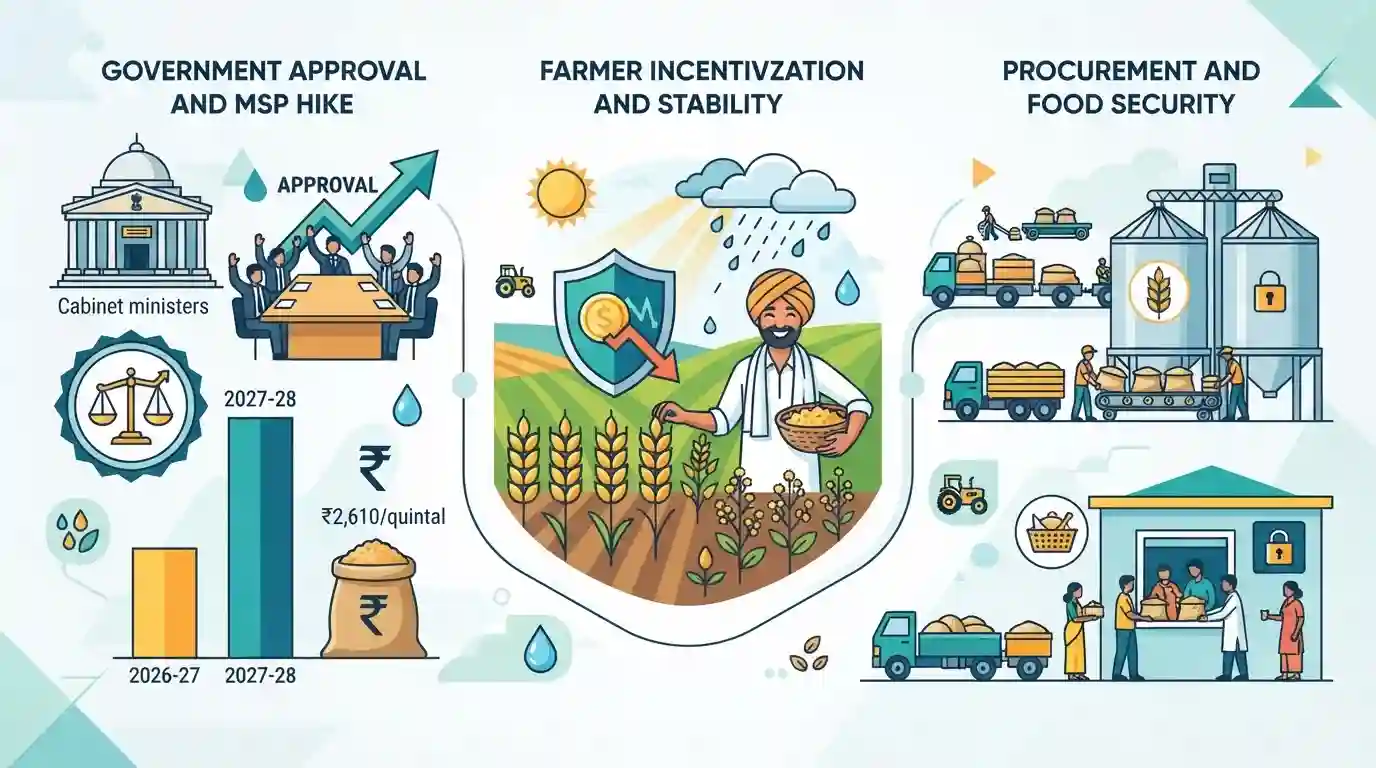
The Union Cabinet approved a hike in the Minimum Support Price (MSP) for wheat and other rabi crops for the 2027-28 season, raising wheat MSP to ₹2,610 per quintal. This policy decision aims to incentivize rabi crop cultivation, safeguard farmers against price volatility, and manage national food security buffer stocks.
Key Points
- The Cabinet approved an increase in the Minimum Support Price (MSP) for wheat by ₹25 to ₹2,610 per quintal for the 2027-28 rabi marketing season.
- MSP hikes are typically recommended by the Commission for Agricultural Costs and Prices (CACP) to incentivize production and ensure remunerative prices to farmers.
- Rabi crops include staples like wheat, barley, gram, masur, and mustard, whose pricing impacts farm incomes and inflation dynamics.
Important Terms
Minimum Support Price (MSP)

A government-set price floor that protects agricultural producers against sharp price drops, ensuring remunerative prices and facilitating food grain procurement for the Public Distribution System.
UPSC context
GS Paper III (Agriculture): Essential for questions on agricultural pricing policies, buffer stocking, food security, and farmers' welfare.
Commission for Agricultural Costs and Prices (CACP)
An expert advisory body under the Ministry of Agriculture and Farmers' Welfare that recommends Minimum Support Prices for specified agricultural commodities based on production costs and market trends.
UPSC context
GS Paper III (Agriculture): Tests institutional mechanisms in price determination and agricultural cost structures.
Cabinet Committee on Economic Affairs (CCEA)
A high-level cabinet committee chaired by the Prime Minister that takes the final policy decisions on economic matters, including the official approval of MSP recommendations.
UPSC context
GS Paper II/III (Polity/Governance & Economy): Relevant for understanding executive decision-making bodies in economic policy.
Static Concepts Connected
How are Minimum Support Prices (MSP) determined and approved in India?
- CACP Role: Recommending body is the Commission for Agricultural Costs and Prices (CACP), an attached office under the Ministry of Agriculture and Farmers Welfare.
- CCEA Approval: Final approval is given by the Cabinet Committee on Economic Affairs (CCEA), chaired by the Prime Minister.
- Coverage Scope: MSP covers 22 mandated crops and one commercially important crop (sugarcane, covered under FRP).
Cross-Topic Patterns
MSP Hikes and Monetary Policy Inflation Targeting
MSP adjustments directly feed into wholesale and consumer price indices, influencing the Monetary Policy Committee's interest rate decisions and inflation targeting mandate.
Food Security Procurement vs WTO Agriculture Rules
Buffer stocking policies tied to MSP procurement interact directly with WTO domestic support limits (Amber Box ceilings).

Expect a multi-statement statement on CACP recommendations vs CCEA approvals, cost definitions (A2+FL vs C2), and statutory backing of MSP.
Linked PYQs · 4
Linked PYQs · 4
- 2023PrelimsGS1
Consider the following statements: 1. The Government of India provides Minimum Support Price for niger (Guizotia abyssinica) seeds. 2. Niger is cultivated as a Kharif crop. 3. Some tribal people in India use niger seed oil for cooking. How many of the above statements are correct?
- 2020PrelimsGS1
Which of the following factors/policies were affecting the price of rice in India in the recent past? 1. Minimum Support Price 2. Government's trading 3. Government's stockpiling 4. Consumer subsidies Select the correct answer using the code given below:
- 2019PrelimsGS1
The economic cost of food grains to the Food Corporation of India is Minimum Support Price and bonus (if any) paid to the farmers plus
- 2018MainsGS3
What do you mean by Minimum Support Price (MSP)? How will MSP rescue the farmers from the low income trap?
