Proposal to Integrate Ecological Value of Trees in Project Approvals
Source:The Hindu ↗
Why It Matters
It provides a concrete example of the debate between infrastructure development and environmental conservation, highlighting a potential policy solution (economic valuation of natural capital) for Environmental Impact Assessments (EIA), which is a key concept in both GS3 (Environment) and GS4 (Environmental Ethics).
Summary
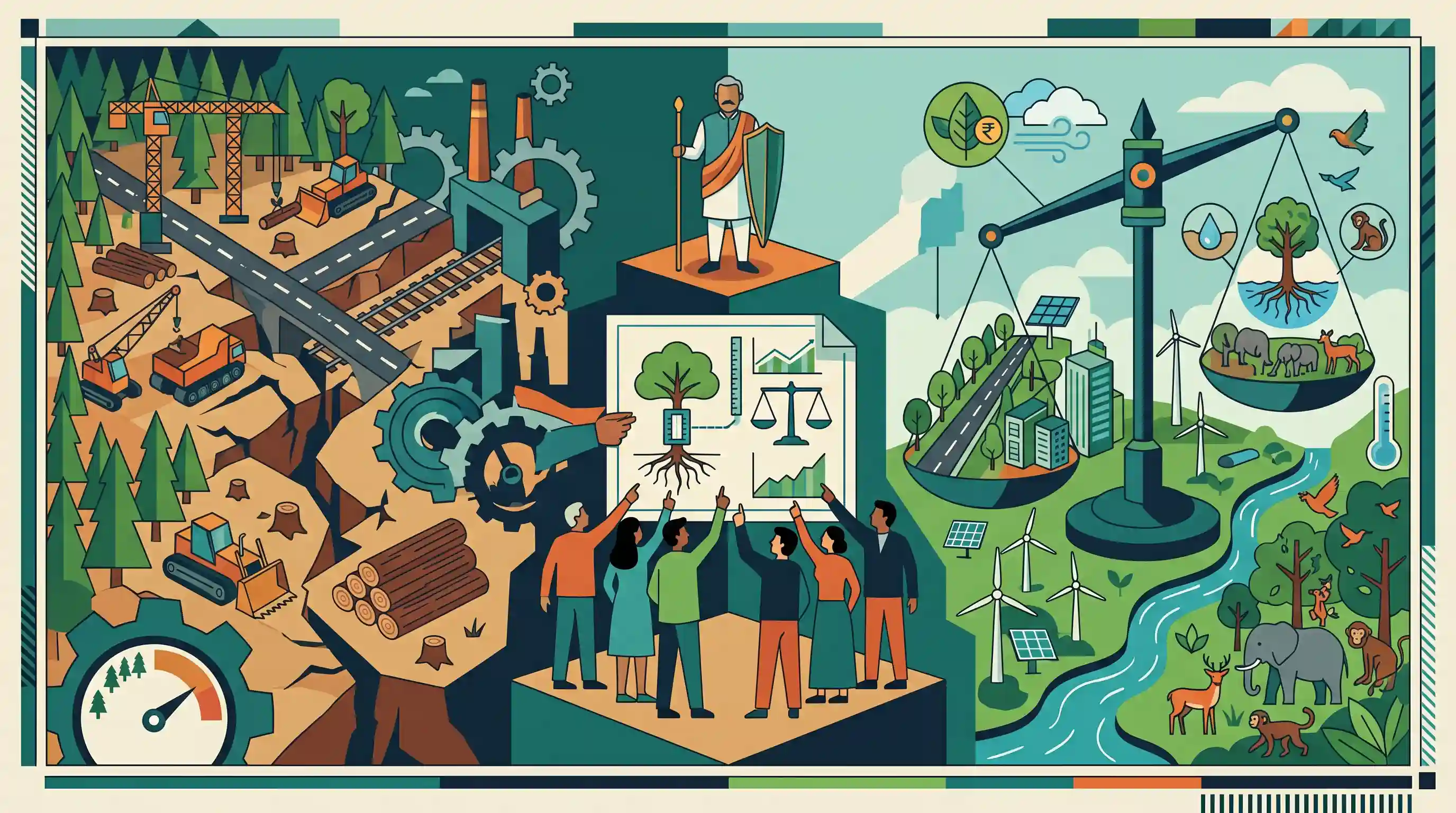
An environmental advocacy group, the Mysore Grahakara Parishat (MGP), is urging the Karnataka government to introduce a formal policy requiring the ecological and economic value of trees to be factored into the approval process for infrastructure and development projects. Citing the loss of nearly 19,000 trees to projects like roads and railways between 2022 and 2026, activists argue that current development models create a 'zero-sum conflict' that harms the environment. Integrating tree valuation into environmental impact assessments would promote sustainable development and help mitigate climate change by ensuring the true costs of ecological degradation are considered before project clearance.
Key Points
- The Mysore Grahakara Parishat (MGP) has urged the Karnataka government to formulate a Cabinet-level policy mandating the inclusion of the economic and ecological value of trees in the appraisal of development projects.
- Between 2022 and 2026, official figures indicate that 18,864 trees were felled across Karnataka for various infrastructure projects, including roads, railways, and power lines.
- Environmentalists argue that current infrastructure planning often creates a zero-sum conflict between development and the environment, prioritizing projects over ecological preservation without proper cost-benefit analysis.
- Factoring the true ecological cost of tree felling into Environmental Impact Assessments could deter unnecessary environmental destruction and serve as a model for broader climate change mitigation efforts.
Important Terms
Environmental Impact Assessment (EIA)

A statutory process evaluating potential environmental consequences of projects before implementation to ensure development remains ecologically sustainable and minimizes damage.
UPSC context
GS Paper III: Environment; essential for understanding project clearances and the EIA Notification 2006 framework.
Ecosystem Services Valuation
The practice of assigning economic value to nature's benefits (e.g., carbon sequestration, air purification) to factor natural capital into national and project accounting.
UPSC context
GS Paper III: Economy/Environment; relates to Green GDP and natural capital accounting in India.
Sustainable Development
Development that meets current needs without compromising the ability of future generations to meet theirs, balancing economic growth with environmental integrity.
UPSC context
GS Paper III: Environment; foundational for SDGs and climate change mitigation strategies.
Precautionary Principle
A legal principle stating that lack of scientific certainty should not justify postponing measures to prevent serious or irreversible environmental damage.
UPSC context
GS Paper III: Environment/Judiciary; key for environmental law and cases like Vellore Citizens' Welfare Forum.
Mysore Grahakara Parishat (MGP)
A Mysuru-based NGO and pressure group active since 1989, focusing on consumer rights, civic advocacy, and environmental protection in Karnataka.
UPSC context
GS Paper II: Governance; illustrates the role of NGOs and pressure groups in policy advocacy.
Environmental Ethics
The study of moral responsibilities toward the environment, often debating the intrinsic value of nature versus its utility to humans.
UPSC context
GS Paper IV: Ethics; relevant for case studies on development-conservation trade-offs and environmental policy-making.
Prelims Trap
"The EIA notification mandates the calculation of monetary ecological value of individual trees before project clearance."
Current EIA and CAMPA rules mandate Net Present Value (NPV) for diverted forest land, but do NOT currently mandate monetary valuation per individual tree for non-forest/urban infrastructure projects.
Static Concepts Connected
What are the key stages of the Environmental Impact Assessment (EIA) process in India?
- Screening phase: Determines if a project requires a full, partial, or no EIA based on its scale and category (Category A or B).
- Scoping phase: The Expert Appraisal Committee (EAC) defines the comprehensive Terms of Reference (ToR) for assessing potential environmental impacts.
- Public Consultation: Mandatory gathering of local concerns and objections, though certain projects (like strategic or defense projects) are legally exempted.
How does the Compensatory Afforestation Fund Act (CAMPA) manage forest diversion?
- Fund distribution: Under the 2016 Act, 90% of the collected funds are disbursed to State funds and 10% to the National fund.
- Net Present Value: Project proponents must pay the NPV for diverted forest land to compensate for the long-term loss of ecosystem services.
- Restricted usage: Funds must be used strictly for afforestation, wildlife protection, and forest management, explicitly barring use for administrative salaries or travel.
Cross-Topic Patterns
Urban Governance vs. Ecological Conservation
Tree protection in non-forest urban areas falls under state-specific Tree Preservation Acts, testing the capacity of municipal governance (74th Amendment) to balance rapid infrastructure goals with ecological preservation.
Environmental Ethics and Natural Capital
Assigning a monetary value to a tree's ecological services bridges anthropocentric economic models with biocentric conservation—a classic theme for GS Paper 4 case studies on development vs. environment.

Expect a 2026 prelims statement distinguishing CAMPA's 'Net Present Value' for forest land from the SC's proposed per-tree valuation.
Linked PYQs · 5
Linked PYQs · 5
- 2024MainsGS3
What role do environmental NGOs and activists play in influencing Environmental Impact Assessment (EIA) outcomes for major projects in India? Cite four examples with all important details.
- 2014MainsGS3
Environmental Impact Assessment studies are increasingly undertaken before a project is cleared by the Government. Discuss the environmental impacts of coal-fired thermal plants located at coal pitheads.
- 2021MainsGS3
“Investment in infrastructure is essential for more rapid and inclusive economic growth.” Discuss in the light of India's experience.
- 2025MainsGS4
Keeping the national security in mind, examine the ethical dilemmas related to controversies over environmental clearance of development projects in ecologically sensitive border areas in the country.
- 2024MainsGS4
Global warming and climate change are the outcomes of human greed in the name of development, indicating the direction in which extinction of organisms including human beings is heading towards loss of life on Earth. How do you put an end to this to protect life and bring equilibrium between the society and the environment?
