Union Cabinet Resolution Marking 50 Years of Emergency
Source:Indian Express ↗
Why It Matters
As 2025 marks the 50th anniversary of the 1975 Emergency, it is highly likely to feature in both Prelims and Mains. Aspirants must thoroughly understand the constitutional mechanics of National Emergency, the judicial scrutiny of executive powers, and the subsequent constitutional safeguards (like the 44th Amendment) enacted to prevent future democratic subversion.
Summary
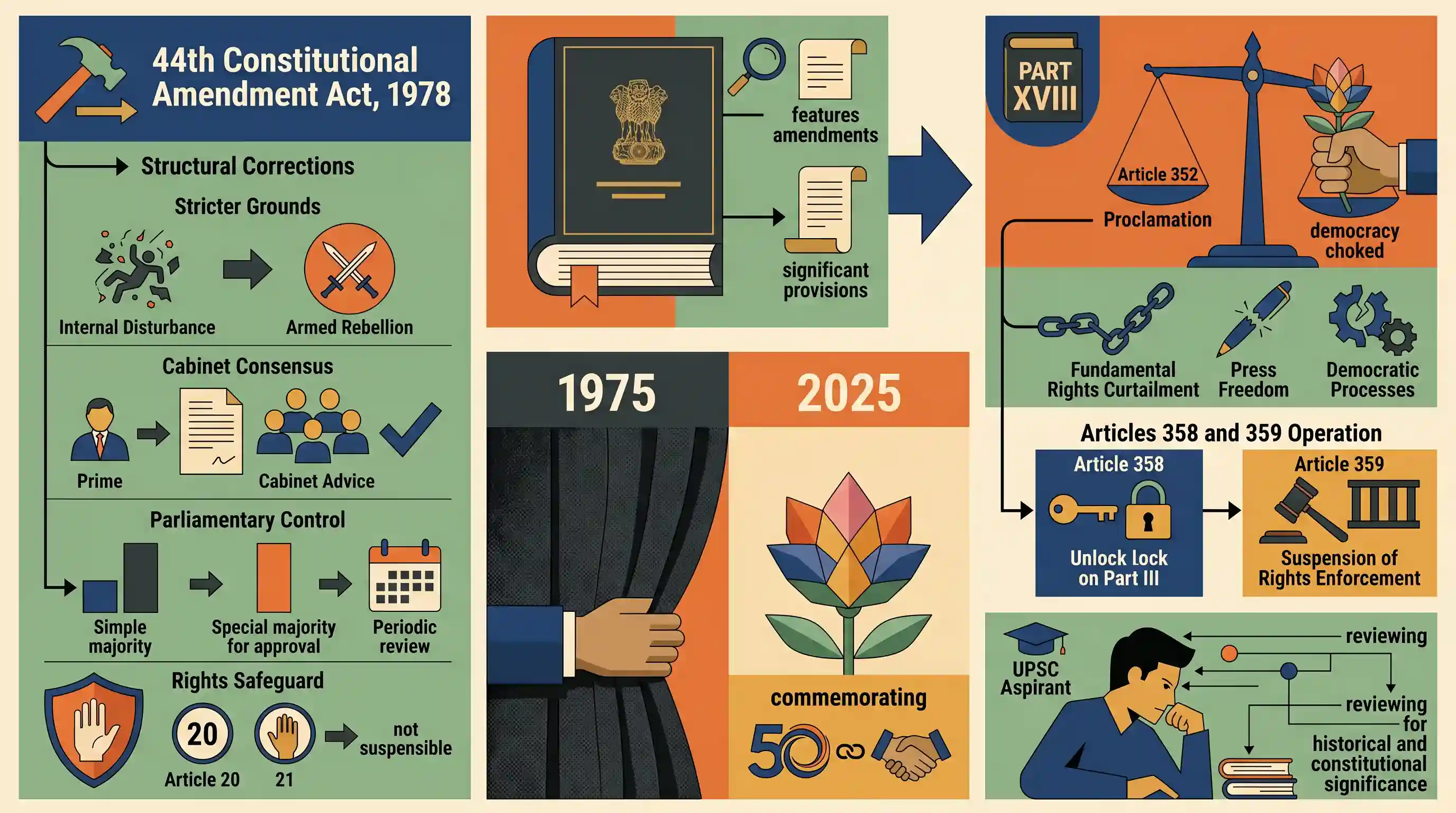
The Union Cabinet has passed a formal resolution to commemorate 50 years since the imposition of the National Emergency in 1975, terming it a dark chapter when 'democracy was choked.' The resolution underscores the severe curtailment of fundamental rights, press freedom, and democratic processes during the 21-month period. For UPSC aspirants, the 50th anniversary elevates the historical and constitutional significance of the Emergency, making it crucial to review Article 352, the suspension of fundamental rights under Articles 358 and 359, and the structural corrections introduced by the 44th Constitutional Amendment Act of 1978.
Key Points
- The Union Cabinet passed a resolution marking the 50th anniversary of the imposition of the 1975 National Emergency, describing it as a time when 'democracy was choked.'
- The Emergency was declared under Article 352 of the Indian Constitution on the ambiguous grounds of 'internal disturbance.'
- The 21-month period witnessed the suspension of fundamental rights, stringent press censorship, and the detention of political opponents.
- The event led to the 44th Constitutional Amendment Act (1978), which introduced critical safeguards such as replacing 'internal disturbance' with 'armed rebellion' and ensuring Articles 20 and 21 cannot be suspended during an Emergency.
Important Terms
Article 352

The constitutional provision empowering the President to proclaim a National Emergency when India's security is threatened by war, external aggression, or armed rebellion.
UPSC context
GS2 Polity; tests understanding of emergency provisions, federalism, and executive powers during national crises.
44th Constitutional Amendment Act (1978)
Legislation enacted in 1978 to restore democratic safeguards; it replaced 'internal disturbance' with 'armed rebellion' and mandated the Union Cabinet's written advice for declaring an emergency.
UPSC context
GS2 Polity & GS1 History; crucial for understanding corrective constitutional measures and democratic safeguards post-Emergency.
42nd Constitutional Amendment Act (1976)
Known as the 'Mini-Constitution,' this 1976 act passed during the Emergency added 'Socialist, Secular, Integrity' to the Preamble and significantly curtailed judicial review.
UPSC context
GS2 Polity; foundational for topics on constitutional amendments and the executive-judiciary power balance.
Armed Rebellion
The specific ground for declaring an 'Internal Emergency' introduced by the 44th Amendment to prevent misuse of the previously vague 'internal disturbance' provision.
UPSC context
GS2 Polity; tests knowledge of procedural constraints on emergency declarations and internal threat definitions.
Articles 358 and 359
Provisions governing the suspension of Fundamental Rights during Emergency; Article 358 automatically suspends Article 19, while Article 359 allows suspension of other rights (except Articles 20 and 21).
UPSC context
GS2 Polity; key for questions on the protection of civil liberties versus national security interests.
Prelims Trap
Article 19 rights are automatically suspended during any declaration of a National Emergency.
Article 358 suspends Article 19 only when Emergency is declared on grounds of war or external aggression, not for 'armed rebellion' (post-44th Amendment).
Static Concepts Connected
How do Articles 358 and 359 differ in suspending Fundamental Rights?
- Scope: Article 358 affects only Article 19. Article 359 affects those Fundamental Rights explicitly specified by Presidential Order (except Articles 20 and 21).
- Trigger: Article 358 applies only to external emergency (war/external aggression). Article 359 applies to both external and internal (armed rebellion) emergencies.
- Operation: Article 358 suspends the right itself automatically. Article 359 only suspends the enforcement of the specified rights, not the rights themselves.
What procedural safeguards for declaring Emergency were introduced by the 44th Amendment?
- Written Cabinet Advice: The President can proclaim an Emergency only after receiving a written recommendation from the Union Cabinet, not merely on the Prime Minister's advice.
- Approval Timeline: The time limit for Parliamentary approval of the Emergency proclamation was reduced from two months to one month.
- Special Majority: Approval requires a special majority in both Houses of Parliament, replacing the earlier requirement of a simple majority.
- Armed Rebellion: The ambiguous phrase 'internal disturbance' was replaced with 'armed rebellion' to prevent arbitrary imposition based on civil unrest.
Cross-Topic Patterns
Emergency era & Basic Structure
The 42nd Amendment enacted during the Emergency attempted to bypass Kesavananda Bharati. The 44th Amendment and the Minerva Mills case later restored the constitutional balance and judicial review.
GS1: JP Movement & Total Revolution
The political turmoil preceding the 1975 Emergency connects directly to the Nav Nirman Andolan, the Bihar Movement, and Jayaprakash Narayan’s call for 'Total Revolution' in post-independence history.

Expect a Prelims multi-statement question contrasting Articles 358 and 359, given the 50th-anniversary focus on the 44th Amendment.
Linked PYQs · 2
Linked PYQs · 2
- 2024PrelimsGS1
Which of the following statements are correct about the Constitution of India? 1. Powers of the Municipalities are given in Part IX A of the Constitution. 2. Emergency provisions are given in Part XVIII of the Constitution. 3. Provisions related to the amendment of the Constitution are given in Part XX of the Constitution. Select the answer using the code given below :
- 2025MainsGS1
Trace India's consolidation process during early phase of independence in terms of polity, economy, education and international relations.
