Urea Investment Policy and Domestic Production Capacity Targets
Source:The Hindu ↗
Why It Matters
Fertilizer subsidies represent one of the largest components of India's non-developmental fiscal expenditure. Sub-sectors like urea pricing, production feedstock (natural gas), and import-dependence are highly tested topics in UPSC Prelims (conceptual questions on ammonia/refinery by-products) and Mains GS3 (agricultural inputs, direct/indirect subsidies, and structural reforms in agriculture). NIPU-2026 directly impacts India's import bills, subsidy burden, and agricultural productivity.
Summary
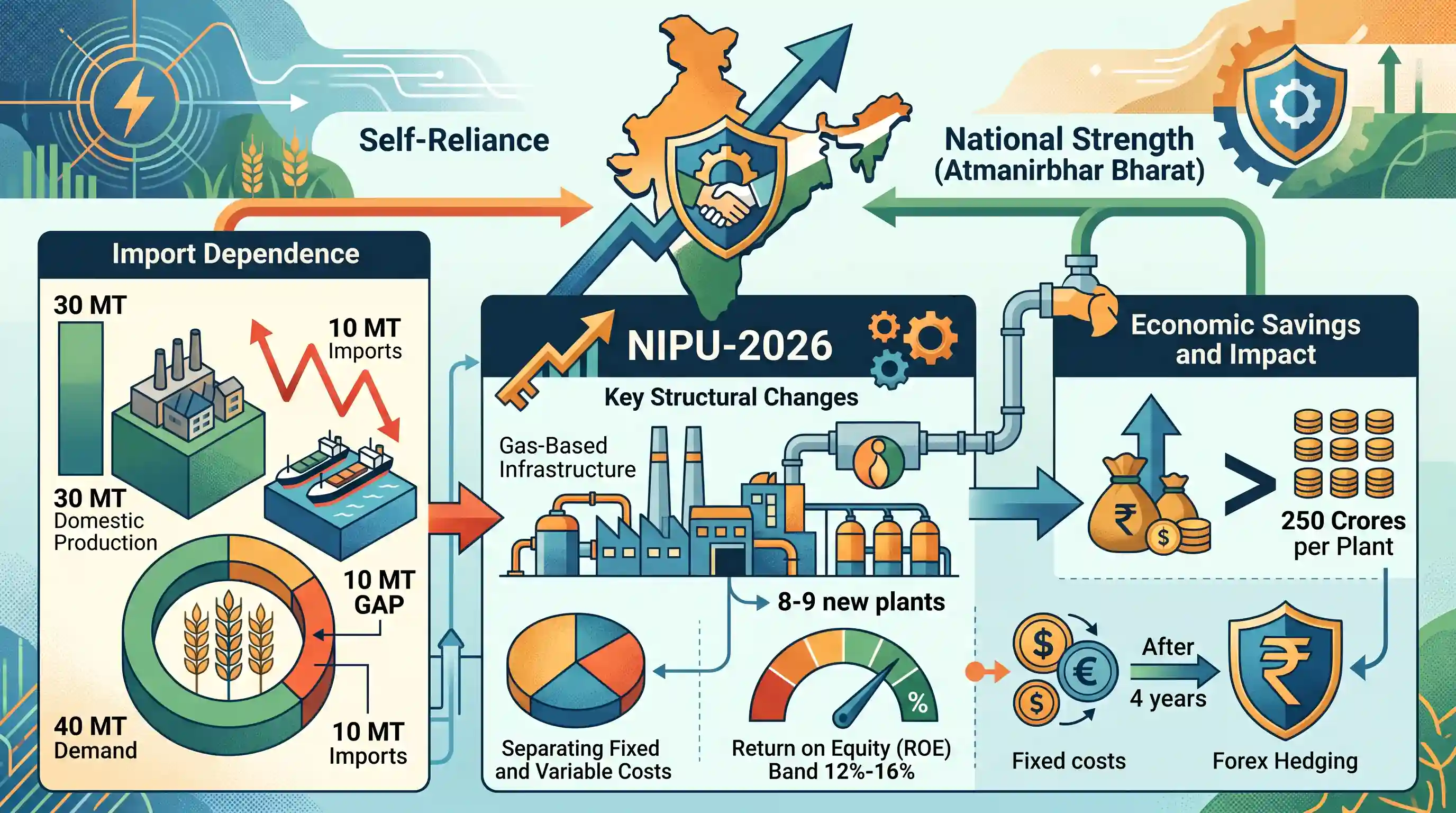
The Union Cabinet has approved the National Investment Policy for Urea (NIPU-2026) to facilitate the setup of 8–9 new gas-based urea manufacturing plants, adding 10 million tonnes of domestic capacity. Aimed at eliminating India's current import dependence of 10 million tonnes (against 30 million tonnes domestic production and 40 million tonnes demand), the revamped policy builds on the expired NIP-2012. Key structural changes include separating fixed and variable costs, setting a 12% to 16% Return on Equity (RoE) band, and converting fixed costs into rupees after four years to hedge against forex risks. These financial adjustments are expected to save over ₹250 crore per plant.
Key Points
- The Union Cabinet approved the National Investment Policy for Urea (NIPU-2026) to encourage fresh investments for establishing 8–9 new gas-based urea plants.
- The policy aims to add 10 million tonnes of additional domestic urea capacity, bridging the current supply gap to achieve complete self-reliance.
- India currently produces around 30 million tonnes of urea annually against a demand of 40 million tonnes, relying on imports of around 10 million tonnes to meet the deficit.
- NIPU-2026 improves on the expired NIP-2012 by separating fixed and variable costs to increase transparency and offering a uniform incentive structure for private, public, and cooperative projects.
- It introduces a viable Return on Equity (RoE) band ranging from a floor of 12% to a ceiling of 16% to attract sustainable investments.
- To mitigate foreign exchange risks, the policy allows the conversion of fixed costs into Indian Rupees after four years based on the prevailing exchange rates, saving an estimated ₹250 crore per plant compared to NIP-2012.
Important Terms
National Investment Policy for Urea (NIPU-2026)

A policy framework approved in 2026 to incentivize the setup of gas-based urea manufacturing plants, aiming to add 10 million tonnes of domestic capacity and eliminate India's dependency on fertilizer imports.
UPSC context
GS Paper III (Agriculture & Subsidies); tests understanding of fertilizer pricing, subsidy reduction strategies, and agricultural self-reliance.
New Investment Policy (NIP-2012)
A policy announced in 2013 to facilitate fresh investments in greenfield, brownfield, expansion, and revival urea projects, which led to the creation of six domestic plants before its investment window closed in 2019.
UPSC context
GS Paper III (Agricultural Inputs & Infrastructure); tests historical policy evolution, public-private partnership models, and gas-based manufacturing efforts.
Union Cabinet
The supreme executive decision-making body of India, chaired by the Prime Minister, consisting of cabinet ministers who collectively formulate national policies and direct executive administration.
UPSC context
GS Paper II (Polity & Governance); tests constitutional provisions on collective responsibility, executive powers, and federal decision-making processes.
Ministry of Chemicals and Fertilizers
The branch of the Government of India responsible for implementing policies, managing subsidies, and regulating production and distribution of chemicals, pharmaceuticals, and agricultural fertilizers.
UPSC context
GS Paper II & III (Government Policies & Agriculture); tests administrative machinery, fertilizer pricing frameworks, and direct benefit transfers.
Prelims Trap
Urea is subsidized under the Nutrient-Based Subsidy (NBS) scheme to ensure balanced NPK ratio application in agricultural soils.
Aspirants often assume all primary fertilizers are covered under the Nutrient-Based Subsidy (NBS) scheme. In reality, Urea is strictly excluded and remains under statutory price control.
Static Concepts Connected
Why is Urea excluded from the Nutrient-Based Subsidy (NBS) Scheme?
- NBS Objective: Launched in 2010 to fix flat per-kg subsidies based on nutrient content (N, P, K, S) to encourage balanced fertilizer usage.
- Urea Pricing Regime: Urea is excluded; its Maximum Retail Price (MRP) is statutorily fixed by the government, and the gap between production/import cost and MRP is paid as a subsidy.
- Imbalance Consequence: Because urea remains highly artificially cheap relative to P&K fertilizers, farmers over-apply nitrogen, distorting soil chemistry (ideal NPK ratio is 4:2:1; India's is highly skewed).
What is the role of Natural Gas as a feedstock in Urea manufacturing?
- Ammonia Precursor: Natural gas is converted into ammonia (NH3) via the Haber-Bosch process, which is then reacted with carbon dioxide to synthesize urea.
- Import Vulnerability: Since India imports a significant portion of its natural gas (LNG) for fertilizer plants, domestic urea production costs remain highly vulnerable to volatile global energy markets.
- Alternative Feedstock: To reduce LNG import dependency, the government is piloting coal-gasification-based urea production (e.g., at the Talcher plant in Odisha).
Cross-Topic Patterns
Fertilizer subsidies vs WTO Amber Box norms
India's high domestic subsidy on urea faces constant challenges at the WTO under Amber Box limits, intersecting domestic food security goals with international trade compliance.
Soil Health Cards vs skewed NPK ratios
The structural cheapness of urea due to its exclusion from the NBS scheme directly undermines the micro-nutrient targeting objectives of the Soil Health Card Scheme.

Expect questions comparing the regulatory/subsidy regimes of urea versus P&K fertilizers, focusing on NBS exclusion and gas feedstock.
Linked PYQs · 4
Linked PYQs · 4
- 2020PrelimsGS1
With reference to chemical fertilizers in India, consider the following statements : 1. At present, the retail price of chemical fertilizers is market-driven and not administered by the Government. 2. Ammonia, which is an input of urea, is produced from natural gas. 3. Sulphur, which is a raw material for phosphoric acid fertilizer, is a by-product of oil refineries. Which of the statements given above is/are correct?
- 2016PrelimsGS1
Why does the Government of India promote the use of 'Neem-coated Urea' in agriculture?
- 2023MainsGS3
What are the direct and indirect subsidies provided to farm sector in India? Discuss the issues raised by the World Trade Organization (WTO) in relation to agricultural subsidies.
- 2015MainsGS3
In what way could replacement of price subsidy with Direct Benefit Transfer (DBT) change the scenario of subsidies in India ? Discuss.
