Karnataka Legislation against Social Boycott and Caste Panchayats
Source:The Hindu ↗
Why It Matters
The legislation offers a contemporary example for Mains answers concerning state interventions against human rights violations by extra-judicial bodies like Khap or caste panchayats. It also touches on balancing animal preservation laws with the economic hardships of farmers.
Summary
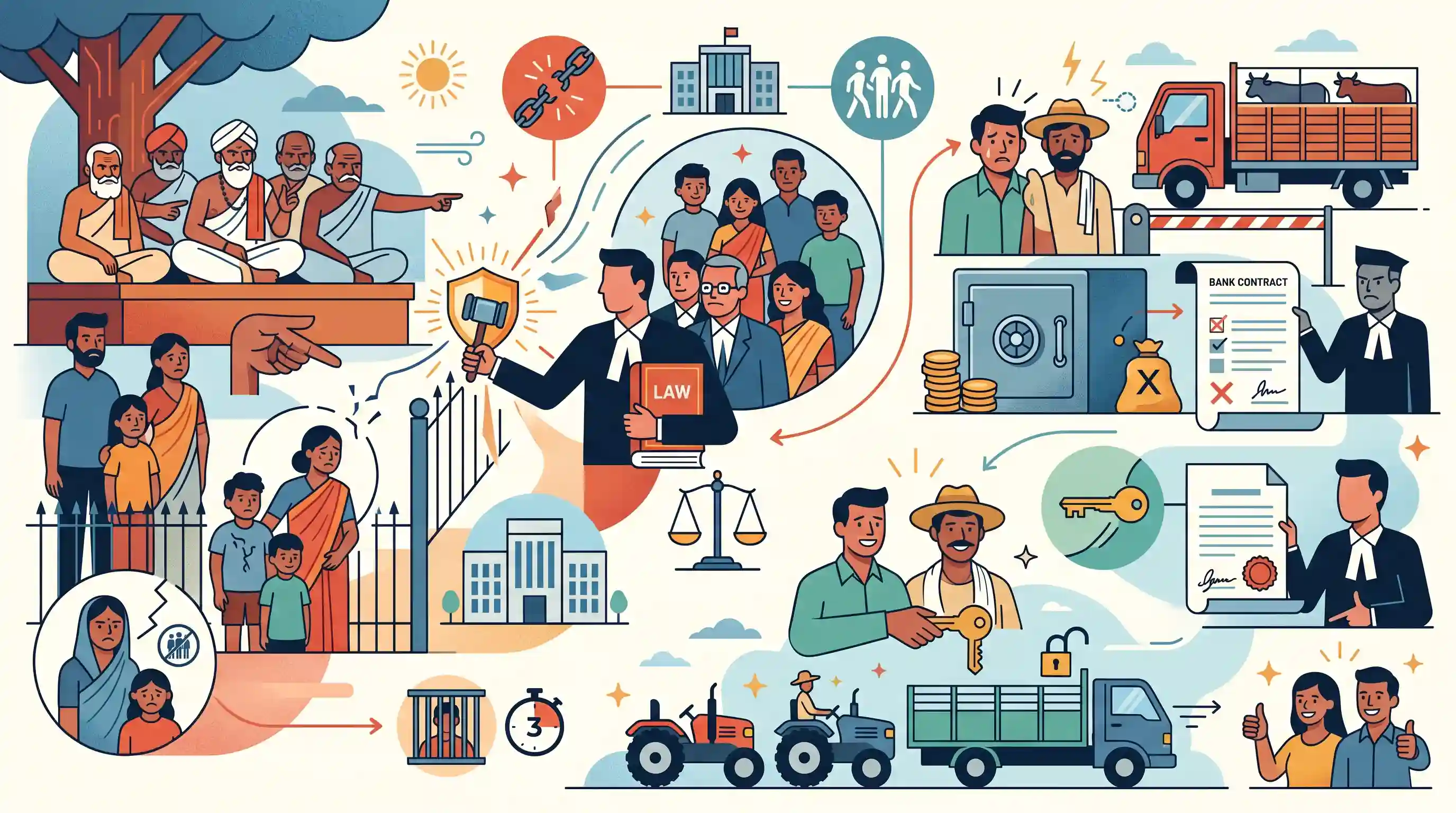
The Karnataka Cabinet has approved the Karnataka Protection of People from Social Boycott (Prevention, Prohibition and Redressal) Bill, 2025, which aims to eradicate social boycotts and discrimination enforced by extra-judicial bodies like caste panchayats. Offenses under this Bill will attract up to three years of imprisonment. Additionally, the Cabinet approved the Karnataka Prevention of Slaughter and Preservation of Cattle (Amendment) Bill, 2025, allowing seized vehicles to be released upon executing an indemnity bond rather than a bank guarantee, to ease the burden on farmers and transporters.
Key Points
- The Karnataka Cabinet approved a Bill to prevent and prohibit social boycotts enforced by extra-judicial bodies like caste and community panchayats.
- The Bill provides for imprisonment of up to three years or a fine of up to ₹1 lakh for offenders imposing social boycott.
- A social boycott prohibition officer, at the rank of a taluk social welfare officer, will be appointed to enforce the provisions and prevent discrimination against marginalized communities like Dalits.
- The Cabinet also approved an amendment to the cattle slaughter law to allow the release of seized vehicles on the execution of an indemnity bond, instead of a bank guarantee, offering relief to farmers and transporters.
Important Terms
Karnataka Social Boycott (Prevention, Prohibition and Redressal) Bill, 2025

A proposed state law criminalising social exclusion and discrimination enforced by informal bodies. It prescribes up to three years' imprisonment for practices that deny individuals social, religious, or economic participation.
UPSC context
GS Paper II (Social Justice/Governance): Addresses the state's role in curbing informal justice systems and protecting individual dignity.
Caste Panchayats
Informal, traditional, and extra-constitutional village councils that resolve intra-community disputes. They often enforce social norms through regressive diktats, including social boycotts, which can violate fundamental rights like equality and life.
UPSC context
GS Paper II/I (Governance/Social Issues): Tests understanding of parallel judicial systems and their conflict with constitutional morality.
Social Boycott
The collective ostracization or exclusion of individuals from community life, commercial relations, or public services. It is often used as a tool for social control by dominant groups or caste-based bodies.
UPSC context
GS Paper II (Fundamental Rights): Relates to Articles 15, 17, and 21, ensuring equality and the right to live with dignity.
Karnataka Prevention of Slaughter and Preservation of Cattle (Amendment) Bill, 2025
State legislation intended to ease the release of vehicles seized for alleged illegal cattle transport by replacing mandatory bank guarantees with indemnity bonds to reduce financial burdens on farmers.
UPSC context
GS Paper III (Agriculture/Animal Husbandry): Tests knowledge of state-level agricultural regulations and leur socio-economic impacts on farmers.
Extra-judicial bodies
Informal groups or traditional councils that exercise judicial powers—such as passing sentences or imposing fines—without legal authorization or recognition by the formal state legal system.
UPSC context
GS Paper II (Governance): Concerns the challenges of maintaining the Rule of Law against non-state actors.
Indemnity Bond
A legal contract where one party agrees to compensate another for any potential loss or damage. In this bill, it replaces the cash-intensive bank guarantee for reclaiming seized property.
UPSC context
GS Paper II/III (Governance/Economy): Relates to administrative reforms and ease of doing business for small-scale agrarian transporters.
Prelims Trap
"The Constitution explicitly defines 'social boycott' under Article 17, and Karnataka is the first state to pass a dedicated law banning it."
The Constitution does not define 'untouchability' or 'social boycott'. Furthermore, Maharashtra was the first state to pass a dedicated law against social boycotts in 2016.
Static Concepts Connected
How do Indian laws address social boycotts and caste panchayats?
- Article 17: Abolishes 'untouchability', though the Constitution does not explicitly define the term.
- PCR Act, 1955: Operationalizes Article 17 by specifically making 'social boycott' a cognizable and non-compoundable offense.
- Article 21: The SC ruled in the Shakti Vahini case (2018) that extra-judicial decrees by caste panchayats violate the fundamental right to life and liberty.
What is the constitutional basis for state laws on cattle slaughter?
- Article 48 (DPSP): Directs the State to organize animal husbandry and prohibit the slaughter of cows, calves, and other milch and draught cattle.
- Seventh Schedule: Preservation of livestock falls under the State List (Entry 15), meaning state governments have the exclusive legislative power to enact cattle laws.
Cross-Topic Patterns
Caste Panchayats + Article 21
Khap/caste panchayats acting as extra-constitutional authorities link directly to Article 21 and the Supreme Court's Shakti Vahini (2018) judgment against parallel justice systems and honor killings.
DPSP operationalization + 7th Schedule
Cattle slaughter laws showcase how certain DPSPs (Article 48) are operationalized exclusively by state legislatures due to livestock falling under the State List, creating interstate variations.

Expect a Prelims question testing the fact that neither 'untouchability' nor 'social boycott' is defined in the Indian Constitution.
Linked PYQs · 2
Linked PYQs · 2
- 2015MainsGS2
Khap Panchayats have been in the news for functioning as extra-constitutional authorities, often delivering pronouncements amounting to human rights violations. Discuss critically the actions taken by the legislative, executive and the judiciary to set the things right in this regard.
- 2018MainsGS1
Caste system is assuming new identities and associational forms. Hence, caste system cannot be eradicated in India." Comment.
