Vibrant Villages Programme Phase 2 Approved to Secure Borders
Source:Indian Express ↗
Why It Matters
Development of border areas is a critical component of India's internal security architecture. Programs like VVP directly address the challenge of out-migration from border regions while actively incorporating local populations into the national security framework, making this highly relevant for GS Paper 3 questions on border management and security.
Summary
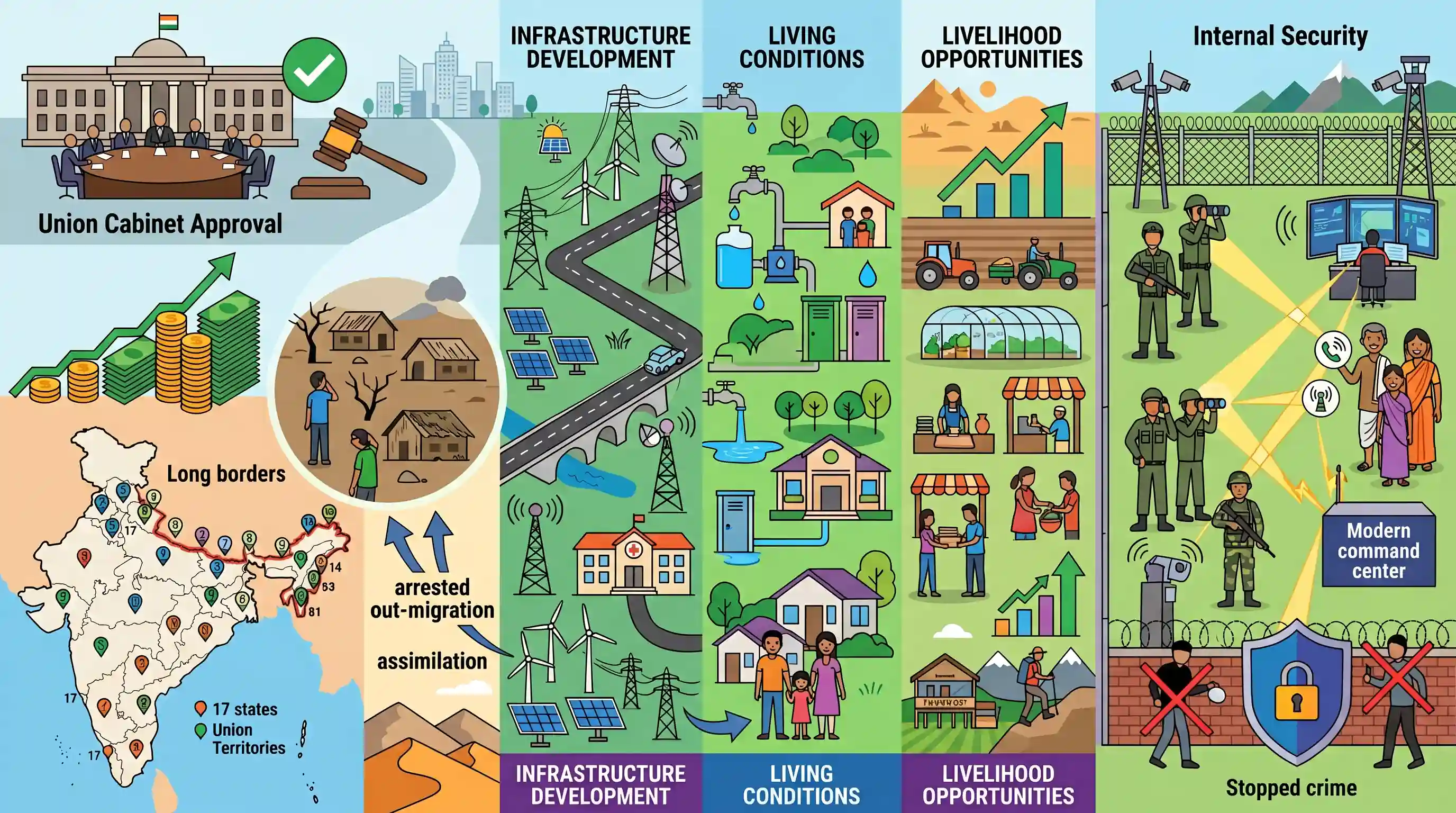
The Union Cabinet has approved Phase-2 of the Vibrant Villages Programme (VVP-II) with a financial outlay of Rs 6,839 crore. The Central sector scheme aims to transform strategic villages abutting international land borders across 17 states and Union Territories into "nerve centers of growth and development." By improving infrastructure, living conditions, and livelihood opportunities, the government intends to arrest out-migration and assimilate border populations. Importantly, the initiative has a strong internal security focus, intending to utilize the local population as the 'eyes and ears' of border guarding forces to prevent trans-border crimes and ensure secure borders.
Key Points
- The Union Cabinet has approved the second phase of the Vibrant Villages Programme (VVP-II) with an outlay of Rs 6,839 crore.
- VVP-II is a Central sector scheme with 100% funding from the Centre, aimed at developing blocks abutting international land borders across 17 states and UTs.
- The scheme aligns with the vision of Viksit Bharat@2047 for safe, secure, and vibrant land borders by creating better living conditions and livelihood opportunities.
- A crucial strategic objective of the scheme is to assimilate the border population and encourage them to act as the 'eyes and ears' of border guarding forces to check trans-border crimes and bolster internal security.
Important Terms
Vibrant Villages Programme (VVP)

A government initiative launched in 2022-23 for comprehensive development of strategic border villages to improve living standards and ensure national security by creating a resilient civilian presence.
UPSC context
GS Paper II (Government Schemes) & GS Paper III (Border Management); tests understanding of border-area stabilization strategies.
VVP Phase-2 (VVP-II)
The second phase of the VVP, approved in 2025 as a 100% Central Sector Scheme with a ₹6,839 crore outlay, expanding coverage to villages across 17 states/UTs.
UPSC context
GS Paper III; specifically focuses on the funding transition to a Central Sector model and expanded geographical scope.
Border Management
The strategic control and development of a country's boundaries to ensure national security, prevent illegal cross-border activities, and integrate border populations into the national mainstream.
UPSC context
GS Paper III (Internal Security); a core pillar of India's defense and internal security architecture.
Central Sector Scheme
A scheme 100% funded and implemented by the Central Government, unlike Centrally Sponsored Schemes where states share a portion of the financial burden.
UPSC context
Prelims/GS Paper II; tests knowledge of fiscal federalism and the financial structure of government initiatives.
Out-migration
The movement of people away from their native regions, often due to lack of livelihoods or infrastructure, creating 'ghost villages' that pose security risks in border areas.
UPSC context
GS Paper I (Population) & GS Paper III (Internal Security); examines the socio-economic drivers of regional instability.
Eyes and Ears of Border Forces
A strategic concept under VVP where local border residents provide vital intelligence and support to security forces (like ITBP) to monitor and secure international boundaries.
UPSC context
GS Paper III (Internal Security); highlights the role of civil-military cooperation in securing sensitive frontiers.
Prelims Trap
VVP Phase-1 and Phase-2 are Centrally Sponsored Schemes focused exclusively on developing villages along the India-China border.
Phase-2 is a Central Sector Scheme (100% Union funded) covering 17 States/UTs on all international borders. Phase-1 was Centrally Sponsored and restricted to the China border.
Static Concepts Connected
What is India's broader Border Management strategy for land frontiers?
- One Border, One Force: The principle assigning specific paramilitary forces (BSF, ITBP, SSB, Assam Rifles) to distinct international borders to avoid overlapping jurisdictions and ensure specialized guarding.
- Community as Sentinels: Integrating local border populations as the "eyes and ears" to provide actionable ground intelligence and prevent a demographic vacuum that adversaries could exploit.
- Smart Border Tech: Deploying the Comprehensive Integrated Border Management System (CIBMS)—using sensors, radars, and technology—alongside human populations to secure porous and difficult riverine terrains.
How do Central Sector Schemes differ from Centrally Sponsored Schemes?
- Central Sector Schemes: 100% funded and directly implemented by the Union Government. VVP Phase-2 falls into this category, unlike Phase-1.
- Centrally Sponsored Schemes: Funded jointly by the Centre and States (usually 60:40, or 90:10 for special category states/NE) but implemented by State government machinery.
Cross-Topic Patterns
Demographic Void and Salami Slicing
Out-migration from remote borders creates a security vacuum. VVP-II addresses this by retaining populations to counter territorial creeping, linking internal border security to local economic geography and livelihood generation.
Infrastructure Convergence: VVP & PMGSY-IV
VVP-II deliberately avoids parallel bureaucracy by using a saturation convergence model. It utilizes PMGSY-IV to build required all-weather roads, successfully merging strategic border security with general rural infrastructure development.

Expect a 2026 Prelims multi-statement question contrasting VVP-I and VVP-II on funding patterns (CSS vs Central Sector) and border coverage.
Linked PYQs · 3
Linked PYQs · 3
- 2024MainsGS3
India has a long and troubled border with China and Pakistan fraught with contentious issues. Examine the conflicting issues and security challenges along the border. Also give out the development being undertaken in these areas under the Border Area Development Programme (BADP) and Border Infrastructure and Management (BIM) Scheme.
- 2020MainsGS3
For effective border area management, discuss the steps required to be taken to deny local support to militants and also suggest ways to manage favourable perception among locals.
- 2020MainsGS3
Analyze internal security threats and transborder crimes along Myanmar, Bangladesh and Pakistan borders including Line of Control (LoC). Also discuss the role played by various security forces in this regard.
