Bihar cabinet approves establishment of specialized state university
Source:timesofindia ↗
Why It Matters
State government legislative initiatives and governance reforms, such as prison administration and higher education advancements, are important for the BPSC Prelims, testing knowledge on the state's current affairs and policy framework.
Summary
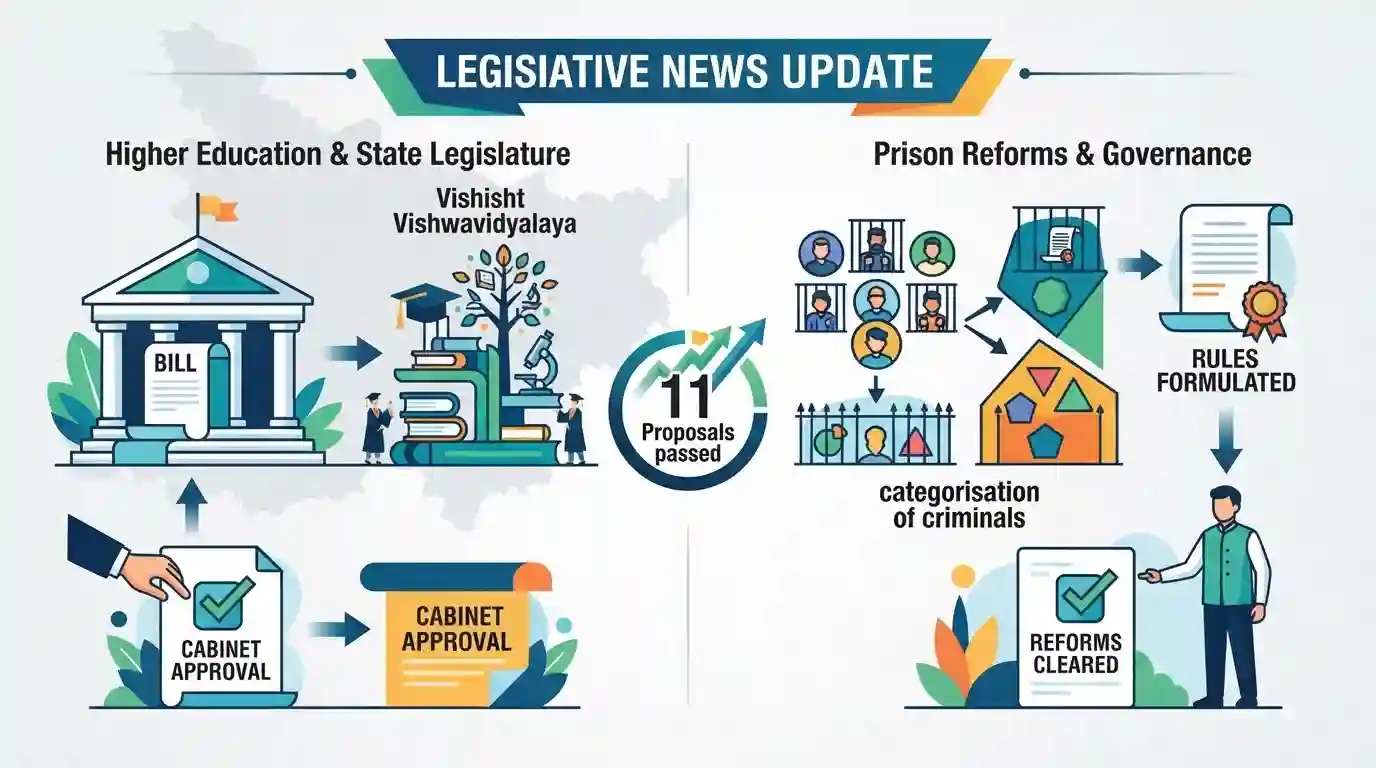
The Bihar state cabinet has approved a proposal to establish a 'Vishisht Vishwavidyalaya' (Special University), with plans to introduce a facilitating Bill in the state assembly. Additionally, acting on the Centre’s advisory on prison reforms, the cabinet cleared the formulation of rules for the categorisation of criminals, among 11 overall proposals passed.
Key Points
- The Bihar state cabinet cleared a proposal to establish a 'Vishisht Vishwavidyalaya' (Special University) in the state.
- A Bill will be introduced in the state assembly to enact the proposal and empower the government to create the Special University.
- The cabinet also approved the framing of rules for the categorisation of criminals, following the Centre's advisory on prison reforms.
- In total, the state cabinet gave its nod to 11 proposals during the meeting.
Important Terms
Vishisht Vishwavidyalaya Bill

A legislative draft approved by the Bihar Cabinet to establish a 'Special University' designed to cater to specialized educational and research demands across the state.
UPSC context
GS Paper II (Education & Governance); tests higher education policy and state-level legislative procedures.
State Cabinet
The executive committee of a state government, led by the Chief Minister, serving as the supreme executive authority for administration and policy-making.
UPSC context
GS Paper II (State Executive); tests understanding of cabinet governance, collective responsibility, and executive powers.
Categorisation of Criminals
The systematic sorting of inmates (such as first-time offenders or high-risk convicts) to maintain safety, prevent negative influences, and execute targeted reformative measures.
UPSC context
GS Paper II & III (Criminal Justice System); tests understanding of prison administration and reformative justice models.
Prison Reforms
Structural and legislative changes designed to modernize jail management, secure human rights of prisoners, reduce overcrowding, and focus on rehabilitation.
UPSC context
GS Paper II (Governance) & GS Paper III (Internal Security); tests state-level initiatives and legislative measures for jail modernization.
Model Prison Manual
A comprehensive guidelines document drafted by the Union Ministry of Home Affairs to standardize, modernize, and reform jail administration across states.
UPSC context
GS Paper II (Federal Relations); tests cooperative federalism in handling State List subjects like prisons.
Prelims Trap
Prisons and reformatories are a Concurrent subject because the Union MHA issues Model Prison Acts.
Prisons fall exclusively under Entry 4 of the State List. The Centre only issues non-binding 'Model Acts' (like the Model Prisons Act 2023) which states must independently legislate to adopt.
Static Concepts Connected
How is legislative power over education and universities distributed in the Seventh Schedule?
- Concurrent List: Moved to the Concurrent List (Entry 25) by the 42nd Amendment, 1976, covering general education.
- State List: The 'incorporation, regulation, and winding up of universities' remains exclusively a State subject (Entry 32).
- Union List: Central Universities and institutions of national importance are exclusively under Union List control (Entries 63-66).
What is the constitutional and legal framework governing prisons in India?
- Constitutional status: Prisons and persons detained therein fall exclusively under Entry 4 of the State List.
- Colonial legacy: Historically governed by the outdated Prisons Act of 1894, focusing primarily on custody and discipline.
- Model Act 2023: The MHA finalized the Model Prisons Act, 2023, shifting focus to correctional administration, rehabilitation, and scientific categorization of prisoners.
Cross-Topic Patterns
Model Acts and cooperative federalism
The Centre increasingly uses "Model Acts" (e.g., Model Prisons Act, Model Tenancy Act) to influence domains strictly under the State List, shaping policy through cooperative federalism rather than direct legislation.
Federal frictions in higher education
The legislative establishment of state universities frequently intersects with ongoing federal frictions, particularly the debates over Governor vs. State Government powers regarding Vice-Chancellor appointments and university administration.

Expect a prelims matching-pair question distinguishing 'Education' (Concurrent) from 'Universities' (State) and 'Prisons' (State).
Linked PYQs · 2
Linked PYQs · 2
- 2024-IBPSC_PRELIMSGS1
Which of the following Acts converted Unicameral Legislature of Bihar into Bicameral : Bihar Legislative Assembly and Bihar Legislative Council?
- 2025BPSC_PRELIMSGS1
In which year, the Nalanda University was re-established in Bihar?
