Constitutional provisions for altering state names in federalism
Source:Indian Express ↗
Why It Matters
Renaming of states tests foundational constitutional knowledge regarding Article 3 versus Article 368. It also touches upon the ongoing themes of linguistic identity and cooperative federalism in Centre-State relations, which are frequently evaluated in both Prelims and Mains.
Summary
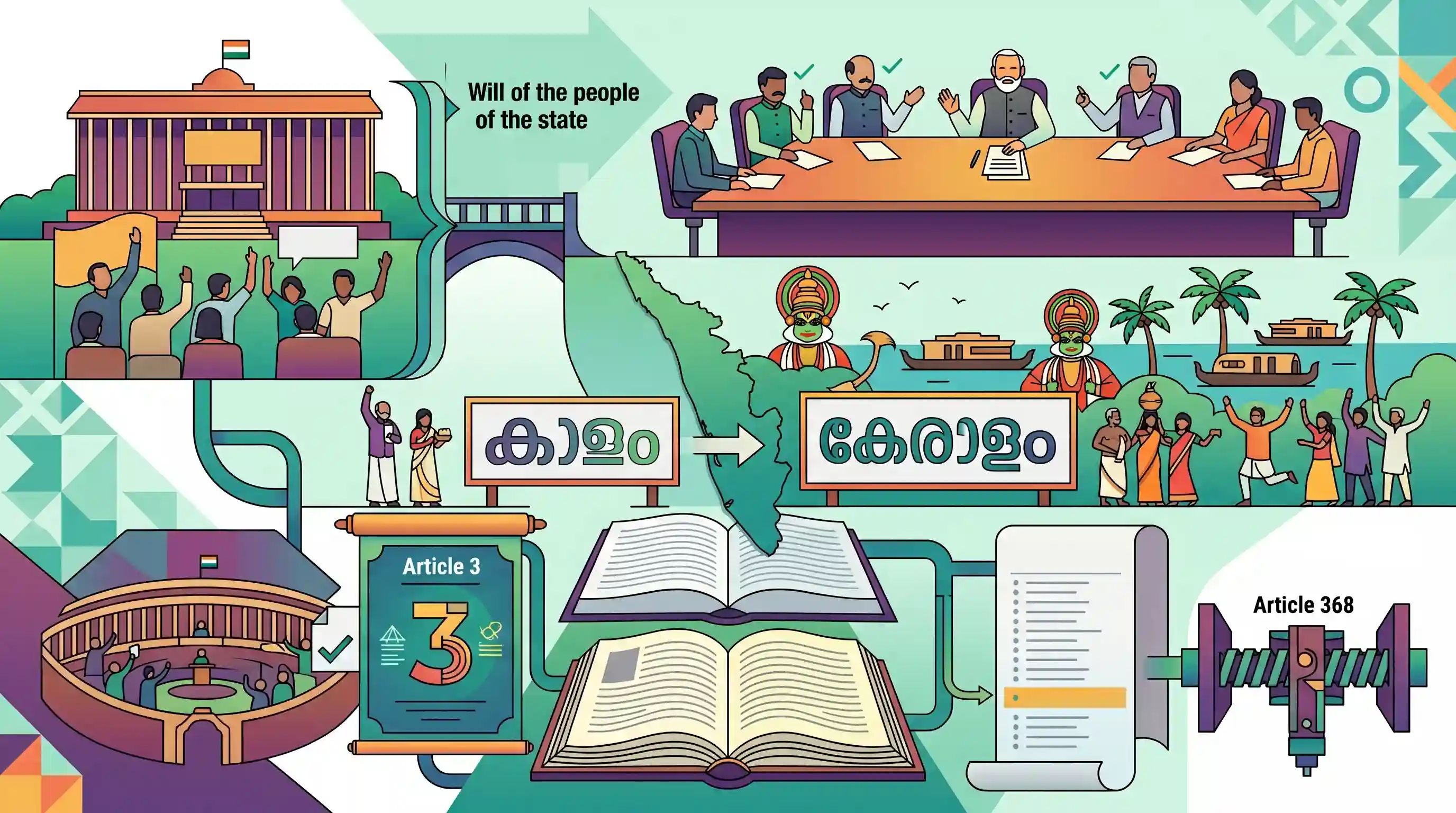
The Union Cabinet has approved the proposal to officially rename 'Kerala' to 'Keralam', fulfilling a long-standing demand of the state assembly. Highlighting cooperative federalism, the Prime Minister noted this decision respects the "will of the people of the state." The name change reflects the linguistic and cultural identity associated with the Malayalam language. Constitutionally, such a renaming process is governed by Article 3, requiring parliamentary legislation which amends the First Schedule but does not constitute a formal constitutional amendment under Article 368.
Key Points
- The Union Cabinet cleared the proposal to officially rename Kerala as 'Keralam', aligning the state's name with its Malayalam roots and cultural identity.
- The Prime Minister endorsed the move as honoring the "will of the people," demonstrating cooperative federalism and respect for the state assembly's unanimous resolution.
- Under Article 3 of the Indian Constitution, Parliament holds the power to alter the name of any state by passing an ordinary law, after referring the matter to the concerned State Legislature for its views.
- A change in a state's name requires updating the First Schedule but is explicitly not considered a constitutional amendment under the rigorous procedure of Article 368.
Important Terms
Article 3 of the Indian Constitution

Constitutional provision empowering Parliament to create new states or alter names, boundaries, and areas of existing states via ordinary legislative process.
UPSC context
GS Paper II: Basic Structure and Federalism. Tests understanding of Parliament's power to redraw India's internal political map.
First Schedule of the Indian Constitution
The constitutional list enumerating the names of all States and Union Territories along with their territorial jurisdictions.
UPSC context
GS Paper II: Indian Constitution. Essential for questions on territorial reorganization and the federal structure of India.
Union Cabinet
The highest executive decision-making body of the Government of India, consisting of senior ministers and headed by the Prime Minister.
UPSC context
GS Paper II: Executive and Legislature. Tests knowledge of the central directing instrument of government policy and administration.
Article 368
The procedure for amending the Constitution; notably, changes under Article 3 are technically not considered formal amendments under this article.
UPSC context
GS Paper II: Amendment process. Tests the distinction between constituent power and ordinary legislative power in state reorganization.
Simple Majority
A voting threshold where a bill is passed by more than 50% of the members present and voting in each House.
UPSC context
GS Paper II: Parliamentary procedures. Crucial for understanding how state names/boundaries are altered without a special majority.
State Legislative Assembly
The state-level representative body; its views on renaming must be sought by the President, though they are not binding on Parliament.
UPSC context
GS Paper II: Centre-State relations. Examines the consultative role of states in India's quasi-federal structure.
Prelims Trap
"Renaming a state requires a Constitutional Amendment under Article 368 passed by a special majority."
Under Article 4, laws modifying the First Schedule to alter a state's name are explicitly excluded from Article 368 and require only a simple majority in Parliament.
Static Concepts Connected
What is the constitutional procedure to alter a State's name?
- Presidential Recommendation: A bill seeking to alter a state's name can only be introduced in Parliament with the prior recommendation of the President.
- State Legislature Views: The President must refer the bill to the concerned State Legislature for its views within a specified period, though these views are not binding on Parliament.
- Simple Majority: Parliament can pass the bill using a simple majority. It operates as an ordinary legislative process.
- Not Article 368: Modifying the First and Fourth Schedules for this purpose is exempted from the rigorous constitutional amendment procedure of Article 368.
What was the Aikya Kerala Movement?
- Linguistic Unification: A historical campaign aiming to unify all Malayalam-speaking territories (Travancore, Cochin, and Malabar) into a single socio-political entity.
- States Reorganisation 1956: The vision was realized on November 1, 1956, following the States Reorganisation Act, which redrew state boundaries largely on linguistic lines.
Cross-Topic Patterns
State vs. City renaming powers
While State renaming mandates Parliamentary legislation under Article 3, renaming a city or railway station is an executive process requiring a 'No Objection Certificate' (NOC) from the Union Home Ministry.
Linguistic identity & Classical Languages
The renaming honors Malayalam, a Classical language. UPSC frequently tests the intersection of Eighth Schedule languages, classical language criteria, and state-identity movements.

Expect a multi-statement Prelims question mixing Article 3 procedures, Article 368 exemptions, and the Aikya Kerala Movement.
Linked PYQs · 4
Linked PYQs · 4
- 2016MainsGS1
Has the formation of linguistic States strengthened the cause of Indian Unity?
- 2022MainsGS1
The political and administrative reorganization of states and territories has been a continuous ongoing process since the mid-nineteenth century. Discuss with examples.
- 2024PrelimsGS1
As per Article 368 of the Constitution of India, the Parliament may amend any provision of the Constitution by way of : 1. Addition 2. Variation 3. Repeal Select the correct answer using the code given below:
- 2024MainsGS2
What changes has the Union Government recently introduced in the domain of Centre-State relations ? Suggest measures to be adopted to build the trust between the Centre and the States and for strengthening federalism.
