Cabinet Approves Critical Minerals Royalty Rationalisation and Exports
Source:The Hindu ↗
Why It Matters
Export promotion strategies are vital for economic growth and MSME development. Meanwhile, securing the critical minerals supply chain is a strategic imperative for India's energy transition and technological sovereignty.
Summary
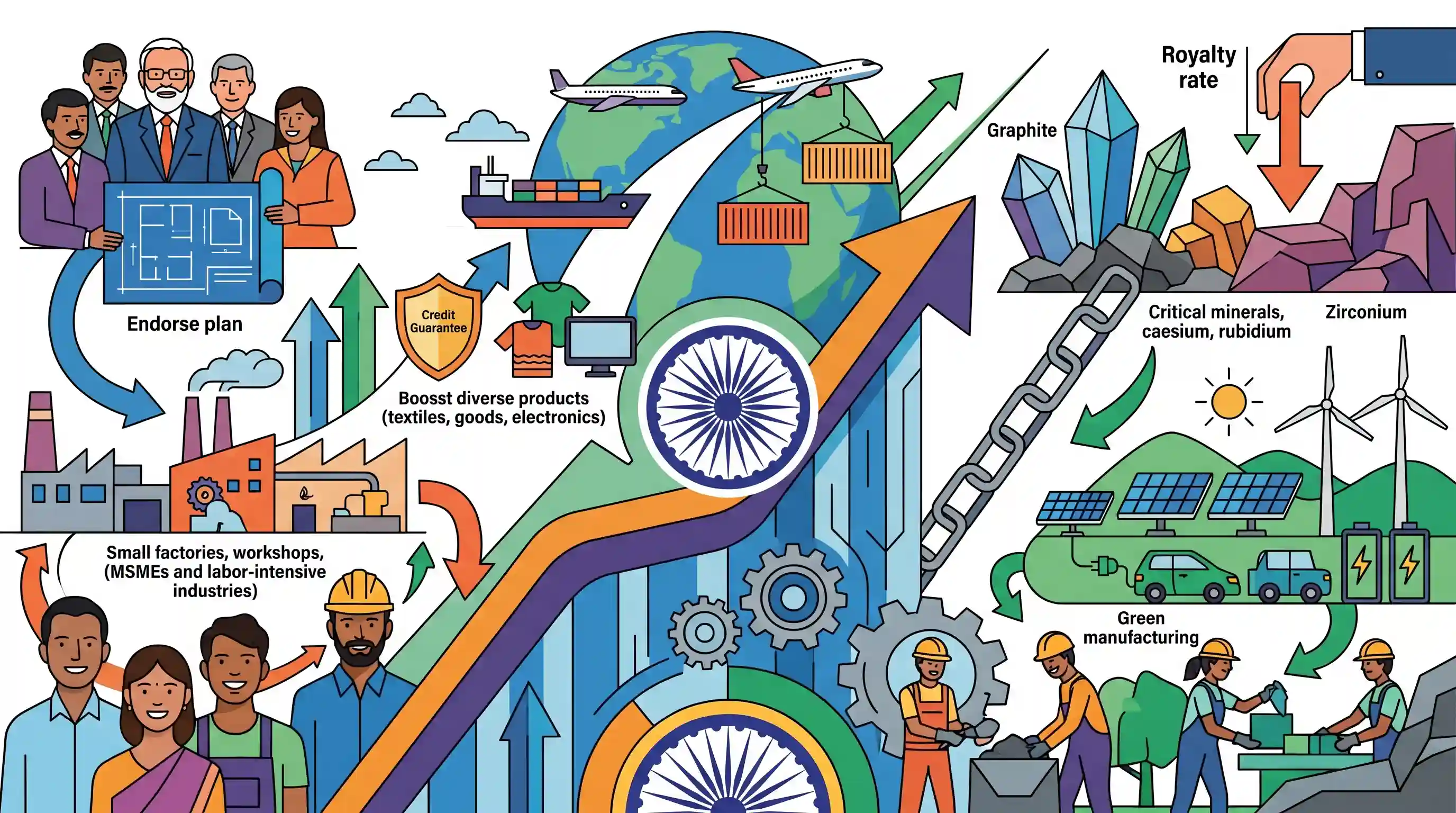
The Union Cabinet has approved key initiatives to bolster India's economic self-reliance and global trade standing, including the Export Promotion Mission (EPM) and a Credit Guarantee Scheme for Exporters. The EPM will provide outcome-based support to MSMEs, first-time exporters, and labor-intensive industries. Furthermore, the government rationalized the royalty rates for critical minerals—graphite, caesium, rubidium, and zirconium—which are essential for green energy technologies, aiming to secure domestic supply chains and create employment opportunities.
Key Points
- The Union Cabinet approved the Export Promotion Mission (EPM) to enhance India's global export competitiveness, specifically targeting MSMEs, first-time exporters, and labor-intensive sectors.
- A Credit Guarantee Scheme for Exporters was introduced to ensure smooth business operations and advance the vision of an Aatmanirbhar Bharat.
- The Cabinet rationalized royalty rates for four critical minerals: graphite, caesium, rubidium, and zirconium.
- The critical minerals initiative aims to fortify supply chains, boost sustainability, create jobs, and support the transition to green energy.
Important Terms
Export Promotion Mission (EPM)

A flagship framework approved in 2025 with a ₹25,060 crore outlay to unify export support. It provides financial and non-financial aid to enhance the global competitiveness of MSMEs and labor-intensive sectors.
UPSC context
GS-III: Indian Economy and Trade. Relevant for questions on export-led growth and institutional trade reforms.
Credit Guarantee Scheme for Exporters (CGSE)
A government-backed initiative providing 100% guarantee coverage to lenders for credit extended to exporters. It aims to de-risk lending and ensure liquidity for businesses facing global trade challenges.
UPSC context
GS-III: Mobilization of resources and growth. Tests understanding of financial instruments used to support industrial liquidity.
Critical Minerals
Strategic minerals (e.g., graphite, zirconium) essential for high-tech, defense, and green energy industries. Their availability is critical for national security and the transition to a net-zero economy.
UPSC context
GS-III: Infrastructure (Energy) and Resources. Tests knowledge of resource security and technological self-reliance.
Ad Valorem Royalty
A mining royalty calculated as a percentage of the mineral's market value rather than a fixed amount per unit of weight. It aligns government revenue with market price fluctuations.
UPSC context
GS-III: Resource mobilization. Tests understanding of fiscal policy and mining sector reforms.
MSMEs (Micro, Small and Medium Enterprises)
Enterprises classified by investment and turnover limits (e.g., Micro: <₹1cr investment, <₹5cr turnover). They contribute ~30% to India's GDP and ~40% to its total exports.
UPSC context
GS-III: Industrial policy and employment. Tests knowledge of the primary drivers of inclusive economic growth.
Prelims Trap
"Zirconium is primarily extracted to manufacture lithium-ion battery anodes for electric vehicles."
Aspirants often mix up new mineral uses. Graphite is crucial for Li-ion battery anodes. Zirconium is vital for atomic energy (nuclear fuel rod cladding).
Static Concepts Connected
What is an Ad Valorem royalty or tax?
- Meaning: Latin for "according to value," it is levied as a percentage of the assessed value (Average Sale Price) of the item.
- Distinction: It contrasts with a specific or fixed duty, which charges a flat fee per unit (e.g., per tonne) regardless of the market price.
- Economic impact: It protects government revenue against inflation, as the tax collected automatically rises when commodity market prices increase.
What are the strategic applications of Graphite and Zirconium?
- Graphite: Crucial for manufacturing anodes in lithium-ion batteries, making it indispensable for electric vehicles (EVs) and green energy storage.
- Zirconium: Extensively used for cladding nuclear reactor fuel rods due to its high corrosion resistance and very low thermal neutron capture cross-section.
- Caesium & Rubidium: Used in high-tech fields, including atomic clocks, photoelectric cells, and specialized medical/industrial applications.
Cross-Topic Patterns
MSME export dependence & trade goals
India's MSME sector contributes nearly 40% to overall exports. The new Export Promotion Mission directly links MSME working capital access to India's broader target of $2 trillion exports by 2030.
Critical minerals + Net Zero targets
Rationalizing royalties for graphite and zirconium connects the MMDR Act amendments directly to India's Net Zero 2070 targets, reducing reliance on China for EV and green-tech supply chains.

Expect a 2026 prelims pairing question matching minerals (Zirconium, Graphite, Caesium) with their specific strategic uses (Nuclear, EVs).
Linked PYQs · 2
Linked PYQs · 2
- 2023MainsGS3
Faster economic growth requires increased share of the manufacturing sector in GDP, particularly of MSMEs. Comment on the present policies of the Government in this regard.
- 2013MainsGS1
With growing scarcity of fossil fuels, the atomic energy is gaining more and more significance in India. Discuss the availability of raw material required for the generation of atomic energy in India and in the world.
