Union Cabinet Approval of Nationwide Caste Census
Source:Indian Express ↗
Why It Matters
The caste census is a highly significant topic for UPSC candidates, touching upon GS1 (Indian Society, Caste System) and GS2 (Social Justice, Reservation Policy, Governance). It involves understanding the historical context of census exercises, the rationale behind affirmative action, and the socio-political implications of enumerating caste in modern India.
Summary
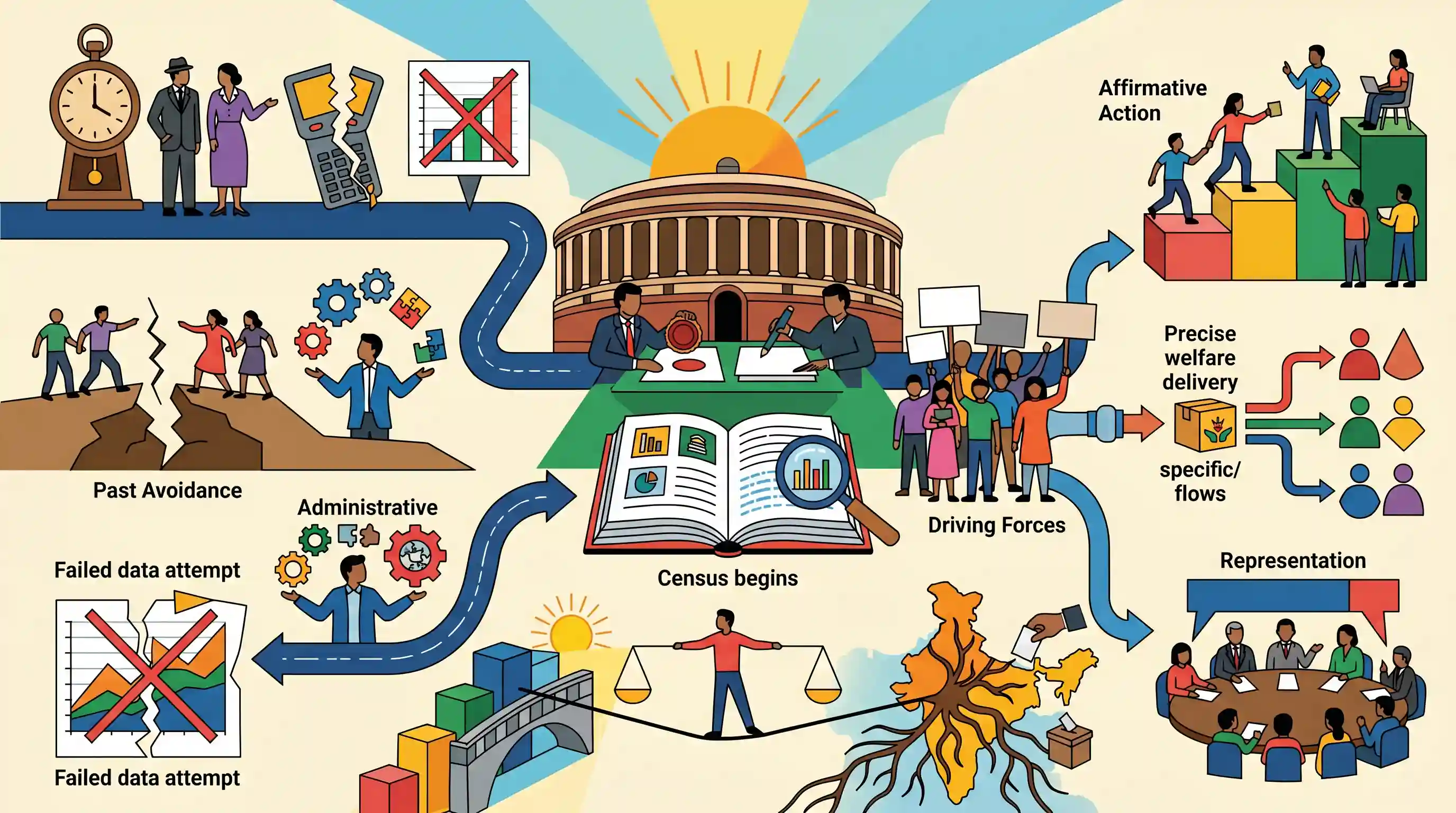
The Union Cabinet's approval of a nationwide caste census represents a major policy reversal and a historic step in India's demographic enumeration. For decades, governments had avoided collecting comprehensive caste data—beyond Scheduled Castes and Scheduled Tribes—since the last full exercise in 1931, citing administrative complexities and the risk of exacerbating social divisions. Although the Socio-Economic Caste Census (SECC) was conducted in 2011, its caste findings were withheld due to cited inaccuracies. The recent decision stems from intense political debates and demands for concrete data to refine affirmative action policies, target welfare delivery accurately, and address the backward classes' representation. The debate highlights the tension between achieving data-driven social justice and the potential of entrenching caste identities in the political landscape.
Key Points
- The Union Cabinet has officially approved the conduct of a nationwide caste census, marking a significant shift in government policy.
- The last comprehensive enumeration of caste populations in India (beyond SC/STs) was conducted during the 1931 Census.
- While the Socio-Economic Caste Census (SECC) was undertaken in 2011, the caste data was never officially published by the Union government due to alleged methodological flaws and data errors.
- Supporters of the caste census argue it is vital for empirical, data-driven policymaking, ensuring equitable distribution of resources, and rationalizing affirmative action and reservation quotas.
- Critics contend that a caste census risks institutionalizing social divisions, solidifying caste identities, and fueling vote-bank politics.
- The government's approval reflects a response to mounting political pressure from opposition parties and regional outfits advocating for social justice.
Important Terms
Census of India

The official decennial enumeration of India's population, capturing demographic, social, and economic data. Conducted since 1881, it is the largest administrative exercise in the country.
UPSC context
GS I (Society) and GS II (Governance). Crucial for demographic analysis, policy planning, and constitutional processes like delimitation.
Census Act, 1948
The legal framework for conducting the census, enacted by Parliament in 1948. It mandates public cooperation while guaranteeing the strict confidentiality of individual data.
UPSC context
GS II (Polity). Tests knowledge of statutory frameworks governing administrative data collection and privacy protections.
Socio-Economic Caste Census (SECC) 2011
A comprehensive survey identifying households living below the poverty line. While it captured caste data, findings were largely withheld from the public due to classification inaccuracies.
UPSC context
GS II (Social Justice). Relevant for welfare targeting (e.g., Ayushman Bharat) and debates on evidence-based affirmative action.
Union Cabinet
The inner core of the Council of Ministers, headed by the Prime Minister. It is the supreme decision-making and policy-formulating authority of the Indian executive.
UPSC context
GS II (Polity/Executive). Tests understanding of the parliamentary form of government and executive decision-making processes.
Other Backward Classes (OBCs)
Communities identified as "socially and educationally backward" under Article 340. They are entitled to specific reservations in education and government employment.
UPSC context
GS II (Social Justice). Key for questions on reservations, affirmative action, and the 27% quota implementation.
Mandal Commission
A commission established in 1979 that estimated the OBC population at 52% and recommended 27% reservation in government jobs, implemented in 1990.
UPSC context
GS I (Indian Society) and GS II (Social Justice). Essential for understanding the history and evolution of caste-based reservations.
Delimitation
The process of redrawing boundaries of Lok Sabha and State Assembly constituencies to reflect population changes, legally linked to updated census figures.
UPSC context
GS II (Polity/Elections). Vital for questions on political representation and the upcoming post-2026 constituency readjustment.
Prelims Trap
"The decennial Census of India does not collect any caste-wise demographic data."
The regular decennial Census has consistently enumerated Scheduled Castes (SCs) and Scheduled Tribes (STs) since independence. It is only the OBCs and forward castes whose enumeration was discontinued.
Static Concepts Connected
What are the constitutional mechanisms for identifying backward classes?
- Article 340: Empowers the President to appoint a commission to investigate the conditions of socially and educationally backward classes (e.g., Mandal and Rohini Commissions).
- 102nd Amendment Act: Granted constitutional status to the National Commission for Backward Classes (NCBC) by inserting Article 338B into the Constitution.
- Article 342A: Empowers the President, in consultation with the Governor, to specify the socially and educationally backward classes for a particular State or Union Territory.
What were the landmark directives in the Indra Sawhney judgment (1992)?
- 50% Ceiling: Total reservations must not exceed 50%, a cap that can only be breached in extraordinary, far-flung, or exceptional situations.
- Creamy Layer: Mandated the exclusion of the socially and economically advanced sections (creamy layer) among OBCs from reservation benefits.
- Caste as Class: Recognized that a caste can be and quite often is a social class, making it a valid primary criterion for determining backwardness.
Cross-Topic Patterns
OBC Sub-categorization (Justice Rohini)
The Justice G. Rohini Commission found extreme skew in OBC quota benefits. A national caste census provides the exact empirical baseline required to implement its sub-categorization recommendations equitably.
Federalism and 7th Schedule (Entry 69)
While 'Census' is strictly a Union List subject (Entry 69), states like Bihar bypassed this by conducting socio-economic 'surveys,' testing federal boundaries and prompting this Union response.

Expect a GS2 Mains question on whether empirical caste data necessitates a constitutional review of the Indra Sawhney 50% quota ceiling.
Linked PYQs · 2
Linked PYQs · 2
- 2018MainsGS1
Caste system is assuming new identities and associational forms. Hence, caste system cannot be eradicated in India." Comment.
- 2022MainsGS2
Discuss the role of the National Commission for Backward Classes in the wake of its transformation from a statutory body to a constitutional body.
