Bihar Cabinet Decisions: SC/ST Special Courts and Sports Policy
Source:uniindia ↗
Why It Matters
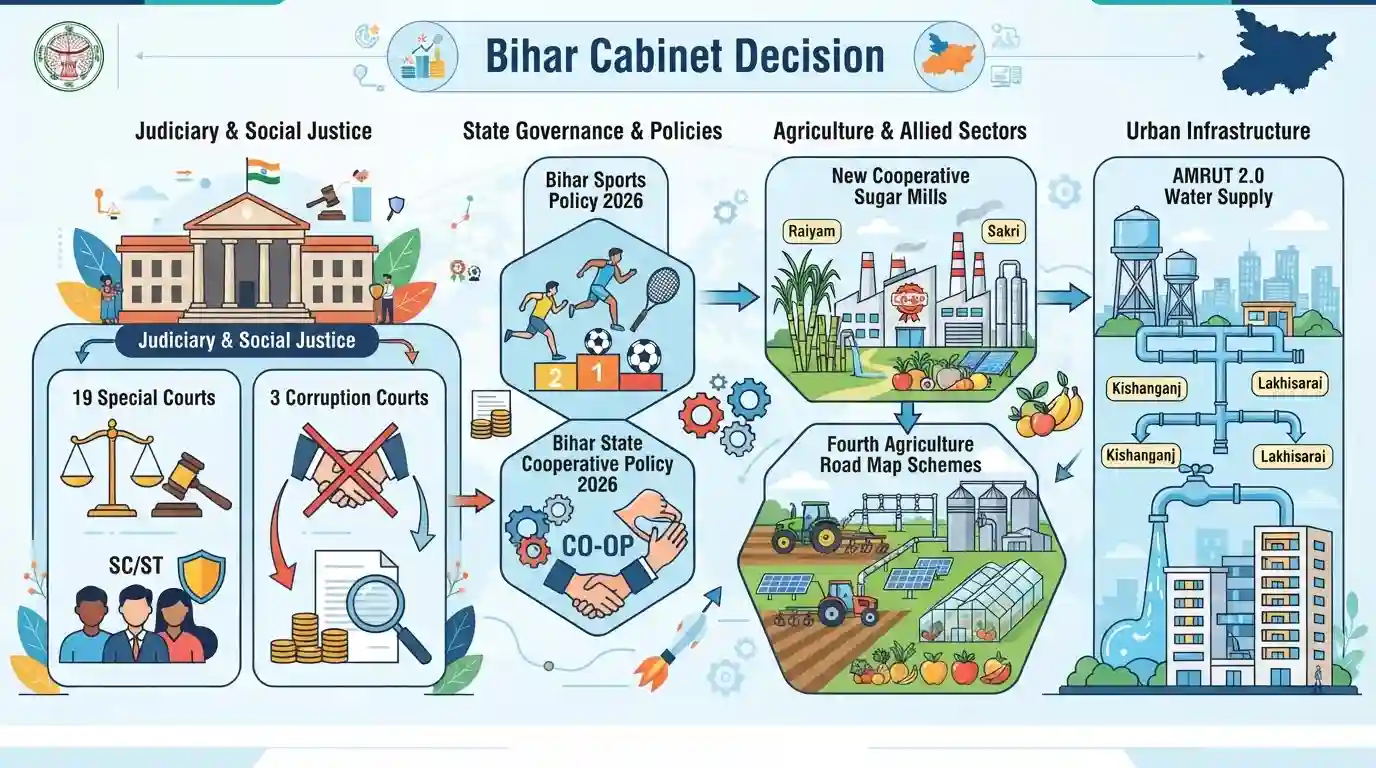
The slew of policy approvals in Bihar covers important developmental themes ranging from legal infrastructure for marginalized sections and anti-corruption to agricultural development, cooperative societies, and urban water supply—all recurring themes in BPSC Prelims testing state-specific schemes.
Summary
The Bihar Cabinet has approved several key policy decisions, prominently establishing 19 exclusive special courts for speedy trials under the SC/ST (Prevention of Atrocities) Act and three new courts under the Prevention of Corruption Act. Furthermore, it greenlit the Bihar Sports Policy 2026, the Bihar State Cooperative Policy 2026, and initiatives to build new cooperative sugar mills at the defunct Raiyam and Sakri sites. Additional approvals include water supply projects under AMRUT 2.0 in Kishanganj and Lakhisarai, and multiple schemes to boost agricultural infrastructure under the Fourth Agriculture Road Map.
Key Points
- The Bihar cabinet approved the establishment of 19 exclusive special courts for the speedy trial of cases under the SC/ST (Prevention of Atrocities) Act.
- Three additional special courts will be set up under the Prevention of Corruption Act, with two located in Patna and one in Muzaffarpur.
- The cabinet cleared the Bihar Sports Policy 2026 and the Bihar State Cooperative Policy 2026 to foster respective sector developments.
- New cooperative sugar mills and sugarcane by-product units are approved to be set up on the premises of closed sugar mills in Raiyam and Sakri.
- Approvals were also granted for water supply schemes in Kishanganj and Lakhisarai under AMRUT 2.0, along with agricultural initiatives under the Fourth Agriculture Road Map.
Important Terms
SC/ST (Prevention of Atrocities) Act, 1989

A central Indian legislation enacted to prevent violence and discrimination against Scheduled Castes and Scheduled Tribes, establishing special courts for speedy trials and providing victim rehabilitation.
UPSC context
GS Paper II: Social Justice and Vulnerable Sections; crucial for understanding protective legal mechanisms and caste-based issues.
Prevention of Corruption Act, 1988
An Act of Parliament designed to combat bribery and corruption among public servants in India, specifying offences, penalties, and establishing special judges for speedy trials.
UPSC context
GS Paper II: Governance and Accountability; GS Paper IV: Ethics and Integrity in Public Administration.
AMRUT 2.0
A central scheme launched in 2021 by the Ministry of Housing and Urban Affairs aiming to make cities water-secure through universal piped water supply and sewerage coverage.
UPSC context
GS Paper II: Centrally Sponsored Schemes; GS Paper III: Infrastructure and Urban Development.
Fourth Agriculture Road Map
Bihar's comprehensive strategic plan (2023-2028) aimed at enhancing agricultural productivity, promoting climate-resilient farming, crop diversification, organic cultivation, and modernizing allied sector infrastructure.
UPSC context
GS Paper III: Agriculture, irrigation, and federal/state-specific agricultural policies and infrastructure growth.
Bihar State Cooperative Policy, 2026
A newly approved state-level policy in Bihar aimed at strengthening the rural economy, local cooperative networks, and boosting sectors like processing and sugar industries.
UPSC context
GS Paper II: State Governance; GS Paper III: Inclusive growth, cooperative sectors, and rural economic development.
Prelims Trap
The State Government has unilateral statutory authority to establish Exclusive Special Courts under the SC/ST (Prevention of Atrocities) Act, 1989.
Under Section 14 of the Act, establishing or specifying these courts strictly requires the concurrence of the Chief Justice of the High Court, not unilateral executive notification.
Static Concepts Connected
What are the statutory mandates for establishing Special Courts under the SC/ST Act?
- Section 14 Mandate: State Governments must establish Exclusive Special Courts or specify Courts of Session as Special Courts to ensure speedy trials.
- High Court Concurrence: The designation or establishment of these courts strictly requires the formal concurrence of the Chief Justice of the respective High Court.
- Trial Timeline: The Act mandates that trials should ideally be completed within two months from the date of filing the charge sheet.
How does the Indian Constitution regulate and promote cooperative societies?
- Fundamental Right: Article 19(1)(c) guarantees citizens the fundamental right to form cooperative societies.
- Directive Principles: Article 43B directs the State to promote voluntary formation, autonomous functioning, democratic control, and professional management of cooperatives.
- Part IXB Limitations: Added via the 97th Amendment; the Supreme Court struck down its application to state-subject cooperatives due to lack of requisite ratification by state legislatures.
Cross-Topic Patterns
Judiciary reform and social justice
Linking the setup of district-level exclusive courts directly to the reduction of case pendency and the realization of Article 21's right to a speedy trial for marginalized communities.
Cooperative federalism and agro-processing
Intersecting state cooperative policies with Union reforms to revive defunct agro-industries like sugar mills, directly addressing rural credit, crop diversification, and local employment.

Expect questions testing the statutory nuances of the SC/ST Act (like Chief Justice concurrence) alongside judicial pendency solutions.
Linked PYQs · 2
Linked PYQs · 2
- 2022BPSC_PRELIMSGS1
Which type of banks is proposed to be established for agriculture and rural development in Bihar?
- 2023BPSC_PRELIMSGS1
Which food industry dominates among the agro-based industries in Bihar?
