PM Gati Shakti Railway Projects Approved for Freight Expansion
Source:The Hindu ↗
Why It Matters
This article serves as a practical example for Mains GS3 questions on infrastructure-led economic growth, logistics efficiency, and the implementation of PM Gati Shakti. Additionally, the specific locations mentioned (e.g., Kanha, Pench, Dhuandhar waterfall) are prime targets for GS1 Prelims map-based and geography matching questions.
Summary
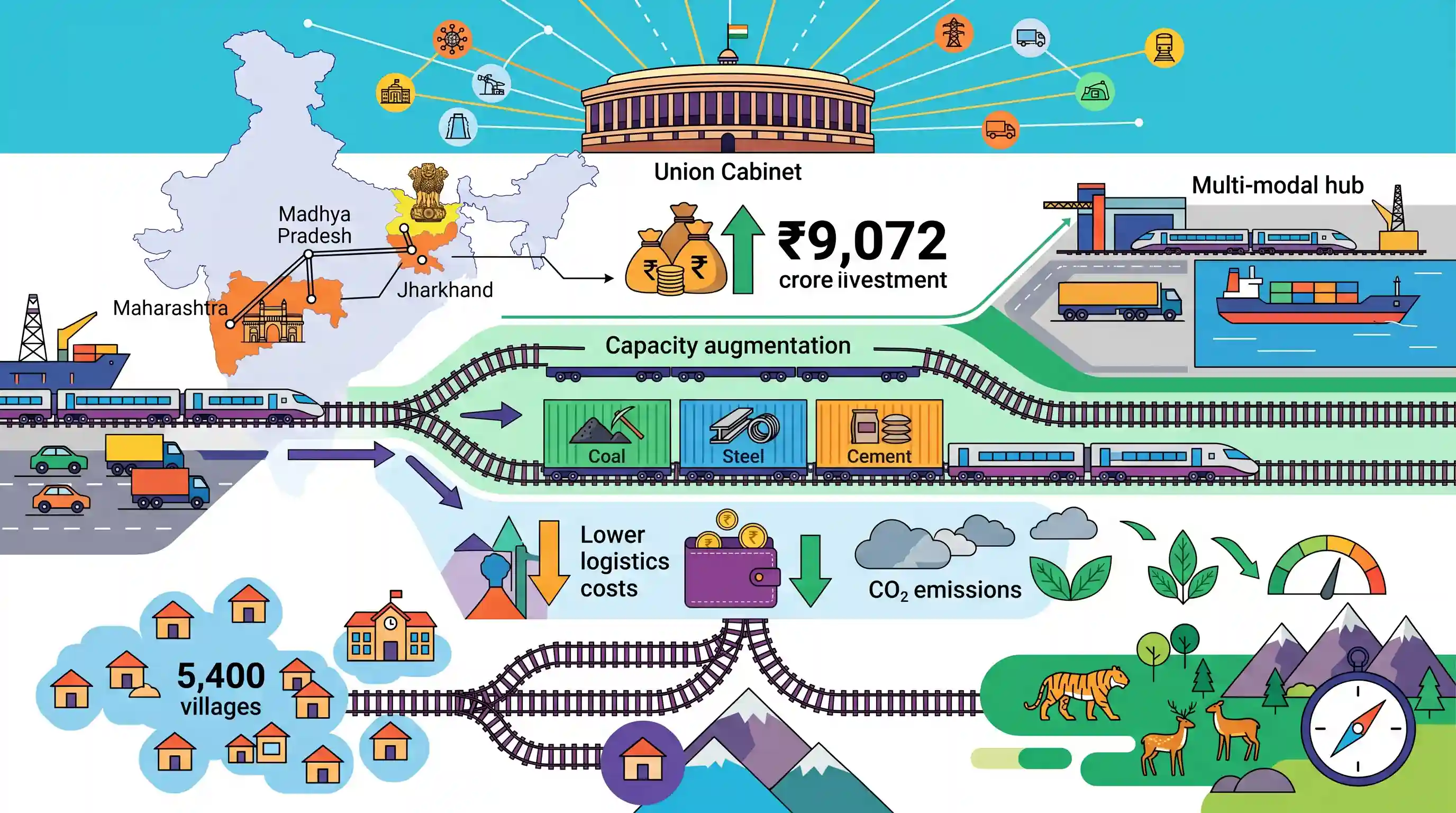
The Union Cabinet has cleared three multi-tracking railway projects worth ₹9,072 crore covering Maharashtra, Madhya Pradesh, Bihar, and Jharkhand. Executed under the PM-Gati Shakti National Master Plan, the 307-km capacity augmentation seeks to decongest busy routes and boost multi-modal freight transport of commodities like coal, steel, and cement by 52 million tonnes per annum. In addition to minimizing logistics costs and curbing CO2 emissions, the infrastructure upgrade will improve connectivity for over 5,400 villages and provide better access to key tourist and ecological destinations, including Kanha and Pench National Parks.
Key Points
- The Cabinet Committee on Economic Affairs approved three multi-tracking railway projects worth ₹9,072 crore across four states.
- The 307-km projects include doubling the Gondia-Jabalpur section and laying 3rd/4th lines on the Punarakh-Kiul and Gamharia-Chandil routes.
- The projects are part of the PM-Gati Shakti National Master Plan, aiming to reduce congestion, optimize logistics, and support additional freight traffic of ~52 MTPA.
- They will enhance passenger connectivity for 5,407 villages and improve access to eco-tourism spots like Kanha and Pench National Parks and Dhuandhar falls.
- The shift to rail freight aims to lower logistics costs, decrease oil imports by 6 crore liters, and mitigate 30 crore kg of CO2 emissions.
Important Terms
PM-Gati Shakti National Master Plan

A GIS-based digital platform for integrated, synchronized planning of infrastructure across 16+ ministries to improve multimodal connectivity and reduce logistics costs.
UPSC context
GS Paper 3: Infrastructure/Economic Development; tests knowledge of integrated logistics and transformative governance frameworks.
Cabinet Committee on Economic Affairs (CCEA)
A high-level standing committee chaired by the Prime Minister that approves major economic policies, large-scale investment proposals, and infrastructure projects.
UPSC context
GS Paper 2: Governance/Executive; GS Paper 3: Investment Models. Tests understanding of executive decision-making bodies.
Multi-modal Connectivity
The seamless integration of different transport modes (rail, road, water, air) to facilitate efficient movement of goods and people, reducing transit time.
UPSC context
GS Paper 3: Infrastructure and Logistics; critical for enhancing India's manufacturing competitiveness and 'Make in India' goals.
Logistics Cost
Total expenditure on moving, storing, and managing goods. India seeks to reduce this from ~13-14% to 8% of GDP to match global benchmarks.
UPSC context
GS Paper 3: Economy/Infrastructure; focuses on supply chain efficiency and reducing industrial overheads.
Kanha National Park
A major Tiger Reserve in Madhya Pradesh, known for the hard-ground Barasingha and its ecological role in the Central Indian Highlands.
UPSC context
GS Paper 1: Geography; GS Paper 3: Biodiversity. Tests knowledge of protected areas and wildlife conservation.
Pench National Park
A National Park spanning Madhya Pradesh and Maharashtra, critical for tiger conservation and named after the river that bisects it.
UPSC context
GS Paper 1: Geography; GS Paper 3: Environment. Tests regional ecology and trans-state wildlife corridors.
Indian Railways
The world’s fourth-largest network, acting as the 'backbone' of India's economy by transporting over 1.2 billion tonnes of freight annually.
UPSC context
GS Paper 3: Infrastructure; tests role in regional development, freight corridors, and decarbonizing transport.
Prelims Trap
PM Gati Shakti provides direct central funding for new railway projects.
PM Gati Shakti is a GIS-based digital platform for coordinated planning by various ministries, not a separate funding scheme or financial allocation.
Static Concepts Connected
What is the ecological significance of the Kanha-Pench corridor?
- Satpura-Maikal bridge: It geographically connects the Maikal hills (Kanha) and the Satpura range (Pench), acting as a vital migratory route.
- Source-sink dynamics: It facilitates natural dispersal and prevents inbreeding (genetic bottlenecking) among the Central Indian tiger populations.
- Barasingha conservation: Kanha is globally renowned for saving the highly endangered Hard-ground Barasingha (swamp deer) from extinction.
How do PM Gati Shakti and the National Logistics Policy (NLP) differ?
- Infrastructure planning: Gati Shakti focuses on the physical planning of multi-modal connectivity using a centralized GIS digital master plan.
- Process optimization: NLP focuses on operational "software" (process digitization, standardizing rules) to reduce logistics costs to global benchmarks (around 8% of GDP).
- Synergistic approach: Gati Shakti builds the physical network, while the NLP streamlines the operational processes utilizing that network.
Cross-Topic Patterns
Linear infrastructure vs wildlife corridors
Railway augmentation in the Kanha-Pench region highlights the tension between economic logistics expansion and the National Wildlife Action Plan guidelines for creating eco-bridges over linear infrastructure.
Mineral belt freight decongestion
The Bihar-Jharkhand (Punarakh-Kiul, Gamharia-Chandil) rail multi-tracking aligns with the historical geography of heavy industries, specifically addressing the evacuation bottleneck in the resource-rich Chota Nagpur plateau.

Geography matching pairs: Narmada/Dhuandhar falls, Kanha/Maikal, and Pench/Satpura are highly probable given infra-expansion in the region.
Linked PYQs · 3
Linked PYQs · 3
- 2021MainsGS3
“Investment in infrastructure is essential for more rapid and inclusive economic growth.” Discuss in the light of India's experience.
- 2025MainsGS3
Elaborate the scope and significance of supply chain management of agricultural commodities in India.
- 2024PrelimsGS1
Consider the following information (Waterfall — Region — River): 1. Dhuandhar — Malwa — Narmada 2. Hundru — Chota Nagpur — Subarnarekha 3. Gersoppa — Western Ghats — Netravati In how many of the above rows is the given information correctly matched?
