Cabinet approves Kanpur-Kabrai section of NH-34 on BOT toll mode
Source:projects-monitor ↗
Why It Matters
Infrastructure and connectivity projects in Uttar Pradesh are a high-priority area for the UPPSC Prelims. Understanding major expressway projects, highway corridors (like the Bhopal-Kanpur Economic Corridor), the implementing agencies, financing models (like BOT Toll), and their alignment with central master plans (like PM GatiShakti) is essential for state-level and national infrastructure questions.
Summary
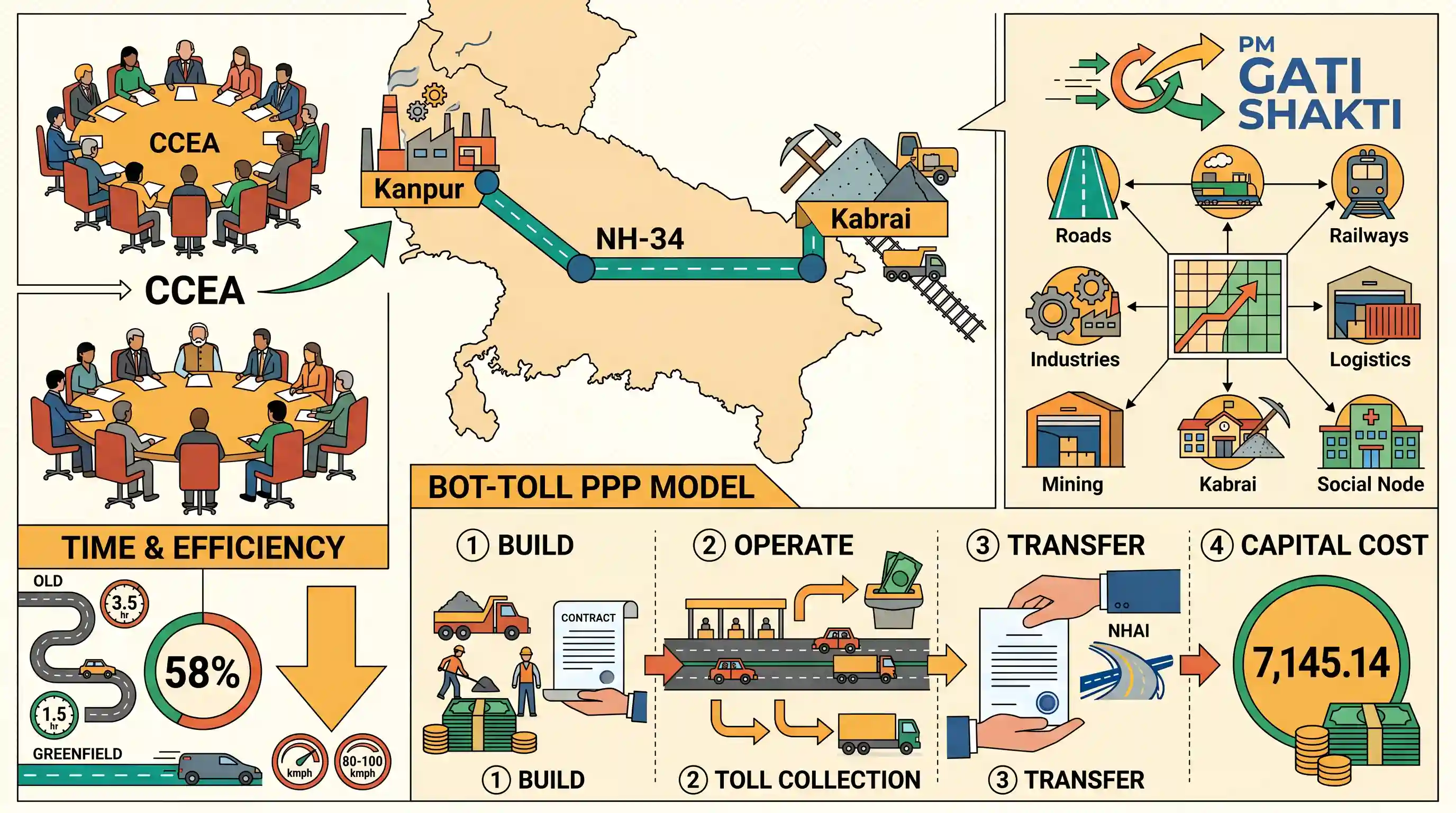
The Cabinet Committee on Economic Affairs (CCEA) has approved the construction of a 4/6-lane access-controlled Kanpur-Kabrai greenfield section of National Highway-34 (NH-34) in Uttar Pradesh. Spanning 117.7 km, the project will be implemented by the NHAI under the Build-Operate-Transfer (BOT-Toll) mode at a capital cost of Rs 7,145.14 crore. Aligning with the PM GatiShakti National Master Plan, this segment of the Bhopal-Kanpur Economic Corridor is set to boost regional connectivity, particularly benefitting the mining hub of Kabrai and the industrial city of Kanpur, while drastically slashing travel times by 58%.
Key Points
- The CCEA, chaired by PM Narendra Modi, approved the construction of the 117.7 km Kanpur-Kabrai section of NH-34 in Uttar Pradesh.
- The project will be built as a 4-lane access-controlled greenfield highway (with structures designed for future expansion to 6 lanes) under the BOT (Toll) public-private partnership model.
- The estimated total capital cost of the project is Rs 7,145.14 crore, which will be managed and implemented by the National Highways Authority of India (NHAI).
- It is a critical segment of the Bhopal-Kanpur Economic Corridor and is fully aligned with the PM GatiShakti National Master Plan, seeking to improve connectivity across 16 Economic, 9 Social, and 10 Logistics Nodes.
- The project reduces travel time between Kanpur and Kabrai (a major mining and stone hub in the Bundelkhand region) from 3.5 hours to 1.5 hours, facilitating smoother trade and freight movement.
- The expressway connects directly with critical logistics networks including NH-34, NH-35, the Bundelkhand Expressway, and the Kanpur Ring Road.
Important Terms
PM GatiShakti National Master Plan

A transformative digital platform launched in 2021 coordinating infrastructure planning across 16 ministries to ensure integrated, multimodal connectivity and seamless logistics in India.
UPSC context
GS Paper III (Infrastructure); tests understanding of integrated multimodal planning and logistics.
Build-Operate-Transfer (BOT) Toll Model
A Public-Private Partnership model where a private developer finances, builds, and operates a highway, recovering its investment through user tolls before transferring it to the government.
UPSC context
GS Paper III (Investment Models); tests knowledge of private sector mobilization and risk allocation.
Bhopal-Kanpur Economic Corridor
A major planned logistics transit route designed to provide high-speed, seamless connectivity and boost trade between the industrial centers of Uttar Pradesh and Madhya Pradesh.
UPSC context
GS Paper III (Infrastructure: Roads); tests economic corridors and regional trade integration.
National Highways (Original) Programme
An ongoing central government funding framework under which non-scheme highway development and maintenance works are prioritized based on specific traffic requirements.
UPSC context
GS Paper III (Infrastructure: Roads); tests awareness of highway project classifications and central schemes.
Cabinet Committee on Economic Affairs (CCEA)
A crucial Cabinet Committee chaired by the Prime Minister that reviews economic trends, decides on investment proposals, and approves major national infrastructure projects.
UPSC context
GS Paper II (Cabinet Committees); tests executive decision-making bodies and economic governance.
National Highways Authority of India (NHAI)
A statutory body under the Ministry of Road Transport and Highways responsible for developing, maintaining, and managing the National Highways network in India.
UPSC context
GS Paper II & III (Statutory Bodies); tests institutional mechanisms for road transport management.
Prelims Trap
Under BOT-Toll PPP models, the government guarantees minimum traffic volumes to insulate the private concessionaire from commercial risks.
Under BOT-Toll, the private developer bears the entire traffic and revenue risk. Minimum revenue guarantees and traffic cushions are features of HAM or BOT-Annuity models, not BOT-Toll.
Static Concepts Connected
What are the structural differences between BOT (Toll), BOT (Annuity), and HAM models?
- BOT-Toll Model: The private developer bears 100% of the financial, construction, and traffic/revenue risk, recovering investments directly through user-collected toll fees over a long concession period.
- BOT-Annuity Model: The government pays the developer fixed annual installments (annuities) post-construction, meaning the government bears the commercial traffic/toll risk while the developer bears construction risk.
- Hybrid Annuity Model (HAM): A 40:60 mix where the government provides 40% construction funding in tranches, and the private player raises 60% debt/equity, with the government retaining toll collection risk.
What is the institutional framework of PM GatiShakti National Master Plan?
- Unified Digital Platform: A GIS-based spatial planning platform integrates database layers from various ministries to map existing and proposed infrastructure, preventing overlapping works and utility damage.
- Six Core Pillars: It is structured around six pillars: Comprehensiveness, Prioritization, Optimization, Synchronization, Analytical (using GIS tools), and Dynamic (using satellite imagery for progress tracking).
- Logistics Efficiency Target: Aims to lower India's logistics cost (historically 13-14% of GDP) to global standards (~8%), enhancing export competitiveness through multi-modal connectivity.
Cross-Topic Patterns
PPP models and fiscal deficit management
Shifting from EPC to BOT-Toll reduces immediate capital expenditure pressure on the exchequer, helping the government meet fiscal consolidation targets while sustaining highway construction.
Regional development and mineral-logistics corridors
Connecting Bundelkhand's stone-mining hubs to industrial cities like Kanpur illustrates how corridor-based infrastructure planning targets structural regional backwardness.

UPSC may test the risk-allocation matrix of BOT-Toll vs HAM alongside the six analytical GIS pillars of PM GatiShakti in 2026.
Linked PYQs · 3
Linked PYQs · 3
- 2023UPPSC_PRELIMSGS1
With reference to 'PM Gati Shakti Scheme', which of the following statement/s is/are correct? (1) The PM Gati Shakti Scheme-National Plan was launched in 2022. (2) The PM Gati Shakti Scheme pertains to seven engines (Roads, Railways, Airports, Ports, Mass Transport, Waterways, Logistics Infrastructure). NIP will be aligned with PM Gati Shakti Framework. Select the correct answer from the code given below -
- 2013UPPSC_PRELIMSGS1
The North-South and East West corridors of the National Highway Development Project meet at
- 2023UPPSC_PRELIMSGS1
Which of the following Scheme/Programme is not the Central Government Programme and it is Uttar Pradesh Government's Programme?
