Kanpur Kabrai Greenfield Highway NH 34 Project and Economic Corridor
Source:projectsmonitor ↗
Why It Matters
UPPSC Prelims regularly features questions on major infrastructure projects in Uttar Pradesh (such as expressways and national highway alignments), their connecting districts, executing bodies (NHAI/UPEIDA), and the investment models (like BOT and HAM) used. The integration with PM GatiShakti and impact on the Bundelkhand regional economy make this highly relevant.
Summary
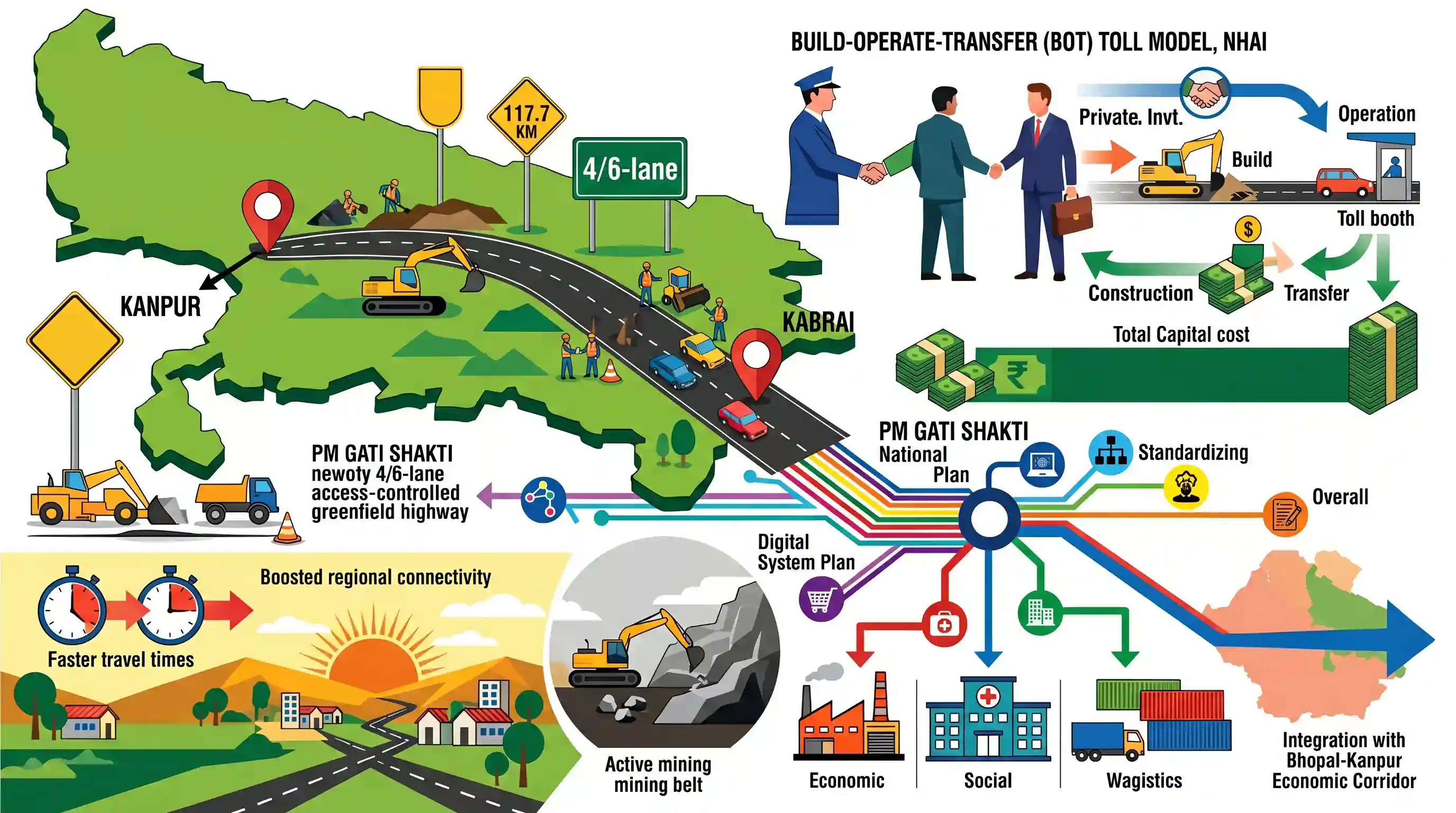
The Cabinet Committee on Economic Affairs (CCEA) has approved the 117.7 km Kanpur-Kabrai Access-Controlled Greenfield Highway on NH-34 in Uttar Pradesh. Constructed on a Build-Operate-Transfer (BOT) Toll model by NHAI at a capital cost of Rs 7,145.14 crore, this 4/6-lane project is a key component of the Bhopal-Kanpur Economic Corridor. It aims to reduce travel times, boost regional connectivity in the Bundelkhand region, support the Kabrai mining belt, and integrate vital economic, social, and logistics nodes under the PM GatiShakti National Master Plan.
Key Points
- The CCEA approved the construction of the 117.7 km Kanpur-Kabrai Access-Controlled Greenfield Highway (NH-34) at an estimated capital cost of Rs 7,145.14 crore.
- The project will be built as a four-lane access-controlled highway, designed for future six-laning, and executed on the Build-Operate-Transfer (BOT) (Toll) mode by the NHAI.
- It is a critical segment of the Bhopal-Kanpur Economic Corridor and is aligned with the PM GatiShakti National Master Plan.
- Designed for operating speeds of 80–100 kmph, it will cut down travel time between Kanpur and Kabrai (Mahoba) from 3.5 hours to 1.5 hours.
- The highway integrates regional infrastructure, connecting with NH-34, NH-35, the Bundelkhand Expressway, Kanpur Ring Road, and State Highways SH-46, SH-91, SH-10B, and SH-42.
- It will provide vital transit for the Kabrai mining belt (Bundelkhand) and link 16 Economic Nodes, 9 Social Nodes, and 10 Logistics Nodes across UP and MP, generating close to 1.2 crore person-days of direct and indirect employment.
Important Terms
PM GatiShakti National Master Plan

A digital multi-modal platform launched in 2021 that integrates infrastructure planning across various ministries to break departmental silos, reduce logistics costs, and improve last-mile connectivity.
UPSC context
GS Paper III (Infrastructure and Planning); tests policies on logistical efficiency, multi-modal connectivity, and ease of doing business.
Build-Operate-Transfer (BOT) Toll model
A public-private partnership (PPP) model where a private developer designs, finances, builds, and operates an infrastructure project, recovering investments via direct user toll collection before transferring ownership to the government.
UPSC context
GS Paper III (Investment Models); tests knowledge of private sector financing in public infrastructure and risk-sharing mechanisms.
Cabinet Committee on Economic Affairs (CCEA)
An extra-constitutional standing committee of the Union Cabinet, chaired by the Prime Minister, responsible for reviewing economic trends, formulating economic policies, and approving major investment proposals.
UPSC context
GS Paper II (Executive/Cabinet Committees); tests understanding of the executive decision-making machinery and top-level economic governance in India.
National Highways Authority of India (NHAI)
An autonomous statutory body set up under the NHAI Act, 1988, tasked with developing, maintaining, and managing the national highways network in India.
UPSC context
GS Paper III (Infrastructure development); tests institutional structures responsible for roadways construction and state-level asset monetization models.
Bhopal-Kanpur Economic Corridor
A planned high-speed highway corridor aimed at improving trade, passenger safety, and freight connectivity between industrial areas in Uttar Pradesh and agricultural or mineral-rich areas in Madhya Pradesh.
UPSC context
GS Paper III (Infrastructure/Roadways); tests understanding of economic corridors in enhancing regional growth, supply-chain resilience, and logistics.
National Highways (O) Programme
The National Highways (Original) works scheme, a central sector programme of MoRTH under which development and expansion projects for national highways are directly funded and executed by the Centre.
UPSC context
GS Paper III (Infrastructure: Roads); tests awareness of central sector schemes and financing structures for state-level connectivity upgrades.
Prelims Trap
The Cabinet Committee on Economic Affairs is a statutory body chaired by the Union Finance Minister.
The CCEA is an extra-constitutional Cabinet Committee established under transaction of business rules and is chaired by the Prime Minister, not the Finance Minister.
Static Concepts Connected
What are the core differences between BOT (Toll) and HAM in PPPs?
- BOT risk: The private developer bears construction, operation, and entire traffic/revenue risks under this model.
- HAM structure: NHAI provides 40% funding during construction, developer finances 60%, and NHAI collects toll while paying fixed annuities.
- EPC contrast: Entirely government-funded with zero long-term commercial or traffic risk for the private developer.
How is the Cabinet Committee on Economic Affairs (CCEA) constituted?
- Constitutional status: It is an extra-constitutional body formed under the Government of India (Transaction of Business) Rules, 1961.
- Leadership: The Prime Minister chairs the CCEA, which handles major economic policies and public sector investment approvals.
Cross-Topic Patterns
Infrastructure and mining economics
Regional transport corridors like NH-34 unlock stranded mining assets, linking infrastructure planning with environmental impacts and local resource economics.
GatiShakti and cooperative federalism
Multi-modal integration across UP and MP requires synchronized spatial planning, testing cooperative federalism through data sharing under PM GatiShakti.

PPP model risk allocations (BOT vs HAM) and Cabinet Committee leadership rules are highly likely to be tested in Prelims 2026.
Linked PYQs · 3
Linked PYQs · 3
- 2023UPPSC_PRELIMSGS1
With reference to 'PM Gati Shakti Scheme', which of the following statement/s is/are correct? (1) The PM Gati Shakti Scheme-National Plan was launched in 2022. (2) The PM Gati Shakti Scheme pertains to seven engines (Roads, Railways, Airports, Ports, Mass Transport, Waterways, Logistics Infrastructure). NIP will be aligned with PM Gati Shakti Framework. Select the correct answer from the code given below -
- 2018UPPSC_PRELIMSGS1
'Purvanchal Express Way' in Uttar Pradesh will not pass through which of the following cities?
- 2023UPPSC_PRELIMSGS1
Which of the following Scheme/Programme is not the Central Government Programme and it is Uttar Pradesh Government's Programme?
