Maharashtra AI Policy 2031 Targets Investment and Job Growth
Source:Indian Express ↗
Why It Matters
As a pioneering state-level technology framework, Maharashtra's AI Policy provides a strong case study for GS2 (e-governance, digital infrastructure) and GS3 (S&T advancements, startup ecosystem, employment). Innovations like 'Compute-as-a-service' and 'State AI Data Exchange' represent next-generation state interventions in the Fourth Industrial Revolution.
Summary
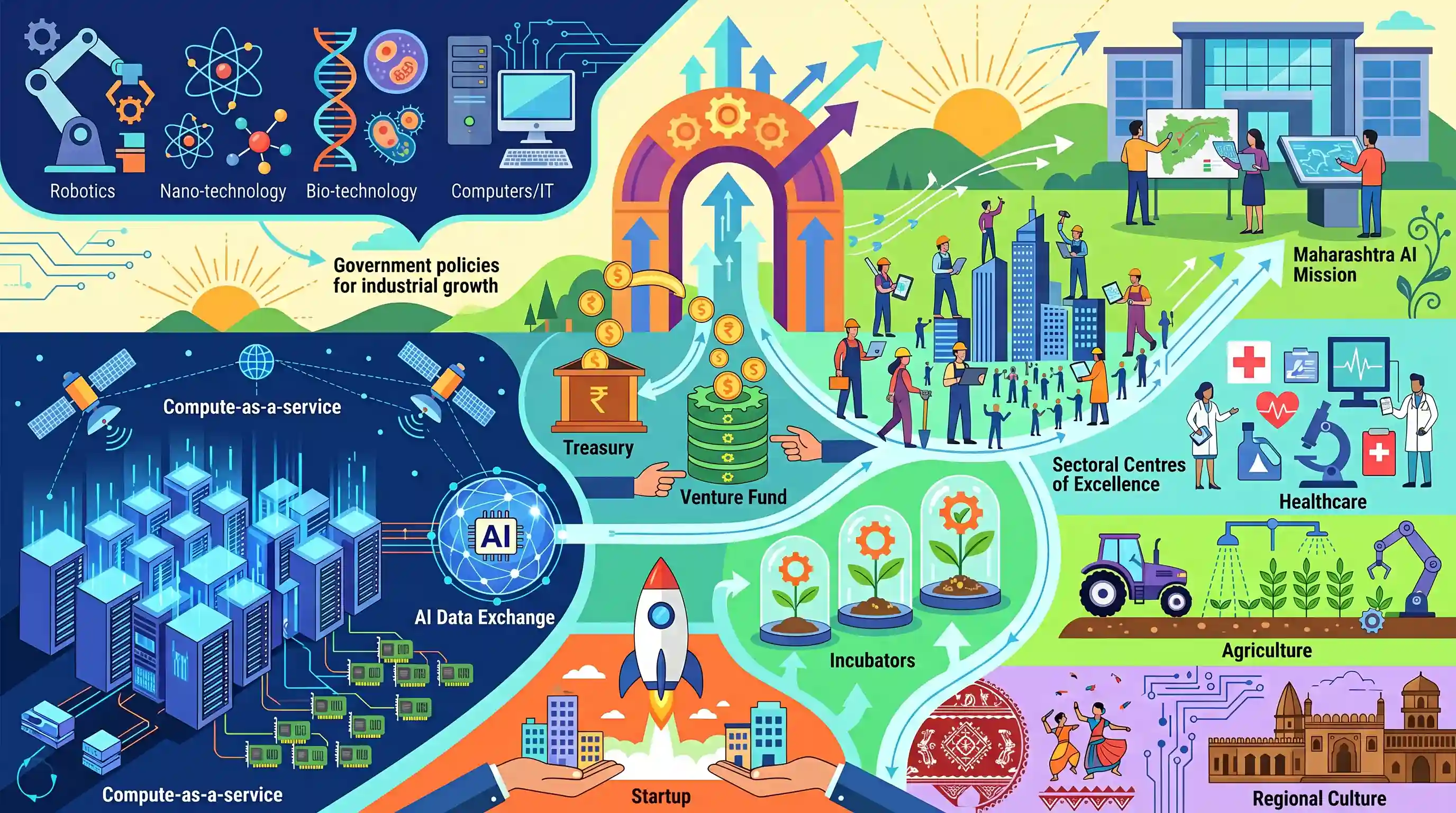
The Maharashtra Cabinet has approved a comprehensive Artificial Intelligence Policy aimed at establishing the state as a premier national AI hub. Targeting Rs 10,000 crore in investments and the creation of 1.5 lakh jobs by 2031, the policy introduces substantial digital public infrastructure initiatives, including a 'Compute-as-a-service' model with 2000 GPUs and a State AI Data Exchange. It places a strong emphasis on MSMEs and startups through a Rs 500 crore venture fund, capital subsidies, and a network of incubators. Furthermore, sectoral Centres of Excellence will drive AI applications in critical areas like healthcare, agriculture, and regional culture, overseen by a newly established Maharashtra AI Mission.
Key Points
- The Maharashtra Cabinet has approved the state's first Artificial Intelligence (AI) Policy aiming to attract Rs 10,000 crore in investments and create 1.5 lakh jobs by 2031.
- The policy envisions establishing five AI innovation cities and six sectoral Centres of Excellence focused on healthcare, agriculture, education, urban development, Marathi language, and finance.
- A 'Compute-as-a-service' model featuring 2000 GPUs will be implemented, alongside a State AI Data Exchange to provide startups and developers access to anonymized, non-personal datasets.
- To boost the ecosystem, the state will create a Rs 500 crore venture fund for AI startups, offer MSME subsidies, and establish 12 AI incubators across Maharashtra.
- The governance framework mandates the creation of the Maharashtra AI Mission to oversee implementation, coupled with annual 'AI readiness audits' for continuous monitoring.
Important Terms
Maharashtra Artificial Intelligence Policy 2026

A strategic framework aimed at positioning Maharashtra as a national hub for ethical AI, targeting ₹10,000 crore in investment and 1.5 lakh jobs by 2031.
UPSC context
GS Paper III: Science & Technology and Industrial Policy. Relevant for questions on regional tech governance and economic growth.
Maharashtra AI Mission (MAIM)
The nodal body established to implement state-wide AI initiatives, promote research, and ensure responsible governance, modeled after the central IndiaAI Mission.
UPSC context
GS Paper II: Government Policies and Interventions. Tests understanding of implementation mechanisms for emerging technologies.
Compute-as-a-Service (CaaS)
An infrastructure model providing government departments with shared access to 2,000 Graphics Processing Units (GPUs) for high-performance computing without upfront hardware investments.
UPSC context
GS Paper III: IT and Awareness in Fields of Computers. Highlights innovative delivery models for digital public infrastructure.
State AI Data Exchange
A digital platform facilitating the sharing of localized datasets (Marathi, dialects) to build regional AI models, integrated with the central IndiaAI Datasets Platform.
UPSC context
GS Paper II: E-governance. Concerns data democratization and linguistic inclusivity in technology.
Maharashtra Centre for Advanced AI Training (MCAT)
A dual partnership platform between industry and academic institutions tasked with upskilling 2 lakh youth and professionals in advanced AI technologies.
UPSC context
GS Paper III: Human Capital and Employment. Relevant for challenges/solutions in workforce transformation due to automation.
AI Innovation Cities and Centres of Excellence
Dedicated urban clusters and hubs in six sectors (e.g., healthcare, agriculture) designed to drive innovation, research, and AI-led industrial ecosystems.
UPSC context
GS Paper III: Economic Growth and Sectoral Impact. Tests knowledge of cluster-based development strategies.
Prelims Trap
The State AI Data Exchange provides startups with access to all personal and non-personal public data for AI training.
The exchange will only provide anonymized, non-personal datasets. Using personal data for such open access would violate the Digital Personal Data Protection (DPDP) Act.
Static Concepts Connected
How does 'Compute-as-a-Service' function in AI infrastructure?
- On-demand Access: Provides cloud-based access to high-performance computing resources like GPUs without requiring physical hardware ownership.
- Cost Efficiency: Lowers capital expenditure barriers for startups and researchers by utilizing a pay-as-you-go operational model.
- Scalability: Allows rapid scaling of computational power needed for training large language models (LLMs) and complex AI algorithms.
What is India's policy framework for Non-Personal Data (NPD)?
- NDGFP: The National Data Governance Framework Policy (NDGFP) aims to safely mobilize non-personal data for research and innovation.
- India Datasets Program: Proposes creating a unified repository of anonymized government data to catalyze the domestic AI and startup ecosystem.
- Anonymization Mandate: Strictly excludes personally identifiable information, meaning it operates completely outside the purview of the DPDP Act 2023.
Cross-Topic Patterns
AI as the new DPI
Embedding computing power (GPUs) and datasets into state-managed infrastructure reflects an evolution of Digital Public Infrastructure beyond identity (Aadhaar) and payments (UPI).
Tech-Federalism in emerging tech
State-level AI missions and policies (Maharashtra, Telangana) complement the central IndiaAI Mission, showcasing cooperative federalism and echoing the state-led IT boom of the 1990s.

Expect a GS3 question evaluating state-led 'Compute-as-a-Service' initiatives and Data Exchanges as the next frontier of India's DPI.
Linked PYQs · 4
Linked PYQs · 4
- 2023MainsGS3
Introduce the concept of Artificial Intelligence (AI). How does Al help clinical diagnosis? Do you perceive any threat to privacy of the individual in the use of Al in healthcare?
- 2023MainsGS3
Faster economic growth requires increased share of the manufacturing sector in GDP, particularly of MSMEs. Comment on the present policies of the Government in this regard.
- 2025MainsGS2
e-governance projects have a built-in bias towards technology and back-end integration than user-centric designs. Examine.
- 2023MainsGS2
e-governance, as a critical tool of governance, has ushered in effectiveness, transparency and accountability in governments. What inadequacies hamper the enhancement of these features ?
