Maharashtra Approves New Artificial Intelligence Policy Framework
Source:Indian Express ↗
Why It Matters
Highlighting a progressive state-level AI policy provides a roadmap for integrating emerging technologies into governance and the economy. The focus on regional language datasets, MSME subsidies, and mandatory government tech audits showcases a model for responsible and inclusive digital growth, highly relevant for mains answers on technology policy, structural employment, and e-governance.
Summary
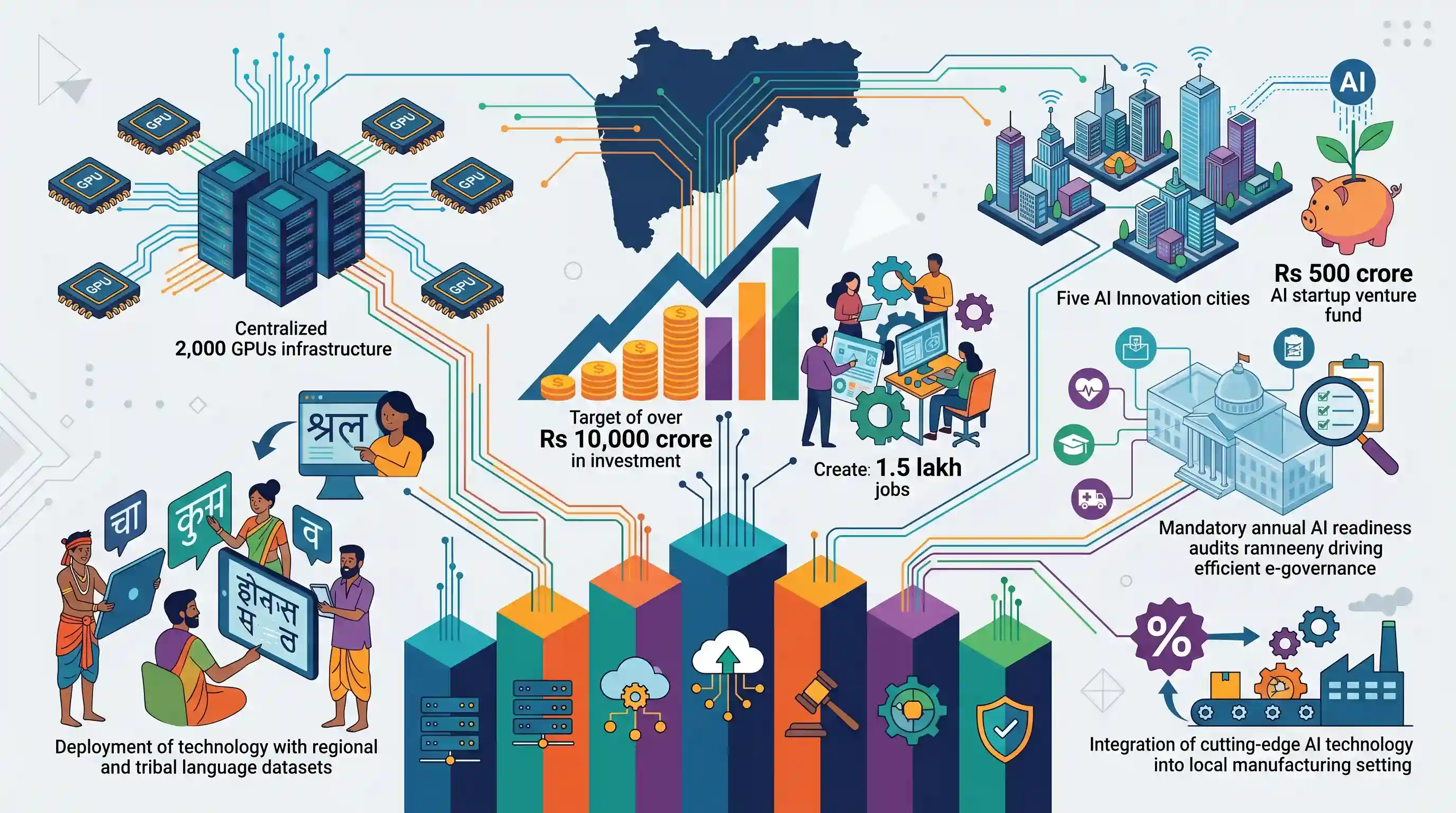
The Maharashtra Cabinet has introduced the ambitious Artificial Intelligence (AI) Policy 2026, targeting over Rs 10,000 crore in investment and the creation of 1.5 lakh jobs by 2031. Designed to establish the state as a national AI hub, the framework is anchored on seven pillars, including infrastructure, data ecosystems, and governance. Major announcements include setting up a common computing backbone with 2,000 GPUs, creating five AI innovation cities, and establishing a Rs 500 crore AI startup venture fund. Importantly, the policy ensures inclusive technology deployment through regional and tribal language datasets and mandates annual AI readiness audits for all government departments to drive efficient e-governance. Additionally, MSMEs will be incentivized with a 20% subsidy for integrating AI technologies, bridging the gap between cutting-edge technology and local manufacturing.
Key Points
- The Maharashtra Cabinet approved the state's AI Policy 2026, seeking to attract Rs 10,000 crore investment and generate 1.5 lakh jobs by 2031.
- The framework aims to build a common computing backbone with 2,000 GPUs operating under a 'compute-as-a-service' model to foster local innovation.
- Emphasizing inclusivity and localization, the policy will develop Marathi, regional, and tribal language datasets through a new State AI Data Exchange.
- To accelerate tech-driven governance, the policy mandates annual AI readiness audits across all state government departments.
- Financial support includes a Rs 500 crore AI startup venture fund and a 20% subsidy for MSMEs adopting AI technologies.
Important Terms
Maharashtra Artificial Intelligence (AI) Policy 2026

A state framework targeting ₹10,000 crore investment and 1.5 lakh jobs by 2031, focusing on infrastructure, inclusive data, and ethical governance through seven strategic pillars.
UPSC context
GS Paper III (IT & Computers); tests knowledge of state-level digital policies and industrial growth strategies in the Fourth Industrial Revolution.
Maha AI Tools Hub
A central platform providing AI tools and use-cases to industries, specifically offering a 20% subsidy to 5,000 MSMEs to lower the barrier for technology adoption.
UPSC context
GS Paper III (Inclusive Growth/MSMEs); relevant for studying technology-driven interventions to enhance small-scale industrial productivity and competitiveness.
State AI Data Exchange (Maharashtra)
A repository for regional, Marathi, and tribal language datasets intended to facilitate inclusive AI development and integrated with the national 'India AI Mission'.
UPSC context
GS Paper II (Governance); highlights issues of language inclusivity, data sovereignty, and the role of local data in ethical AI.
Maharashtra Centre for Advanced AI Training (MCAT)
An industry-academia partnership body tasked with providing AI skills training to 2 lakh youth and professionals to bridge the specialized workforce gap.
UPSC context
GS Paper III (Employment/Skilling); tests understanding of institutional mechanisms for human capital development in emerging tech sectors.
AI Readiness Audit
A mandatory annual evaluation for government departments to assess their progress in adopting AI for public services, ensuring accountability and digital efficiency.
UPSC context
GS Paper II (e-Governance); focuses on transparency and accountability frameworks within modern digital administration.
Prelims Trap
"National AI infrastructure and 'compute-as-a-service' models are exclusively implemented by the Union Government under the IndiaAI Mission."
Aspirants often assume AI compute infrastructure is purely a Central subject. States like Maharashtra are increasingly launching their own independent AI venture funds, compute capacities, and data exchanges.
Static Concepts Connected
How do GPUs differ from CPUs in artificial intelligence applications?
- Core Architecture: CPUs possess a few powerful cores designed for complex sequential processing and general-purpose tasks.
- Parallel Processing: GPUs feature thousands of smaller, more efficient cores that handle multiple basic operations simultaneously.
- AI Workloads: This parallel architecture makes GPUs highly efficient at performing the massive matrix multiplications required to train deep learning models and process big data.
What are the progressive stages of e-governance evolution?
- Computerisation: Transitioning from manual records to installing personal computers and basic IT infrastructure in government departments.
- Networking: Connecting distinct government entities through local and wide area networks, establishing the backbone for data sharing.
- Interactive Presence: Establishing websites for information dissemination, followed by two-way communication portals (e.g., downloading and submitting forms).
- Integrated & Predictive: Delivering end-to-end G2C services online, advancing towards AI-driven, predictive governance and automated decision-making.
Cross-Topic Patterns
Digital India Bhashini & State Datasets
Maharashtra's push for tribal language AI datasets mirrors the Centre's Bhashini mission, linking artificial intelligence to inclusive growth and the preservation of indigenous linguistic heritage (GS1/GS3).
Capital Subsidies for MSME Tech Adoption
Subsidizing AI for MSMEs links advanced tech with manufacturing competitiveness, shifting the policy focus from basic credit guarantee schemes to tech-driven productivity and Industry 4.0 integration.

Expect a 2026 GS-3 Mains question linking AI compute infrastructure and localization efforts to e-governance efficiency and MSME growth.
Linked PYQs · 3
Linked PYQs · 3
- 2023MainsGS3
Introduce the concept of Artificial Intelligence (AI). How does Al help clinical diagnosis? Do you perceive any threat to privacy of the individual in the use of Al in healthcare?
- 2023MainsGS3
Faster economic growth requires increased share of the manufacturing sector in GDP, particularly of MSMEs. Comment on the present policies of the Government in this regard.
- 2024MainsGS2
e-governance is not just about the routine application of digital technology in service delivery process. It is as much about multifarious interactions for ensuring transparency and accountability. In this context evaluate the role of the 'Interactive Service Model' of e-governance.
