Karnataka Hate Speech and Hate Crimes Prevention Legislation
Source:The Hindu ↗
Why It Matters
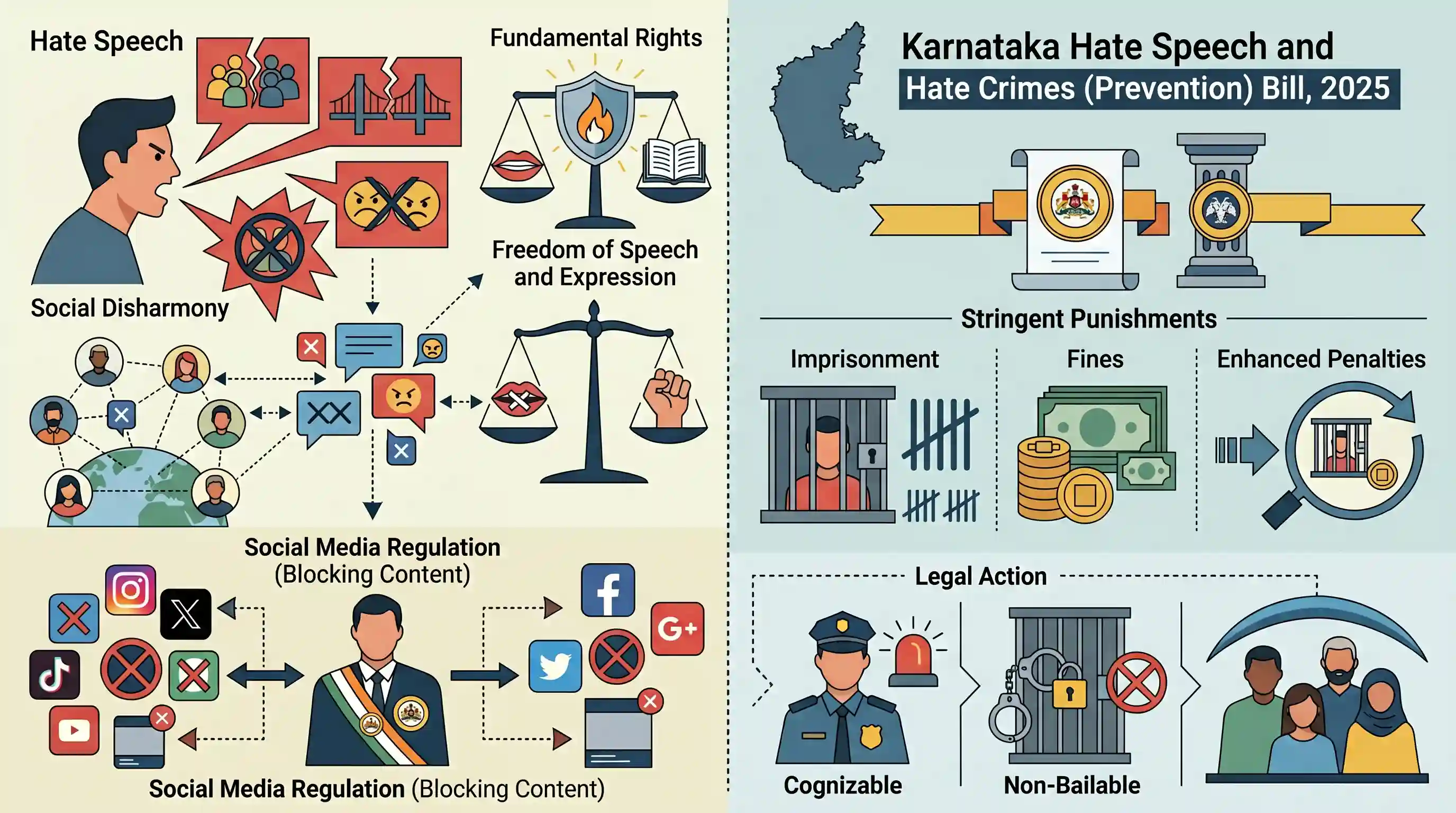
This Bill is significant as it represents a dedicated state-level legislative effort to define and penalize hate speech, an issue that frequently clashes with the Fundamental Right to Freedom of Speech and Expression (Article 19). It also touches upon the governance of digital spaces, internal security, and the responsibilities of intermediaries in curbing inflammatory content.
Summary
The Karnataka Cabinet has approved the Karnataka Hate Speech and Hate Crimes (Prevention) Bill, 2025, a dedicated legislation to combat hate speech and crimes causing social disharmony. The Bill prescribes stringent punishments, including imprisonment of up to seven years and fines, with enhanced penalties for repeat offenders. It also empowers state authorities to direct intermediaries and electronic media to block or remove offensive content. The offenses are categorized as cognizable and non-bailable, signaling a strict state-level approach to regulating inflammatory content and protecting vulnerable groups.
Key Points
- The Karnataka Cabinet approved a dedicated Bill to penalize hate speech and hate crimes, with punishments ranging from one to seven years of imprisonment and fines.
- The Bill defines hate speech as expressions meant to incite enmity or ill-will based on religion, race, caste, gender, sexual orientation, place of birth, or language.
- Designated state officers are empowered to issue orders to internet service providers and electronic media to block or remove hate content.
- The offenses under the proposed law are cognizable and non-bailable, and are to be tried by a Judicial Magistrate First Class.
Important Terms
Karnataka Hate Speech and Hate Crimes (Prevention) Bill, 2025

India's first state-level legislation specifically defining "hate speech" and "hate crimes," prescribing 1–10 years imprisonment and empowering authorities to remove online inflammatory content.
UPSC context
GS Paper II: Governance/Polity. Tests knowledge of state-led legislative innovations and "reasonable restrictions" under Article 19(2).
Bharatiya Nagarik Suraksha Sanhita (BNSS), 2023
The procedural law replacing the CrPC, effective July 2024, which modernizes criminal investigations, mandates forensics for serious offenses, and enhances victim participation in trials.
UPSC context
GS Paper II/III: Criminal Justice Reforms. Essential for understanding the transition from colonial-era codes to modernized Indian criminal procedure.
Judicial Magistrate First Class (JMFC)
A second-tier judicial officer in the district hierarchy empowered to conduct trials and pass sentences (typically up to three years under BNSS).
UPSC context
GS Paper II: Judiciary. Tests understanding of the subordinate judiciary's hierarchy and jurisdictional powers in criminal trials.
Collective Liability
A legal provision in the Karnataka Bill holding office-bearers of an organization criminally accountable for hate speech committed through the entity's platform or activities.
UPSC context
GS Paper II/IV: Legal Ethics/Governance. A novel legal concept regarding organizational accountability for social disharmony.
Social Media Intermediaries
Platforms (e.g., social media) that facilitate data exchange between users; under the Bill, they must comply with state-directed takedown orders for hateful content.
UPSC context
GS Paper III: Internal Security/IT Act. Tests knowledge of digital regulation, platform accountability, and the "Safe Harbor" principle.
Article 19(2)
Constitutional provisions allowing the State to impose "reasonable restrictions" on free speech in the interests of public order, decency, or incitement to an offense.
UPSC context
GS Paper II: Fundamental Rights. The core constitutional yardstick used to evaluate the validity of any hate speech legislation.
Prelims Trap
The Constitution of India explicitly defines 'Hate Speech' as a ground for restricting Freedom of Speech under Article 19(2).
The Constitution mentions 'public order, decency or morality' as grounds for restriction, but explicitly defining 'Hate Speech' is absent in both the Constitution and Central criminal codes.
Static Concepts Connected
What are the constitutional grounds for restricting Freedom of Speech under Article 19(2)?
- Sovereignty & Security: Restrictions must safeguard the security of the State and the sovereignty and integrity of India.
- Public Order: Speech can be restricted to maintain friendly relations with foreign States and to preserve public order.
- Morality & Decency: Restrictions apply to protect decency and morality, or to prevent contempt of court, defamation, or incitement to an offense.
How is jurisdiction over internet and communication services divided between Union and States?
- Union List: Posts, telegraphs, telephones, wireless, broadcasting, and other like forms of communication fall exclusively under List I (Union List).
- State Police Powers: States have jurisdiction over 'public order' and 'police' (List II), creating an overlap when states regulate online content to prevent public disturbances or crimes.
- IT Act Power: Under Section 69A of the IT Act 2000, the power to issue content-blocking orders to online intermediaries is vested primarily in the Central Government.
Cross-Topic Patterns
Digital Federalism: IT Act vs State Laws
State bills empowering local officers to block online content directly clash with the Centre's exclusive powers under Section 69A of the IT Act, raising Seventh Schedule jurisdictional conflicts.
Sexual Orientation as a Protected Identity
By including sexual orientation in its hate speech definition, the Bill aligns with the Navtej Johar ruling's ethos and the T.K. Viswanathan Committee's progressive recommendations on modernizing criminal law.

Expect a 2026 prelims trap asserting "only the Central Govt can block online content," contrasting IT Act Sec 69A with State police powers.
Linked PYQs · 2
Linked PYQs · 2
- 2014MainsGS2
What do you understand by the concept "freedom of speech and expression"? Does it cover hate speech also ? Why do the films in India stand on a slightly different plane from other forms of expression ? Discuss.
- 2024MainsGS3
Social media and encrypting messaging services pose a serious security challenge. What measures have been adopted at various levels to address the security implications of social media? Also suggest any other remedies to address the problem.
