Union Cabinet Extends Technology-Driven PDS Scheme
Source:The Hindu ↗
Why It Matters
The decision showcases the government's strategic roadmap to resolve structural limitations within the PDS supply chain, a highly recurring GS3 topic. The push for automation (SMART PDS) directly serves as content for questions demanding solutions for PDS leakage, transparency, and effective e-governance in food security.
Summary
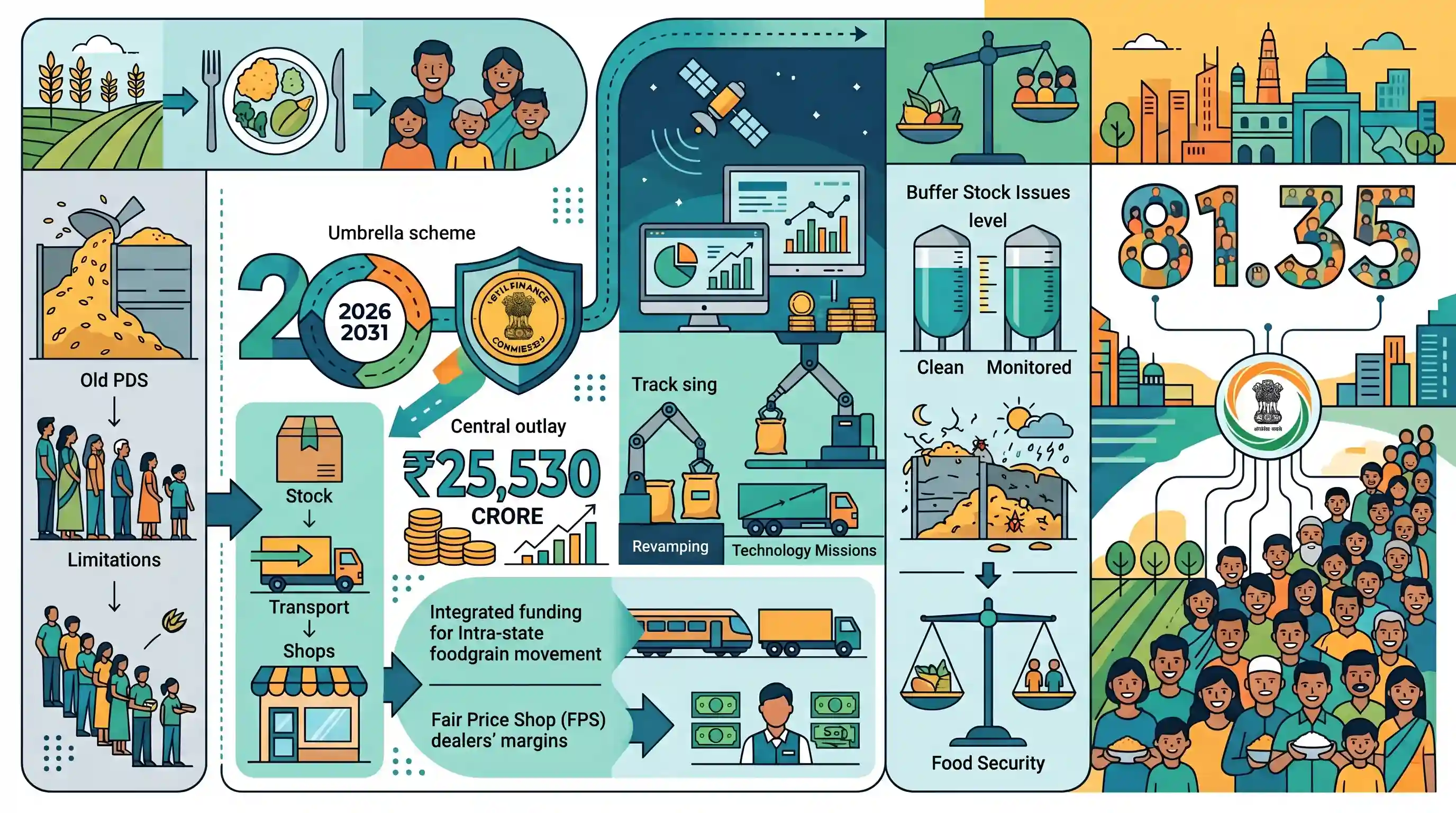
The Union Cabinet has approved the continuation of the 'SARTHAK-PDS' umbrella scheme for the 2026–2031 period with a central outlay of ₹25,530 crore. Designed to coincide with the 16th Finance Commission cycle, the initiative integrates financial assistance for the intra-state movement of foodgrains and FPS dealers' margins alongside the 'SMART PDS' program for system modernization. By heavily relying on technology and automated handling, the framework seeks to comprehensively revamp the Public Distribution System (PDS) logistics, directly enhancing the effective implementation of the National Food Security Act (NFSA) for 81.35 crore beneficiaries.
Key Points
- The Union Cabinet extended the SARTHAK-PDS umbrella scheme with an outlay of ₹25,530 crore for the period 2026-2031, aligning with the 16th Finance Commission cycle.
- The scheme amalgamates ongoing initiatives to provide central financial assistance to States for intra-state movement of foodgrains and Fair Price Shop (FPS) dealers\' margins.
- It integrates the SMART PDS scheme to implement modernization and technical reforms in the Public Distribution System.
- The holistic goal is to streamline logistical operations and increase transparency to effectively deliver foodgrains to 81.35 crore beneficiaries under the National Food Security Act (NFSA).
Important Terms
SARTHAK-PDS

An umbrella scheme (2026–2031) merging 'SMART PDS' with financial assistance for intra-state foodgrain movement and Fair Price Shop (FPS) dealer margins to modernize India’s food security logistics.
UPSC context
GS Paper II/III: Food security, PDS revamping, and structural reforms in welfare delivery.
SMART PDS
The 'Scheme for Modernization and Reforms through Technology in Public Distribution System,' focusing on digitizing ration cards, Aadhaar seeding, and using AI/Blockchain to minimize leakages and improve transparency.
UPSC context
GS Paper III: Technology missions, e-governance, and digital infrastructure in supply chain management.
National Food Security Act (NFSA)
A landmark 2013 legislation providing legal entitlement of subsidized foodgrains to nearly 67% of India's population (75% rural, 50% urban) to ensure food and nutritional security.
UPSC context
GS Paper II/III: Statutory bodies, social justice, and the rights-based approach to food security.
16th Finance Commission
A constitutional body (Article 280) chaired by Arvind Panagariya, recommending the tax-sharing formula and grants between the Centre and States for the 2026–2031 fiscal period.
UPSC context
GS Paper II: Federalism and Indian Constitution; crucial for understanding fiscal federalism and budget cycles.
Fair Price Shop (FPS)
A government-licensed retail outlet responsible for distributing subsidized foodgrains and essential commodities to NFSA beneficiaries under the Targeted Public Distribution System.
UPSC context
GS Paper III: PDS functioning, limitations, and last-mile delivery challenges in welfare programs.
Cabinet Committee on Economic Affairs (CCEA)
A high-level committee chaired by the Prime Minister that reviews and decides on major economic policies, investment proposals, and central sector schemes like SARTHAK-PDS.
UPSC context
GS Paper II: Executive decision-making and the role of Cabinet Committees in economic governance.
Prelims Trap
"The Centre bears 100% of the costs for intra-state movement of foodgrains and FPS dealers' margins."
The Centre does not fund these costs entirely. It provides financial assistance based on specified sharing norms (e.g., 50:50 or 75:25 for special category states) to ease state fiscal burdens.
Static Concepts Connected
What comprises the "Economic Cost" of foodgrains for the FCI?
- Pooled Cost: Includes the Minimum Support Price (MSP) paid directly to farmers, alongside any state-specific bonuses.
- Procurement Incidentals: Costs incurred during the procurement phase, such as mandi taxes, packaging, labor, and local transport to depots.
- Distribution Costs: Expenses for freight, handling, storage charges, interest on loans, and transit losses while moving grain to states.
What are the foundational technological reforms driving PDS modernization?
- Aadhaar Seeding: Digitization of ration cards and their mandatory seeding with Aadhaar to eliminate duplicate, ineligible, or ghost beneficiaries.
- ePoS Devices: Installation of electronic Point of Sale (ePoS) devices at Fair Price Shops to enforce biometric authentication before grain disbursal.
- Supply Chain Tracking: Computerization of supply chain management (like SMART PDS) for real-time tracking of foodgrain movement from FCI godowns to FPS.
Cross-Topic Patterns
Scheme timelines and FC cycles
Aligning the SARTHAK-PDS duration (2026-2031) with the 16th Finance Commission cycle ensures stable, predictable cost-sharing frameworks between the Centre and States for long-term food security planning.
E-governance fixing GS3 logistics
The integration of 'SMART PDS' highlights how digital supply chain tracking and biometric authentication (GS2 E-governance) solve physical leakage problems in buffer stock management (GS3).

Expect a 2026 Prelims question mixing the NFSA cost-sharing mechanisms (Centre vs. State) with SMART-PDS digital interventions.
Linked PYQs · 3
Linked PYQs · 3
- 2022MainsGS3
What are the major challenges of Public Distribution System (PDS) in India ? How can it be made effective and transparent ?
- 2019MainsGS3
What are the reformative steps taken by the Government to make food grain distribution system more effective?
- 2025MainsGS2
Examine the evolving pattern of Centre-State financial relations in the context of planned development in India. How far have the recent reforms impacted the fiscal federalism in India?
