Union Cabinet Approves Expansion of Medical Education Capacity
Source:The Hindu ↗
Why It Matters
The expansion of medical seats directly addresses the chronic shortage of healthcare professionals in India, a core topic in GS Paper 2 (Health and Human Resources). The funding mechanism as a Centrally Sponsored Scheme also touches upon fiscal federalism and Centre-State relations, critical areas for both Prelims and Mains.
Summary
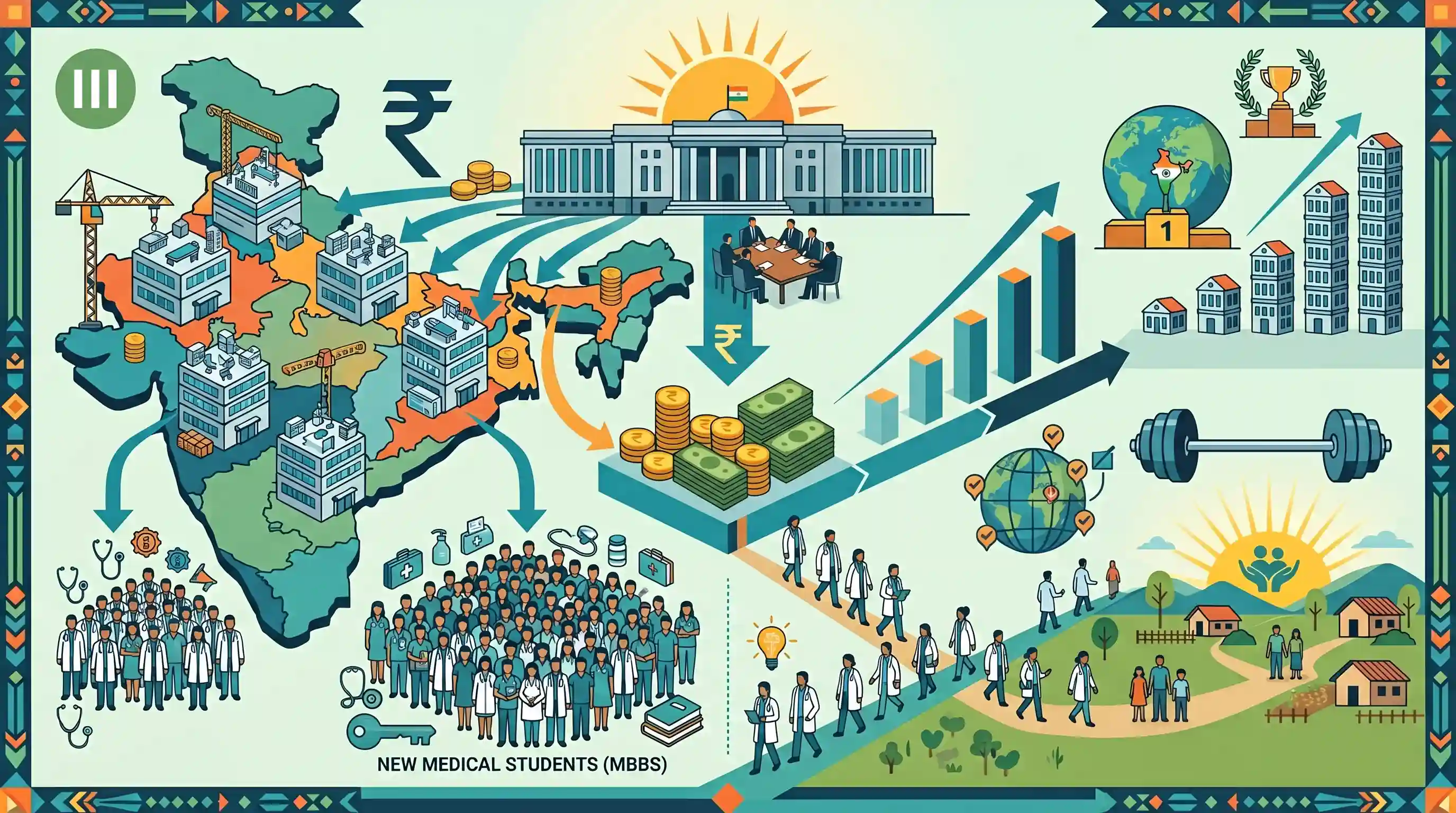
The Union Cabinet has approved Phase-III of a Centrally Sponsored Scheme aimed at significantly expanding India's medical education capacity. Spanning from 2025-26 to 2028-29, the initiative involves a financial outlay of ₹15,034.50 crore to add 5,000 postgraduate and 5,023 MBBS seats by upgrading existing government medical colleges. Highlighting the nation's focus on healthcare human resources, the article notes a massive growth over the past decade, resulting in India hosting the highest number of medical colleges globally. The cost ceiling per seat has also been increased to accommodate rising infrastructure demands, reflecting ongoing efforts to democratize and strengthen healthcare access at the grassroots.
Key Points
- The Union Cabinet approved Phase-III of a Centrally Sponsored Scheme to enhance UG and PG medical education capacity in India.
- The scheme aims to add 5,000 postgraduate and 5,023 MBBS seats by upgrading existing state and central government medical colleges.
- A total financial outlay of ₹15,034.50 crore has been earmarked for the period 2025-26 to 2028-29, sharing costs between the Centre and states.
- The cost ceiling for establishing medical seats has been raised to ₹1.50 crore per seat.
- India's medical education has expanded significantly over the past decade, currently housing the world's highest number of medical colleges (808) and over 1.23 lakh MBBS seats.
Important Terms
Centrally Sponsored Scheme (CSS)

Initiatives jointly funded by the Central and State governments but implemented by States. They typically focus on subjects in the State or Concurrent lists to achieve national developmental goals.
UPSC context
GS Paper II: Centre-State relations, federalism, and government schemes. Tests understanding of fiscal federalism and cooperative governance.
National Medical Commission (NMC)
India's apex regulatory body for medical education and professionals, replacing the Medical Council of India (MCI) to ensure high-quality standards and transparent regulation of medical institutions.
UPSC context
GS Paper II: Statutory/regulatory bodies. Tests knowledge of institutional reforms in the social sector (health).
Pradhan Mantri Swasthya Suraksha Yojana (PMSSY)
A scheme aimed at correcting regional imbalances in tertiary healthcare and augmenting medical education facilities by setting up AIIMS-like institutions and upgrading government medical colleges.
UPSC context
GS Paper II: Welfare schemes for vulnerable sections and health sector interventions. Relevant for issues related to regional disparities.
Medical Institution (Qualifications of Faculty) Regulations 2025
A set of rules introduced to standardize faculty recruitment in medical colleges using a competency-based approach, aimed at addressing teacher shortages during institutional expansions.
UPSC context
GS Paper II: Education and Human Resources. Tests understanding of regulatory shifts to improve professional education quality.
AIIMS (All India Institute of Medical Sciences)
A group of premier autonomous public medical universities declared as 'Institutes of National Importance' (INI), providing state-of-the-art tertiary healthcare and medical training.
UPSC context
GS Paper II: Health-related social sector services and institutional capacity building for tertiary care.
Union Cabinet
The supreme decision-making body of the Indian executive, chaired by the Prime Minister, responsible for major policy approvals and financial outlays for national schemes.
UPSC context
GS Paper II: Indian Polity - Executive and decision-making processes. Tests knowledge of the structure and function of the government.
Prelims Trap
The expansion creates new greenfield medical colleges under a 100% centrally funded Central Sector Scheme.
Aspirants often confuse CSS with Central Sector schemes. This is a Centrally Sponsored Scheme (cost-shared with States) that upgrades existing colleges, rather than building greenfield ones.
Static Concepts Connected
How do Centrally Sponsored Schemes (CSS) differ from Central Sector Schemes?
- Funding Ratio: Central Sector Schemes are 100% Union-funded, whereas CSS are cost-shared (e.g., 60:40 or 90:10) between the Centre and the States.
- Implementation: Central Sector Schemes are implemented by Union government agencies, while CSS are implemented by State governments.
- Constitutional Lists: Central Sector Schemes generally cover Union List subjects. CSS target State List subjects (like Health and Education) to encourage state action.
What is the regulatory architecture under the National Medical Commission (NMC) Act, 2019?
- Apex Regulator: Replaced the corruption-prone Medical Council of India (MCI) to streamline the regulation of medical education and medical professionals in India.
- Autonomous Boards: Functions through four autonomous boards: UG Medical Education, PG Medical Education, Medical Assessment & Rating, and Ethics & Medical Registration.
Cross-Topic Patterns
Health infrastructure & Fiscal Federalism
Expanding medical capacity through a CSS in Health (a State subject) utilizes Article 282 grants, illustrating cooperative yet tied fiscal federalism between the Centre and States.
Skilled workforce & Demographic Dividend
Quantitative expansion of PG and UG medical seats directly addresses India's doctor-to-population ratio, helping convert a youth bulge into a globally exportable skilled healthcare workforce.

Expect a 2026 Prelims question contrasting India's top global rank in medical college numbers against acute rural-urban doctor disparities.
Linked PYQs · 4
Linked PYQs · 4
- 2023MainsGS2
The crucial aspect of development process has been the inadequate attention paid to Human Resource Development in India. Suggest measures that can address this inadequacy.
- 2023MainsGS2
Skill development programmes have succeeded in increasing human resources supply to various sectors. In the context of the statement analyse the linkages between education, skill and employment.
- 2024MainsGS2
What changes has the Union Government recently introduced in the domain of Centre-State relations ? Suggest measures to be adopted to build the trust between the Centre and the States and for strengthening federalism.
- 2024MainsGS2
In a crucial domain like the public healthcare system the Indian State should play a vital role to contain the adverse impact of marketisation of the system. Suggest some measures through which the State can enhance the reach of public healthcare at the grassroots level.
