Employment Linked Incentive Scheme for Formal Job Generation
Source:Indian Express ↗
Why It Matters
Employment is a core pillar of the GS3 syllabus. The ELI scheme addresses the critical UPSC themes of 'jobless growth' and formalizing the workforce. Understanding this scheme is vital for answering questions on how the government is maximizing the demographic dividend and incentivizing labor-intensive manufacturing over capital-intensive growth.
Summary
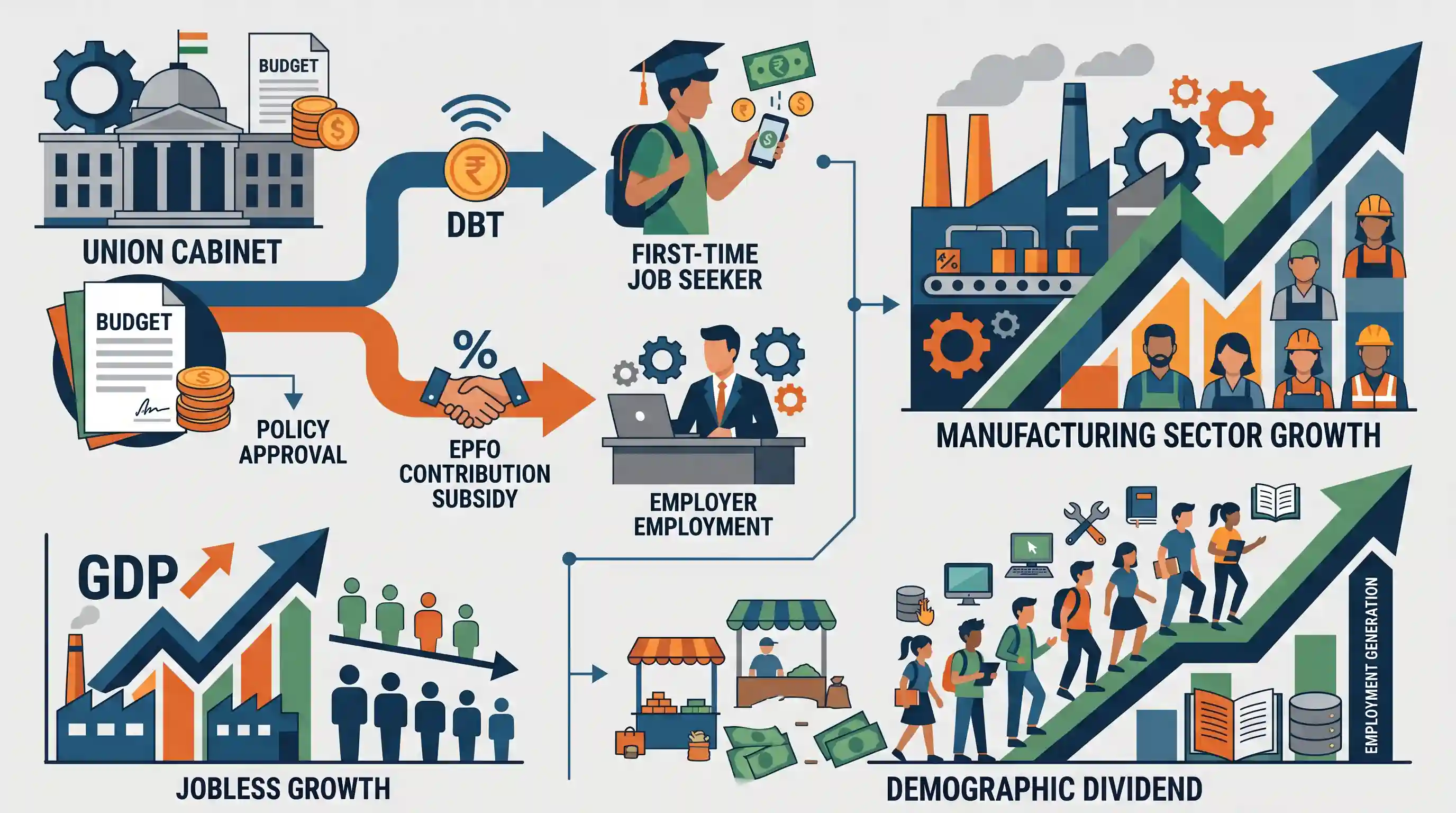
The Union Cabinet has approved the Employment-Linked Incentive (ELI) scheme, a major policy intervention aimed at boosting formal job generation across various sectors. Originally outlined in the Union Budget, the ELI scheme utilizes Direct Benefit Transfers and EPFO contribution subsidies to incentivize both employers to hire and individuals to enter the formal workforce. By specifically targeting the manufacturing sector and first-time job seekers, the initiative seeks to address India's persistent challenge of 'jobless growth' and successfully harness the country's demographic dividend by structurally lowering employment costs.
Key Points
- The Union Cabinet has approved the Employment-Linked Incentive (ELI) scheme to stimulate formal job generation.
- The scheme provides incentives through the Employees' Provident Fund Organisation (EPFO), benefiting both employers and new employees.
- It includes provisions like a direct benefit transfer (DBT) of one month's salary for first-time entrants into the formal workforce.
- A specific focus is placed on the manufacturing sector to encourage large-scale, labor-intensive job creation and structural hiring.
- The initiative aims to counter 'jobless growth' by lowering the cost of hiring for companies while encouraging formalization of the labor market.
Important Terms
Employment-Linked Incentive (ELI) Scheme

A centrally sponsored scheme incentivizing formal job creation through wage subsidies for first-time employees and financial incentives for employers, particularly in the manufacturing sector.
UPSC context
GS Paper III: Economy/Employment. Crucially tests knowledge of government interventions to address unemployment and structural labor market shifts.
Employees' Provident Fund Organisation (EPFO)
A statutory body under the Ministry of Labour and Employment that manages social security funds, including provident funds and pensions, for India's formal workforce.
UPSC context
GS Paper III: Economy/Social Security. Relevant for labor reforms and the transition of workers from informal to formal sectors.
Direct Benefit Transfer (DBT)
The mechanism of transferring subsidies and welfare payments directly into beneficiaries' bank accounts via the Aadhaar Bridge Payment System to reduce leakages and intermediaries.
UPSC context
GS Paper II/III: Governance and Economy. Tests understanding of digital infrastructure (JAM Trinity) in public service delivery efficiency.
Jobless Growth
An economic condition where a country experiences GDP growth without a proportional increase in employment opportunities, often due to capital-intensive or service-led expansion.
UPSC context
GS Paper III: Growth and Development. A recurring theme in Mains regarding India's structural economic challenges and labor market paradoxes.
Demographic Dividend
The economic growth potential that arises when a country’s working-age population (15–64) is larger than its non-working-age (dependent) population.
UPSC context
GS Paper I/III: Social Issues/Human Development. Tests the ability to link population trends with economic policy and skilling requirements.
Formalization of the Economy
The shift of workers and enterprises from the unregulated informal sector into the formal economy, providing legal protections, social security, and tax compliance.
UPSC context
GS Paper III: Indian Economy. Key for questions on labor welfare, productivity, and broadening the tax base.
Prelims Trap
"The ELI scheme provides a uniform 4-year wage subsidy incentive to employers across all sectors."
The ELI scheme deliberately favors manufacturing by offering a 4-year employer incentive. Employers in all other non-manufacturing sectors only receive a 2-year incentive.
Static Concepts Connected
What characterizes 'Jobless Growth' in the Indian macroeconomic context?
- Definition: A macroeconomic phenomenon where an economy experiences GDP expansion without a proportional increase in employment opportunities.
- Primary Causes: Often driven by capital-intensive industrialization, automation, and a skewed transition directly from agriculture to services, bypassing labor-intensive manufacturing.
- Measurement: It is measured by 'Employment Elasticity', which denotes the percentage change in employment associated with a 1% change in economic growth.
What is the Employees' Provident Fund Organisation (EPFO)?
- Statutory Status: A statutory body established under the Employees' Provident Funds and Miscellaneous Provisions Act, 1952, under the Ministry of Labour and Employment.
- Core Functions: It administers mandatory provident fund, pension (EPS), and life insurance (EDLI) schemes for the organized sector workforce in India.
- Formalization Metric: EPFO payroll additions are utilized by the government as a proxy indicator to measure the formalization of the Indian labor market.
Cross-Topic Patterns
Capital (PLI) vs Labor (ELI) Subsidies
While the Production-Linked Incentive (PLI) scheme subsidized output and capital investments, ELI shifts the policy focus to directly subsidizing labor costs, creating a dual push for large-scale, labor-intensive industrialization.
Formalization vs True Job Creation
ELI's mandatory EPFO registration will artificially boost formal payroll data. Aspirants must link this policy-driven formalization with Periodic Labour Force Survey (PLFS) metrics on actual job creation vs mere formalization.

Expect a 2026 Mains question contrasting capital-intensive PLI with labor-intensive ELI in addressing India's jobless growth crisis.
Linked PYQs · 5
Linked PYQs · 5
- 2015MainsGS3
The nature of economic growth in India in recent times is often described as jobless growth. Do you agree with this view ? Give arguments in favour of your answer.
- 2022MainsGS3
Economic growth in the recent past has been led by increase in labour productivity." Explain this statement. Suggest the growth pattern that will lead to creation of more jobs without compromising labour productivity.
- 2014MainsGS3
While we flaunt India's demographic dividend, we ignore the dropping rates of employability. What are we missing while doing so? Where will the jobs that India desperately needs come from? Explain.
- 2023MainsGS3
Faster economic growth requires increased share of the manufacturing sector in GDP, particularly of MSMEs. Comment on the present policies of the Government in this regard.
- 2016MainsGS2
Demographic Dividend in India will remain only theoretical unless our manpower becomes more educated, aware, skilled and creative." What measures have been taken by the government to enhance the capacity of our population to be more productive and employable?
