Madhya Pradesh Cabinet Approves Labour Codes and Healthcare Reforms
Source:the-hitavada ↗
Why It Matters
Understanding recent legislative drafts and policy changes in Madhya Pradesh is crucial for the MPPSC Prelims, specifically regarding the state's economic development, administrative reforms, and healthcare initiatives. Questions frequently target state-specific bills, statutory bodies (like MPIDC), and unique schemes.
Summary
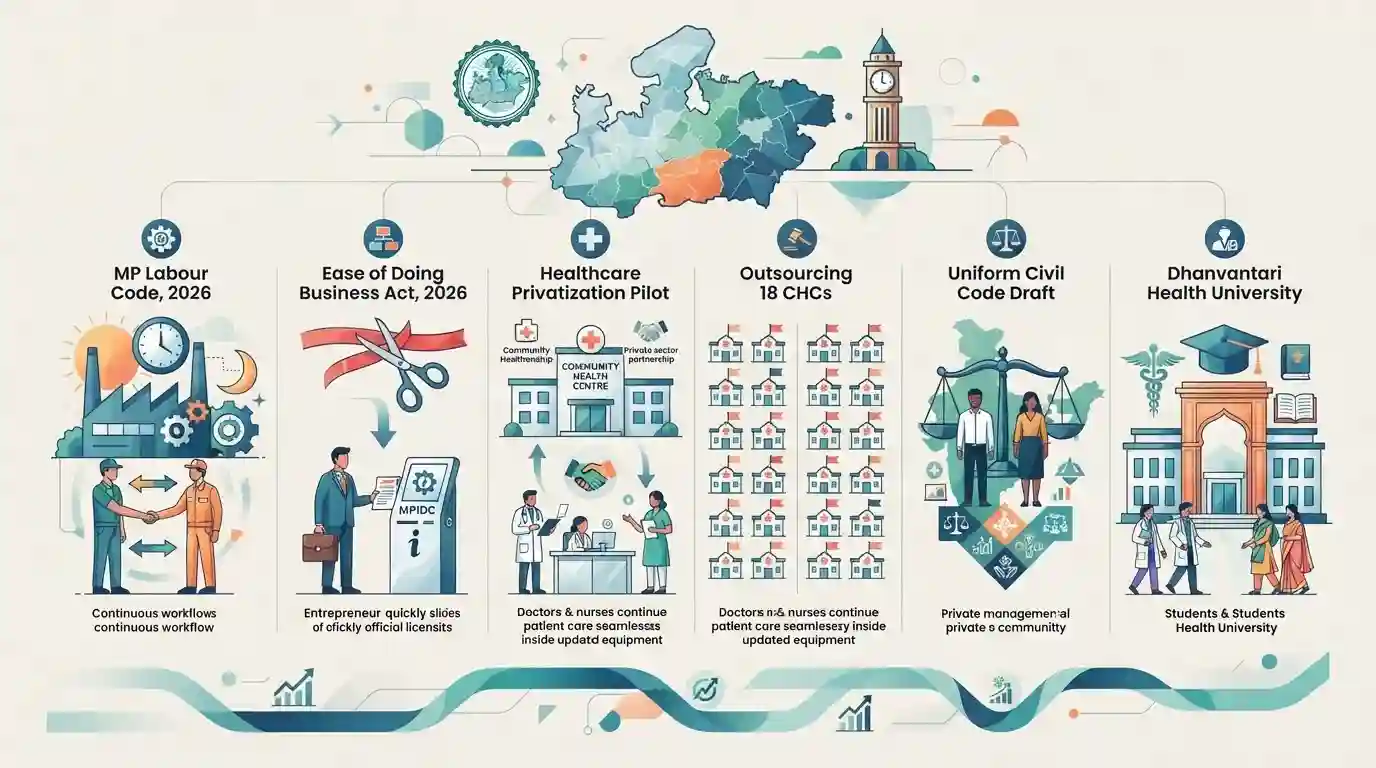
The Madhya Pradesh Cabinet recently approved nine major legislative drafts, introducing sweeping reforms in labour, healthcare, and industrial policy. Key approvals include the MP Labour Code, 2026, which enables round-the-clock operations for specific sectors, and the Ease of Doing Business Act, 2026, which streamlines business setups via the MPIDC. In a significant healthcare move, a pilot project will outsource 18 Community Health Centres to private entities. The state is also advancing its legislative framework by preparing drafts for the Uniform Civil Code and the establishment of the Dhanvantari Health University.
Key Points
- The Madhya Pradesh Cabinet, chaired by CM Dr Mohan Yadav in Jagdishpur, approved drafts on nine major issues.
- The MP Labour Code, 2026 consolidates six old laws, aligns with central acts, and introduces a 3-shift system to allow 24x7 operations for theaters and restaurants.
- A pilot project will outsource the operations of 18 Community Health Centres in Rewa, Dewas, and Guna to private organizations, along with direct non-transferable recruitment of specialist doctors.
- The Ease of Doing Business Act, 2026 mandates a single-window system under the MPIDC, introducing self-declaration models and waiving initial Pollution Control Board certificates.
- Drafts for the MP Uniform Civil Code and the MP Dhanvantari Health University Bill were also cleared to reform state-level civil laws and medical education.
Important Terms
Madhya Pradesh Uniform Civil Code, 2026

A proposed state legislation replacing personal religious laws with common civil rules governing marriage, divorce, and inheritance for all citizens in Madhya Pradesh.
UPSC context
GS Paper II (Polity). Tests the interplay of Article 44 (DPSP), federalism, and state-level implementation of common civil laws.
MP Labour Code, 2026
A comprehensive state labour reform consolidating existing regulations to increase industrial flexibility, notably permitting round-the-clock operations for specific sectors to attract investment.
UPSC context
GS Paper III (Economy). Highlights state-led labour reforms, industrial flexibility, and employment generation strategies within concurrent list subjects.
MP Ease of Doing Business Act, 2026
A legislative framework that streamlines regulatory compliance for businesses, enabling faster setups through the MPIDC and eliminating procedural bottlenecks like early-stage pollution board certificates.
UPSC context
GS Paper III (Economic Development). Relevant for understanding regional investment policies, deregulation, and governance mechanisms for economic growth.
MP Dhanvantari Health University Bill, 2026
A state bill creating a dedicated university for medical and AYUSH education in Madhya Pradesh, restructuring healthcare training and easing administrative burden on existing institutions.
UPSC context
GS Paper II (Health). Evaluates state initiatives to expand healthcare infrastructure, ensure quality medical education, and develop human capital.
MP Industrial Development Corporation (MPIDC)
The primary nodal agency of the Madhya Pradesh government responsible for promoting industrial growth, facilitating investments, and providing single-window regulatory clearances for businesses.
UPSC context
GS Paper III (Investment Models). Important for understanding the institutional mechanisms that execute state-level ease of doing business and infrastructure promotion.
Prelims Trap
State governments lack the legislative competence to enact a Uniform Civil Code because personal laws fall exclusively under the Union List.
Personal laws (marriage, divorce, succession) fall under Entry 5 of the Concurrent List (List III), meaning states have joint jurisdiction with the Centre to enact a UCC, subject to Article 254.
Static Concepts Connected
How is legislative power over 'Labour' and 'Personal Laws' distributed under the Seventh Schedule?
- Concurrent List Jurisdiction: Both subjects fall under List III (Concurrent List) of the Seventh Schedule of the Constitution.
- Labour Entries: Labour welfare, trade unions, and industrial disputes are covered under Entries 22, 23, and 24 of List III.
- Personal Laws Entry: Marriage, divorce, adoption, wills, and succession fall under Entry 5 of List III, enabling both Parliament and States to legislate.
- Repugnancy Doctrine: Under Article 254(2), a State law on a Concurrent subject that conflicts with a Central law can prevail in that State if it receives Presidential assent.
What is the role of Community Health Centres (CHCs) in India's healthcare architecture?
- Secondary Tier Function: CHCs constitute the secondary tier, acting as a referral center for 4 Primary Health Centres (PHCs) and serving 80,000 to 120,000 people.
- Staffing Norms: A standard CHC is mandated to have 30 beds and at least 4 specialists (surgeon, physician, gynecologist, and pediatrician).
- PPP Intervention: Faced with over 70% specialist deficits in rural areas, states are increasingly using PPP models (outsourcing operations) to leverage private human resources.
Cross-Topic Patterns
Federalism + Concurrent List legislative experiments
State-level variations in Labour Codes and UCC drafts highlight how states utilize List III (Concurrent) to pilot reforms, showcasing competitive federalism vs. legislative harmony.
Environmental Governance vs. Ease of Doing Business
Waiving initial Pollution Control Board clearances to improve EoDB showcases the ongoing policy tension between rapid industrialization and environmental compliance protocols.

Concurrent List dynamics of state-level UCCs and localized deviations from Central Labour Codes will be a major GS-2 focus in 2026.
Linked PYQs · 3
Linked PYQs · 3
- 2016MPPSC_PRELIMSGS1
The cause/causes of backwardness of industries in Madhya Pradesh is/are
- 2024MPPSC_PRELIMSGS1
What percentage of all factories in India were located in Madhya Pradesh in the year 2017-18?
- 2021MPPSC_PRELIMSGS1
The Madhya Pradesh Public Service Commission shall consist of maximum
