Cabinet Approves Ten Thousand Crore ATF Price Stabilisation Fund
Source:The Hindu ↗
Why It Matters
Highlights the vulnerability of India's aviation and transportation sectors to global geopolitical shocks. It demonstrates practical fiscal interventions by the government to ensure consumer protection and sector viability through revolving funds and price stabilization mechanisms without causing permanent burdens on the exchequer.
Summary
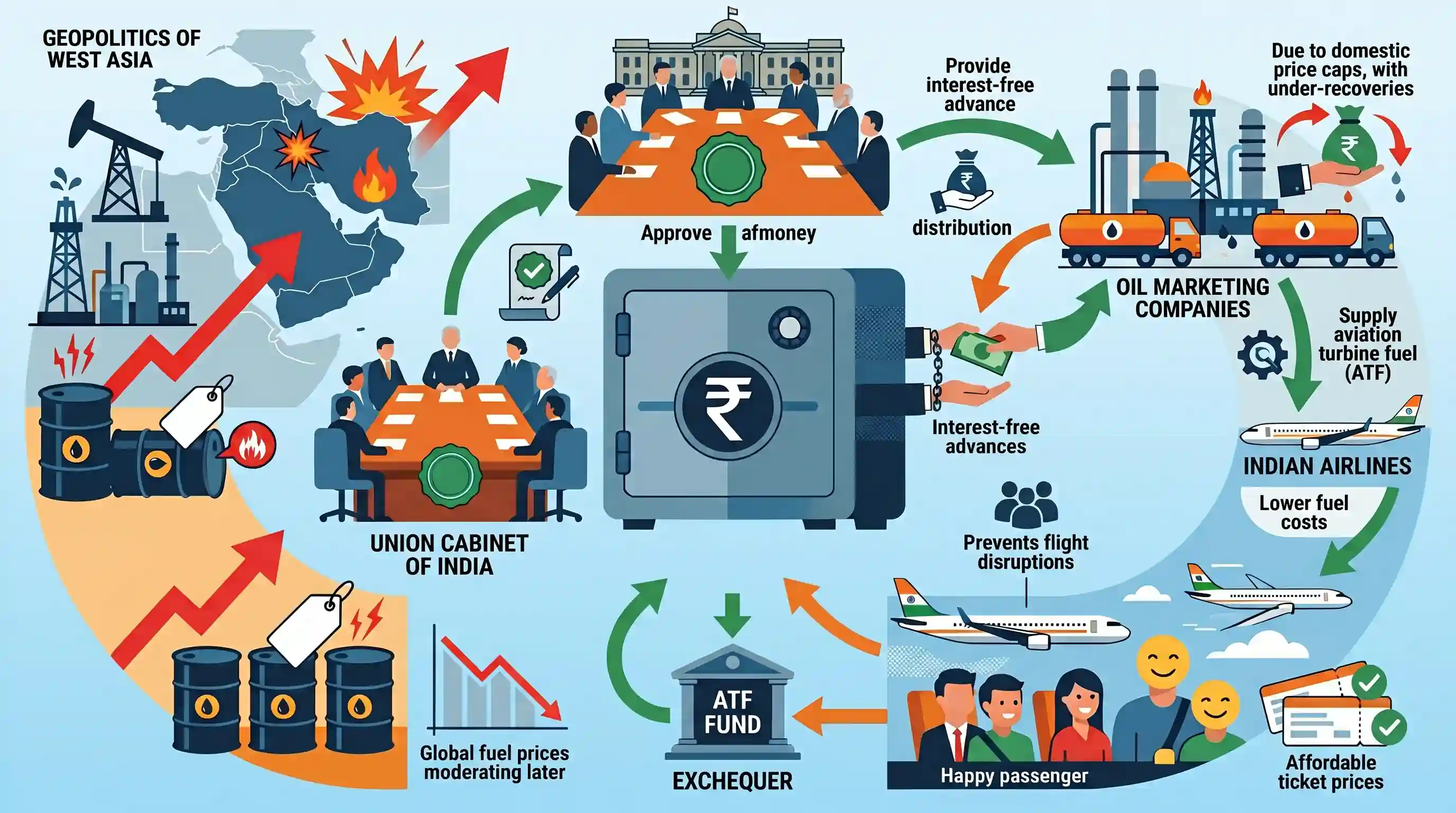
The Union Cabinet has approved a ₹10,000 crore ATF price stabilisation fund to protect Indian scheduled airlines from soaring jet fuel prices driven by geopolitical conflicts in West Asia. Functioning as a revolving fund, it will provide interest-free advances to oil-marketing companies (OMCs), which are currently facing massive under-recoveries due to domestic price caps. The mechanism aims to prevent flight disruptions and sudden passenger fare hikes while ensuring the funds are recouped by the exchequer once global fuel prices moderate.
Key Points
- The Union Cabinet approved a ₹10,000 crore Aviation Turbine Fuel (ATF) price stabilisation fund to shield Indian airlines from surging global jet fuel prices.
- The global ATF prices soared from ₹60.5 per litre in March to ₹142 per litre in May 2026 due to conflicts in West Asia.
- The financial package will act as a self-sustaining revolving fund, providing interest-free advances to Oil-Marketing Companies (OMCs) which were facing an under-recovery of ₹30 per litre.
- Rising fuel costs had led major airlines to cut 250 daily domestic flights to avoid severe operational losses, prompting government intervention.
- Airlines must sign an MoU to procure ATF exclusively from participating OMCs until the advanced amount is recovered or for up to three years.
Important Terms
ATF Price Stabilisation Fund

A government-approved financial mechanism designed to buffer Indian airlines from extreme volatility in jet fuel prices by providing interest-free advances to oil companies.
UPSC context
GS-III: Infrastructure and Energy. Tests understanding of government interventions to ensure sector-specific economic stability and energy security.
Oil-Marketing Companies (OMCs)
Public sector enterprises (e.g., IOCL, BPCL, HPCL) responsible for refining, distributing, and marketing petroleum products; they serve as the implementation arm for fuel pricing policies.
UPSC context
GS-III: Economic Development. Crucial for questions on energy subsidies, fiscal deficits, and the role of PSUs in the economy.
Under-recoveries
The financial loss incurred by OMCs when the domestic retail price of a petroleum product is lower than its international import parity price.
UPSC context
GS-III: Government Budgeting. Evaluates knowledge of the fiscal burden caused by price controls and subsidy mechanisms.
Revolving Fund
A self-sustaining financial pool where the initial capital is replenished through repayments of advances, allowing for continuous reuse without new annual appropriations.
UPSC context
GS-III: Indian Economy. Tests understanding of innovative financing models used for sustainable government schemes.
Aviation Turbine Fuel (ATF)
A specialized petroleum-based fuel used for powering aircraft, constituting roughly 40-50% of an Indian airline's operational costs.
UPSC context
GS-III: Infrastructure (Aviation). Relevant for discussions on the logistics sector, GST rationalization, and ease of doing business.
Union Cabinet
The highest decision-making body of the Indian executive, consisting of the Prime Minister and Cabinet Ministers, responsible for approving major policy changes.
UPSC context
GS-II: Indian Polity (Executive). Fundamental to understanding the machinery of government and executive accountability.
Prelims Trap
"The ATF price stabilisation fund provides direct financial subsidies to scheduled Indian airlines."
The fund does not subsidize airlines directly. It provides interest-free advances to Oil-Marketing Companies (OMCs) to offset their under-recoveries from selling ATF below actual market cost.
Static Concepts Connected
What is the macroeconomic difference between under-recoveries and subsidies?
- Under-recoveries: Losses incurred by Oil-Marketing Companies (OMCs) when forced by the government to sell fuel below the actual international market cost.
- Subsidies: Direct financial aid provided by the government to producers or consumers to artificially lower the final price of a commodity.
- Budgetary impact: Subsidies are explicitly provisioned in the Union Budget, whereas under-recoveries are initially borne by OMCs and may be compensated later via bonds or special funds.
How does a 'Revolving Fund' operate within government public finance?
- Self-replenishing: It functions as a self-sustaining pool of money. Initial capital outlays are loaned out, repaid on a schedule, and then continuously re-loaned for future needs.
- Non-lapsable corpus: Unlike standard budgetary allocations that must be returned if unspent by March 31, balances in revolving funds typically do not lapse at the financial year's end.
Cross-Topic Patterns
Price Stabilisation: Agriculture vs. Energy
The ATF fund borrows the Price Stabilisation Fund (PSF) model used for pulses and onions, extending an agricultural inflation-control mechanism to the corporate aviation sector to shield consumers.
West Asia crises and imported inflation
Instability in West Asia immediately stresses India's energy security, causing 'imported inflation' that forces sudden fiscal interventions like OMC bailouts to prevent domestic transport and supply chain disruptions.

Expect a multi-statement prelims question comparing the mechanics of Price Stabilisation Funds across agriculture (PSF) and energy.
Linked PYQs · 4
Linked PYQs · 4
- 2025MainsGS2
"Energy security constitutes the dominant kingpin of India's foreign policy, and is linked with India's overarching influence in Middle Eastern countries.” How would you integrate energy security with India's foreign policy trajectories in the coming years?
- 2017MainsGS2
The question of India's Energy Security constitutes the most important part of India's economic progress. Analyze India's energy policy cooperation with West Asian countries.
- 2017MainsGS3
Examine the development of Airports in India through joint ventures under Public-Private Partnership (PPP) model. What are the challenges faced by the authorities in this regard?
- 2024MainsGS3
Elucidate the importance of buffer stocks for stabilizing agricultural prices in India. What are the challenges associated with the storage of buffer stock? Discuss.
