Regional Rural Bank Consolidation Impact on Rural Credit Delivery
Source:The Hindu ↗
Why It Matters
The debate over RRB consolidation versus localized differentiated banking models directly impacts rural credit availability, priority sector lending, and financial inclusion in India.
Summary
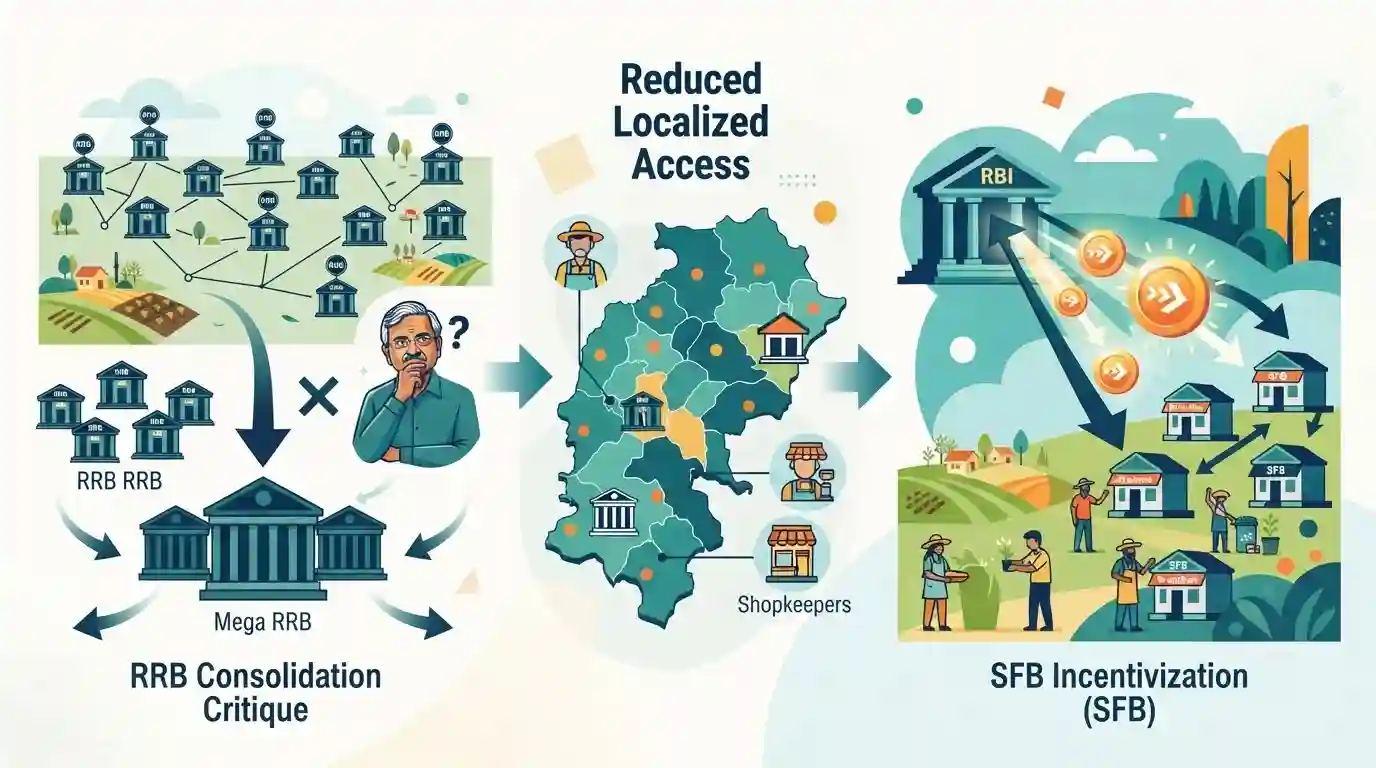
Former RBI Governor C. Rangarajan has critiqued the ongoing consolidation of Regional Rural Banks (RRBs) that reduces their total number, stating it moves away from the core objective of localized rural credit delivery. He called upon the Reserve Bank of India to actively incentivize Small Finance Banks (SFBs) to bridge the rural credit gap.
Key Points
- Former RBI Governor C. Rangarajan criticized the reduction in the number of Regional Rural Banks (RRBs) through consolidation as a step in the wrong direction, arguing it dilutes rural focus.
- He emphasized that RRBs were specifically conceptualized to provide localized, grassroot credit access to agriculture and rural areas, which large-scale consolidation might compromise.
- Rangarajan urged the RBI to incentivize Small Finance Banks (SFBs) and support differentiated banking models to enhance financial inclusion and rural credit delivery.
Important Terms
Reserve Bank of India

India's central banking institution, established in 1935, responsible for regulating monetary policy, issuing currency, supervising commercial and specialized banks, and maintaining financial stability.
UPSC context
Crucial for GS Paper III (Indian Economy & Banking Reforms); tests understanding of monetary policy, regulation, and financial inclusion.
Regional Rural Banks
Scheduled commercial banks operating at regional levels to provide credit and banking services to agriculture, small enterprises, and rural sections, currently undergoing consolidation under the 'One State, One RRB' policy.
UPSC context
Important for GS Paper III (Agriculture and Rural Credit Delivery); tests knowledge of rural institutional credit structures and banking consolidation.
Small Finance Banks
Niche private-sector banks licensed by the RBI to promote financial inclusion by serving unserved segments like small farmers, micro-enterprises, and unorganized sectors through basic deposits and lending.
UPSC context
Relevant for GS Paper III (Inclusive Growth and Banking Sector Reforms); tests understanding of differentiated banking licenses and rural credit options.
Static Concepts Connected
What is the genesis, ownership structure, and mandate of Regional Rural Banks (RRBs) in India?
- Statutory Origin: Established under the RRB Act, 1976, following the recommendations of the Narasimham Working Group (1975).
- Ownership Ratio: Equity is shared between Central Government (50%), Sponsor Bank (35%), and State Government (15%).
- Primary Mandate: Mandated to provide credit to small/marginal farmers, agricultural laborers, and rural artisans in specific notified districts.
How do Small Finance Banks (SFBs) differ from Universal Banks in terms of regulatory mandates?
- PSL Target: Required to allocate 75% of their Adjusted Net Bank Credit (ANBC) to Priority Sector Lending (PSL).
- Ticket Size Limit: Must ensure at least 50% of their loan portfolio comprises loans of up to Rs. 25 lakh.
- Differentiated Model: Operate as differentiated banks focusing on unserved and underserved sections, including micro industries and small farmers.
Cross-Topic Patterns
Rural Credit Evolution & Financial Inclusion
The evolution from structural credit institutions like RRBs (1976) to differentiated banks (SFBs) reflects shifting paradigms in rural poverty alleviation and inclusive growth.

RRB ownership structure (Central:50, Sponsor:35, State:15) and SFB priority sector targets (75% ANBC) are high-yield prelims traps.
Linked PYQs · 3
Linked PYQs · 3
- 2014MainsGS3
In the villages itself no form of credit organization will be suitable except the cooperative society. -All India Rural Credit Survey. Discuss this statement in the background of agricultural finance in India. What constraints and challenges do financial institutions supplying agricultural finance face? How can technology be used to better reach and serve rural clients?
- 2013PrelimsGS1
Priority Sector Lending by banks in India constitutes the lending to
- 2020PrelimsGS1
Consider the following statements: 1. In terms of short-term credit delivery to the agriculture sector, District Central Cooperative Banks (DCCBs) deliver more credit in comparison to Scheduled Commercial Banks and Regional Rural Banks. 2. One of the most important functions of DCCBs is to provide funds to the Primary Agricultural Credit Societies. Which of the statements given above is/are correct?
