Evolution of India foreign policy in Israel and the Middle East
Source:Indian Express ↗
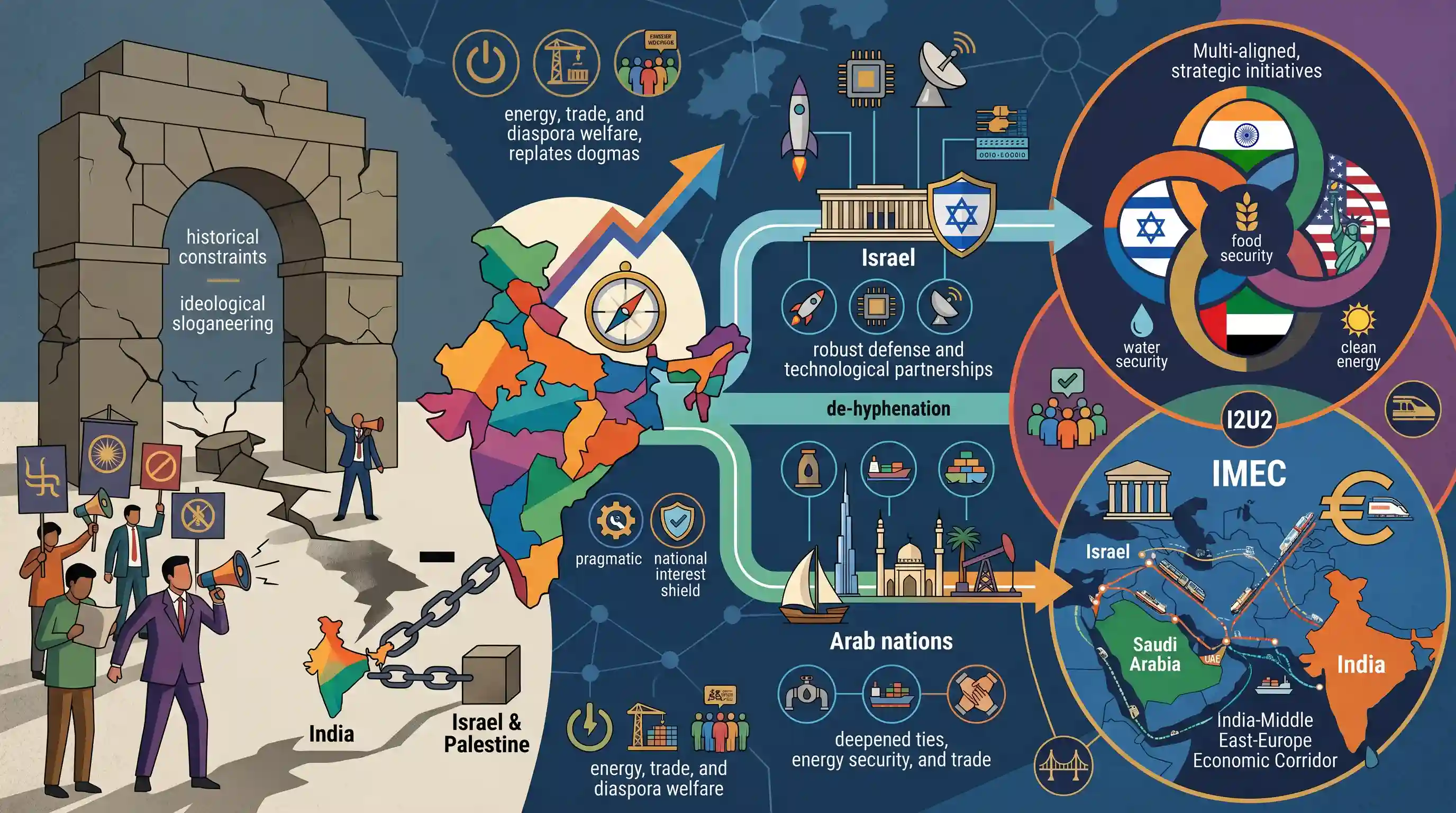
Why It Matters
Understanding the evolution of India's Middle East policy is crucial for Mains GS2, as it provides a practical example of multi-alignment, 'de-hyphenation', and balancing competing geopolitical interests. Students can cite this shift when answering questions on the I2U2 grouping, energy security, and foreign policy pragmatism.
Summary
C Raja Mohan analyzes the structural shift in India's foreign policy towards Israel and the broader Middle East. He observes that India has moved away from historical constraints and ideological sloganeering toward a diplomacy grounded in national interests and pragmatism. By 'de-hyphenating' its relationships, India has built robust defense and technological partnerships with Israel, whilst simultaneously deepening ties with key Arab nations like the UAE and Saudi Arabia. This multi-aligned approach has empowered India to participate in strategic initiatives like I2U2 and IMEC, prioritizing core interests such as energy security, trade, and diaspora welfare over outdated geopolitical dogmas.
Key Points
- India's foreign policy in the Middle East has evolved from ideological alignments and sloganeering to pragmatic, national-interest-driven diplomacy.
- India has successfully 'de-hyphenated' its relationship with Israel and Palestine, deepening strategic, technological, and defense ties with Israel while continuing to support a two-state solution for Palestine.
- India is balancing multiple poles in West Asia by strengthening ties not only with Israel but also with major Arab states like the UAE and Saudi Arabia.
- This pragmatism enables India's participation in new minilateral groupings like I2U2 and large-scale connectivity initiatives such as the India-Middle East-Europe Economic Corridor (IMEC).
- The primary drivers of this engagement are energy security, the welfare of the Indian diaspora, defense modernization, and trade opportunities.
Important Terms
De-hyphenation Policy

The diplomatic strategy of treating India's relations with Israel and Palestine as independent. It enables strategic partnership with Israel while maintaining support for the Palestinian cause based on separate merits.
UPSC context
GS Paper II (IR). Tests understanding of India's transition from ideological posturing to pragmatic, interest-based diplomacy in West Asia.
I2U2 Grouping
A strategic partnership between India, Israel, the UAE, and the USA. It focuses on joint investments in six sectors: water, energy, transportation, space, health, and food security.
UPSC context
GS Paper II (IR). Tests knowledge of new plurilateral groupings and India’s 'Look West' strategy through regional economic cooperation.
IMEC (India-Middle East-Europe Economic Corridor)
A multimodal transport network (rail and ship) connecting India to Europe via the UAE, Saudi Arabia, Jordan, and Israel. It aims to boost trade and energy connectivity.
UPSC context
GS Paper II & III. Tests knowledge of global infrastructure projects and India’s strategic alternative to China’s Belt and Road Initiative.
Look West Policy
A foreign policy framework aimed at deepening engagement with West Asian nations. It prioritizes energy security, trade, diaspora welfare, and maritime cooperation in India's extended western neighborhood.
UPSC context
GS Paper II (IR). Tests the evolution of India's regional outreach and the strategic shift toward the Gulf and Israel.
Abraham Accords
US-brokered normalization agreements (2020) between Israel and several Arab nations (UAE, Bahrain, etc.). These eased regional tensions, facilitating India’s 'multi-aligned' engagement in the Middle East.
UPSC context
GS Paper II (IR). Tests understanding of shifting geopolitical alignments in West Asia and their impact on India's diplomatic maneuverability.
Strategic Autonomy
The pursuit of an independent foreign policy where decisions are based on national interests rather than pressure from external power blocs or ideological constraints.
UPSC context
GS Paper II (IR). Tests the foundational principle of Indian diplomacy and its application in managing rival regional partnerships.
Prelims Trap
India's 'de-hyphenation' policy signifies New Delhi has officially withdrawn its support for the two-state solution for Palestine.
De-hyphenation means treating bilateral ties with Israel and Palestine independently on their own merits. India continues to officially support a negotiated two-state solution.
Static Concepts Connected
What is the I2U2 grouping and what is its primary focus?
- Members: India, Israel, United Arab Emirates, and the United States (often colloquially referred to as the West Asian Quad).
- Core Focus: Geoeconomic and technological cooperation rather than military alliance; specifically targeting joint investments in water, energy, transport, space, health, and food security.
What are the core structural components of the IMEC?
- Corridor Architecture: Comprises two distinct segments: an Eastern Corridor connecting India to the Arabian Gulf, and a Northern Corridor connecting the Gulf to Europe.
- Multimodal Network: Integrates a cross-border ship-to-rail transit network, alongside undersea digital connectivity cables and clean hydrogen export pipelines, providing an alternative to China's BRI.
Cross-Topic Patterns
Multi-alignment replacing Non-alignment
India's West Asia policy is the textbook example of its transition from ideological non-alignment to pragmatic multi-alignment, successfully managing concurrent ties with rival poles (Israel, Iran, Saudi Arabia).
Diaspora and Energy Security driving IR
The shift toward pragmatic minilateralism (like I2U2) is fundamentally anchored in geoeconomic necessities: securing crude oil flows and safeguarding the remittances of 9 million Indian expats amid regional volatility.

Expect a 2026 prelims question mapping Middle East corridors and minilaterals (IMEC, I2U2, INSTC) to their member states and objectives.
Linked PYQs · 4
Linked PYQs · 4
- 2018MainsGS2
“India’s relations with Israel have, of late, acquired a depth and diversity, which cannot be rolled back.” Discuss.
- 2022MainsGS2
How will I2U2 (India, Israel, UAE and USA) grouping transform India's position in global politics?
- 2017MainsGS2
The question of India's Energy Security constitutes the most important part of India's economic progress. Analyze India's energy policy cooperation with West Asian countries.
- 2025MainsGS2
"Energy security constitutes the dominant kingpin of India's foreign policy, and is linked with India's overarching influence in Middle Eastern countries.” How would you integrate energy security with India's foreign policy trajectories in the coming years?
