India France Strategic Partnership and Strategic Autonomy
Source:Indian Express ↗
Why It Matters
Understanding the India-France strategic partnership is crucial for UPSC aspirants as it embodies India's core foreign policy doctrine of 'strategic autonomy'. It provides a critical case study of how India engages with Western powers while resisting block-politics, which is a frequent theme in Mains GS-2 International Relations questions.
Summary
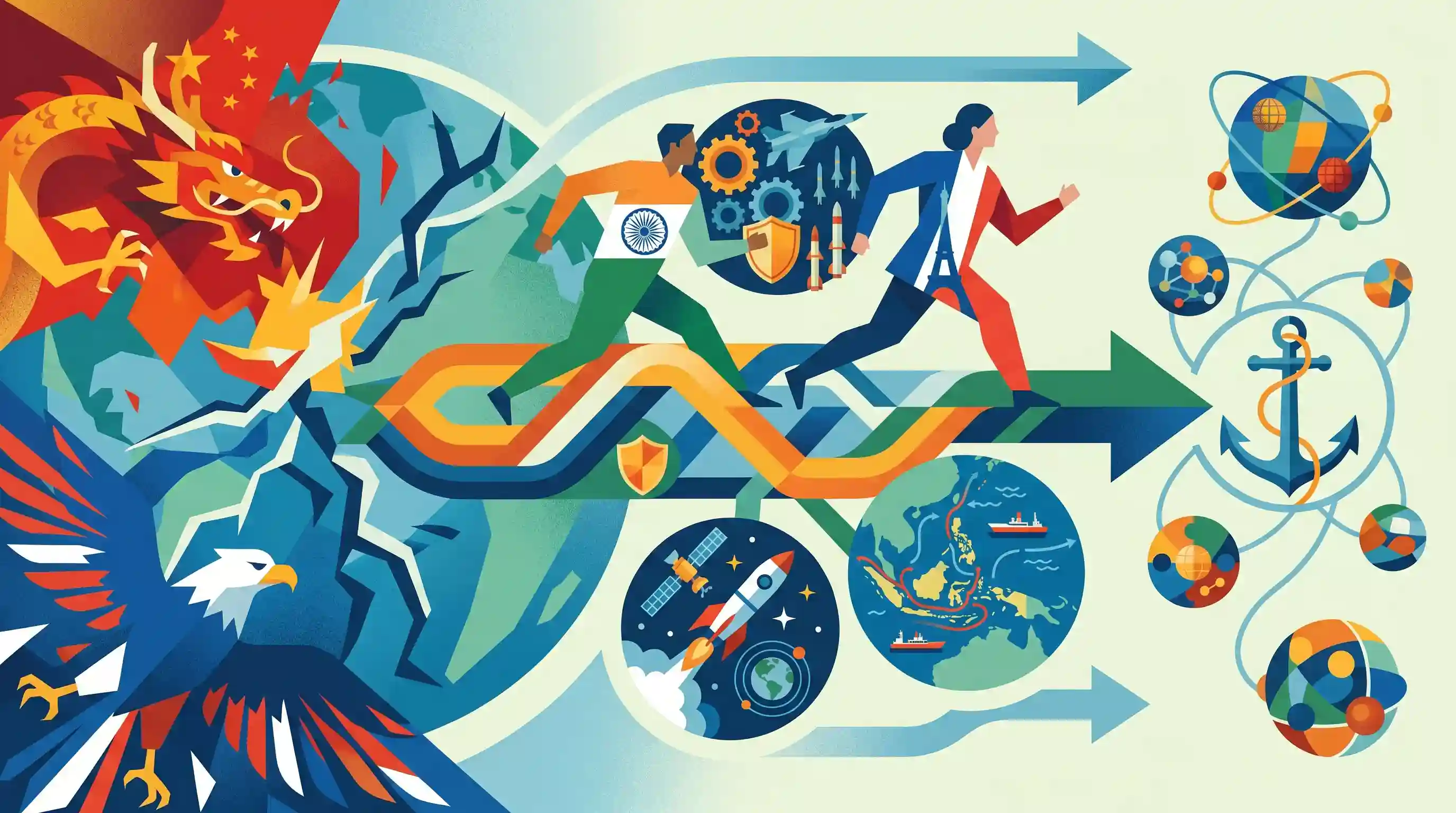
In this column, C Raja Mohan explores the strategic significance of French President Emmanuel Macron's visit to India, highlighting how New Delhi and Paris are collaboratively carving out a 'third way' in global geopolitics. Amidst the intensifying US-China rivalry and traditional East-West divides, both nations prioritize 'strategic autonomy'—France within the Western bloc and India through its multi-aligned foreign policy. Their deepening partnership across defense, space, and the Indo-Pacific serves as a stabilizing force and a model for middle-power coalitions striving to build and sustain a multipolar world order.
Key Points
- Emmanuel Macron's visit to India reinforces the robust strategic partnership between New Delhi and Paris, rooted in shared geopolitical visions.
- Both nations are actively charting a 'third way' in international relations, navigating away from the binary pressures of the US-China geopolitical rivalry.
- France's pursuit of 'strategic autonomy' within the Western alliance complements India's evolution from historical non-alignment to pragmatic multi-alignment.
- The bilateral cooperation is focused on defense integration, space exploration, and maintaining maritime security in the Indo-Pacific.
- This partnership illustrates how middle powers can collaborate to anchor a multipolar global order without being subservient to superpower hegemony.
Prelims Trap
France acts as an external observer and dialogue partner in the Indo-Pacific region.
France is an actual 'resident power' in the Indo-Pacific, not just an external observer. It holds sovereign overseas territories like Réunion and New Caledonia, granting it a massive EEZ.
Static Concepts Connected
How does Strategic Autonomy differ from traditional Non-Alignment?
- Non-Alignment: Historical stance aimed at staying out of Cold War military alliances and maintaining passive neutrality between the US and USSR.
- Strategic Autonomy: Pragmatic engagement with multiple global powers to maximize national interest without surrendering sovereign decision-making in foreign policy.
- Multi-alignment: Proactively building overlapping, issue-based coalitions (e.g., Quad, SCO, BRICS) rather than avoiding blocs altogether.
Why is France considered a 'Resident Power' in the Indo-Pacific?
- Overseas Territories: France controls Réunion, Mayotte, New Caledonia, and French Polynesia, giving it the world's second-largest Exclusive Economic Zone (EEZ).
- Military Presence: It maintains permanent military bases and active troops in both the Indian Ocean and the Pacific to secure maritime routes.
Cross-Topic Patterns
Strategic Autonomy vs. Alliance pressures
France supports India's multi-alignment (e.g., on Russia) more accommodatingly than the US, as both Paris and Delhi seek genuine multipolarity independent of Washington's hegemony.
Middle Powers buffering superpower rivalries
The India-France 'Third Way' aligns with India’s strategy of using middle-power diplomacy (like with Japan and Australia) to insulate the Global South from US-China binary politics.
Space diplomacy and the TRISHNA Mission
Strategic ties heavily rely on tech diplomacy. The ISRO-CNES joint TRISHNA mission reflects how high-trust geopolitical partnerships translate directly into critical earth-observation capabilities.

India-France 'strategic autonomy' convergence will likely feature in Mains GS2 as a contrast to the Quad or US-India relations in 2026.
Linked PYQs · 4
Linked PYQs · 4
- 2024MainsGS2
‘The West is fostering India as an alternative to reduce dependence on China's supply chain and as a strategic ally to counter China's political and economic dominance.’ Explain this statement with examples.
- 2021MainsGS2
“The USA is facing an existential threat in the form of a China, that is much more challenging than the erstwhile Soviet Union.” Explain.
- 2025MainsGS2
"With the waning of globalization, post-Cold War world is becoming a site of sovereign nationalism.” Elucidate.
- 2020MainsGS2
What is the significance of Indo-US defence deals over Indo-Russian defence deals? Discuss with reference to stability in the Indo-Pacific region.
