US Saudi Arabia Strategic Partnership and West Asian Geopolitics
Source:Indian Express ↗
Why It Matters
Provides crucial insights into the shifting balance of power in West Asia, a region central to India's energy security, remittances, and diaspora. Understanding the nuances of the US-Saudi reset is essential for answering questions on Middle Eastern geopolitics, the Abraham Accords, and India's multilateral engagements like IMEC and I2U2.
Summary
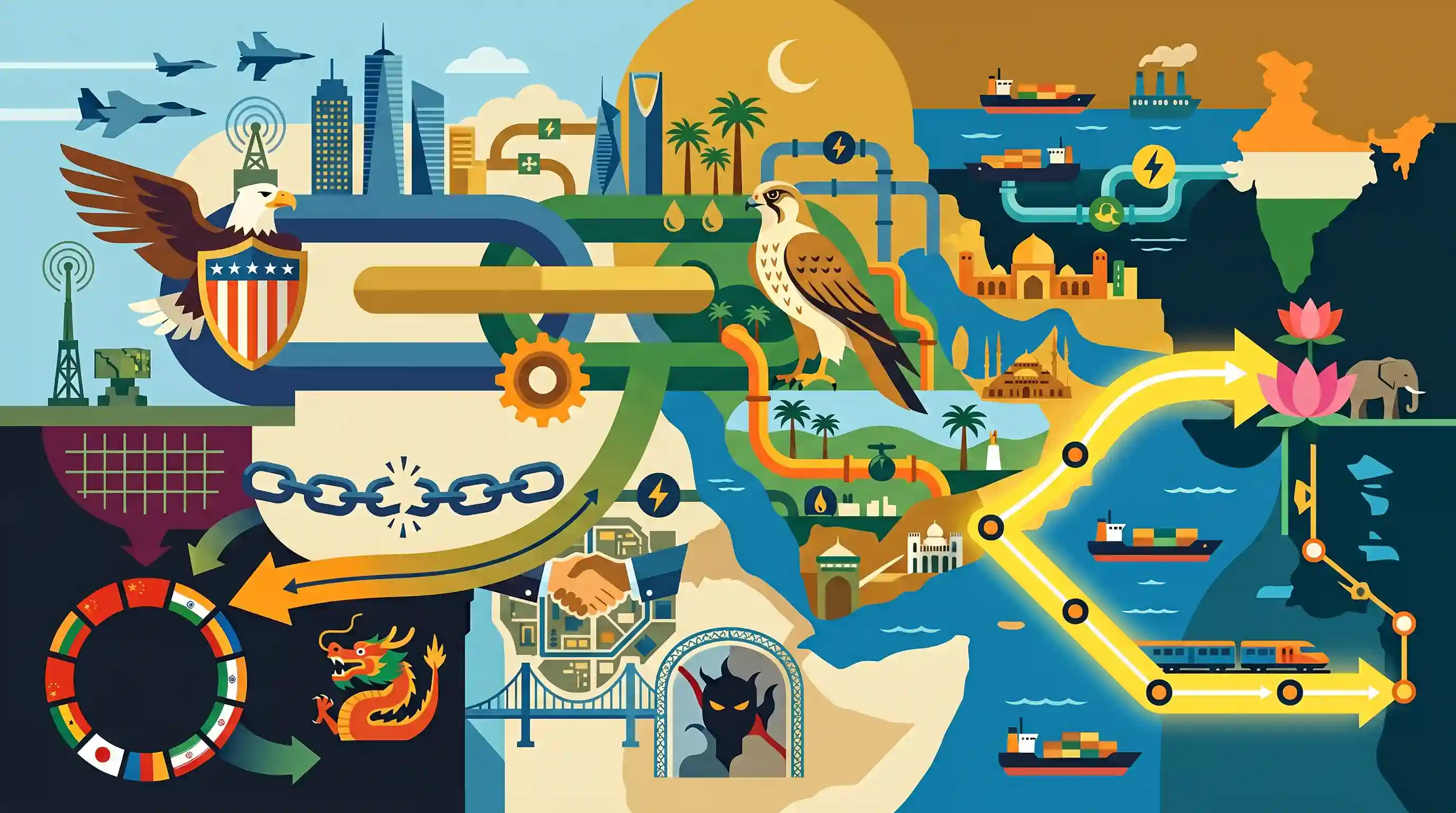
The article by C. Raja Mohan examines the evolving geopolitical dynamics between the United States and Saudi Arabia, arguing that despite recent frictions, the two nations fundamentally need each other. While the traditional 'oil-for-security' framework has weakened and Riyadh has diversified its foreign policy by engaging with China and joining BRICS, the US remains indispensable for Saudi Arabia's defense architecture. Conversely, Washington requires Saudi cooperation to stabilize global energy markets, manage Iranian influence, and foster Israel-Arab normalization. A recalibrated US-Saudi partnership is critical for broader West Asian stability, directly impacting India's energy security and its strategic connectivity projects like the India-Middle East-Europe Economic Corridor (IMEC).
Key Points
- The historically strong US-Saudi alliance, previously anchored on an 'oil-for-security' paradigm, is undergoing structural realignment due to mutual friction over human rights and a perceived US pivot away from West Asia.
- Despite strains, the two nations remain deeply interdependent: the US relies on Saudi Arabia for energy market stability and to counter Iran, while Riyadh needs the US as an irreplaceable security guarantor.
- Saudi Arabia is engaging in strategic hedging by deepening economic relations with China and joining forums like BRICS, while simultaneously mediating a Beijing-brokered detente with Iran.
- Riyadh is leveraging its geopolitical leverage to negotiate a defense pact, advanced arms, and civilian nuclear technology from the US in exchange for establishing diplomatic relations with Israel.
- A functional US-Saudi partnership and broader Middle Eastern stability are vital to India's strategic interests, particularly for energy security, safeguarding the diaspora, and advancing connectivity initiatives like IMEC and I2U2.
Important Terms
Abraham Accords

Agreements mediated by the US in 2020 to normalize diplomatic relations between Israel and several Arab states (UAE, Bahrain, Morocco, Sudan), shifting West Asian geopolitics from historical conflict toward economic and security cooperation.
UPSC context
GS Paper II (International Relations). Tests knowledge of West Asian stability, India’s 'Link West' policy, and evolving regional alliances.
India-Middle East-Europe Economic Corridor (IMEC)
A multi-modal transit corridor launched at the 2023 G20 Summit, connecting India, the Arabian Peninsula, and Europe through ship-to-rail networks to boost trade, digital connectivity, and clean energy exports.
UPSC context
GS Paper II & III (IR and Infrastructure). Key for strategic connectivity, countering China’s BRI, and diversifying trade routes.
BRICS
A grouping of major emerging economies (Brazil, Russia, India, China, South Africa) that expanded in 2024 to include Saudi Arabia and others, aimed at promoting Global South interests and a multipolar world order.
UPSC context
GS Paper II (International Institutions). Relevant for studying global power shifts, South-South cooperation, and challenges to Western-led financial systems.
I2U2 Group
A strategic partnership between India, Israel, the UAE, and the USA (the 'West Asian Quad') focused on joint investments in water, energy, transportation, space, health, and food security.
UPSC context
GS Paper II (Bilateral and Regional Groupings). Highlights India’s de-hyphenated West Asia policy and collaborative approaches to global food and energy security.
Prelims Trap
"Saudi Arabia normalized ties with Israel as a signatory to the Abraham Accords."
Saudi Arabia has NOT joined the Abraham Accords. It is merely leveraging the prospect of future diplomatic normalization with Israel to secure defense and nuclear concessions from the US.
Static Concepts Connected
What are the foundational pillars of I2U2 and IMEC?
- I2U2 Grouping: India, Israel, UAE, and USA focusing on joint investments in water, energy, transport, space, health, and food security.
- IMEC Initiative: A PGII initiative aiming to connect India, the Middle East, and Europe via rail and shipping networks to boost economic integration.
What defined the historic US-Saudi 'Oil-for-Security' paradigm?
- Quincy Agreement: Rooted in the historic 1945 Quincy Agreement between US President Franklin D. Roosevelt and Saudi King Abdul Aziz.
- The Core Exchange: The US provided a strict military security umbrella to the Saudi monarchy in exchange for stable, dollar-denominated global oil supplies (Petrodollar).
Cross-Topic Patterns
Strategic hedging vs Multi-alignment
Saudi Arabia's balancing act (China for diplomacy, US for security) mirrors India's multi-alignment strategy. This makes it a prime comparative case study for GS2 Mains on evolving middle-power diplomacy.
IMEC's geopolitical prerequisites
The India-Middle East-Europe Economic Corridor (IMEC) requires the physical and political bridging of Saudi Arabia and Israel, tying India's geo-economic ambitions directly to US-brokered regional normalization.

Expect a 2026 Prelims multi-statement question confusing I2U2, IMEC, and Abraham Accords memberships regarding Saudi Arabia and Israel.
Linked PYQs · 4
Linked PYQs · 4
- 2025MainsGS2
"Energy security constitutes the dominant kingpin of India's foreign policy, and is linked with India's overarching influence in Middle Eastern countries.” How would you integrate energy security with India's foreign policy trajectories in the coming years?
- 2017MainsGS2
The question of India's Energy Security constitutes the most important part of India's economic progress. Analyze India's energy policy cooperation with West Asian countries.
- 2022MainsGS2
How will I2U2 (India, Israel, UAE and USA) grouping transform India's position in global politics?
- 2018MainsGS2
“India’s relations with Israel have, of late, acquired a depth and diversity, which cannot be rolled back.” Discuss.
