Geopolitical Implications of Ukraine Peace Plan for India
Source:Indian Express ↗
Why It Matters
The article highlights the interconnectedness of global geopolitics. For UPSC aspirants, understanding how a conflict in Europe (and its potential resolution) directly affects India's immediate security environment vis-a-vis China and the US Indo-Pacific strategy is crucial for GS Paper 2 (International Relations).
Summary
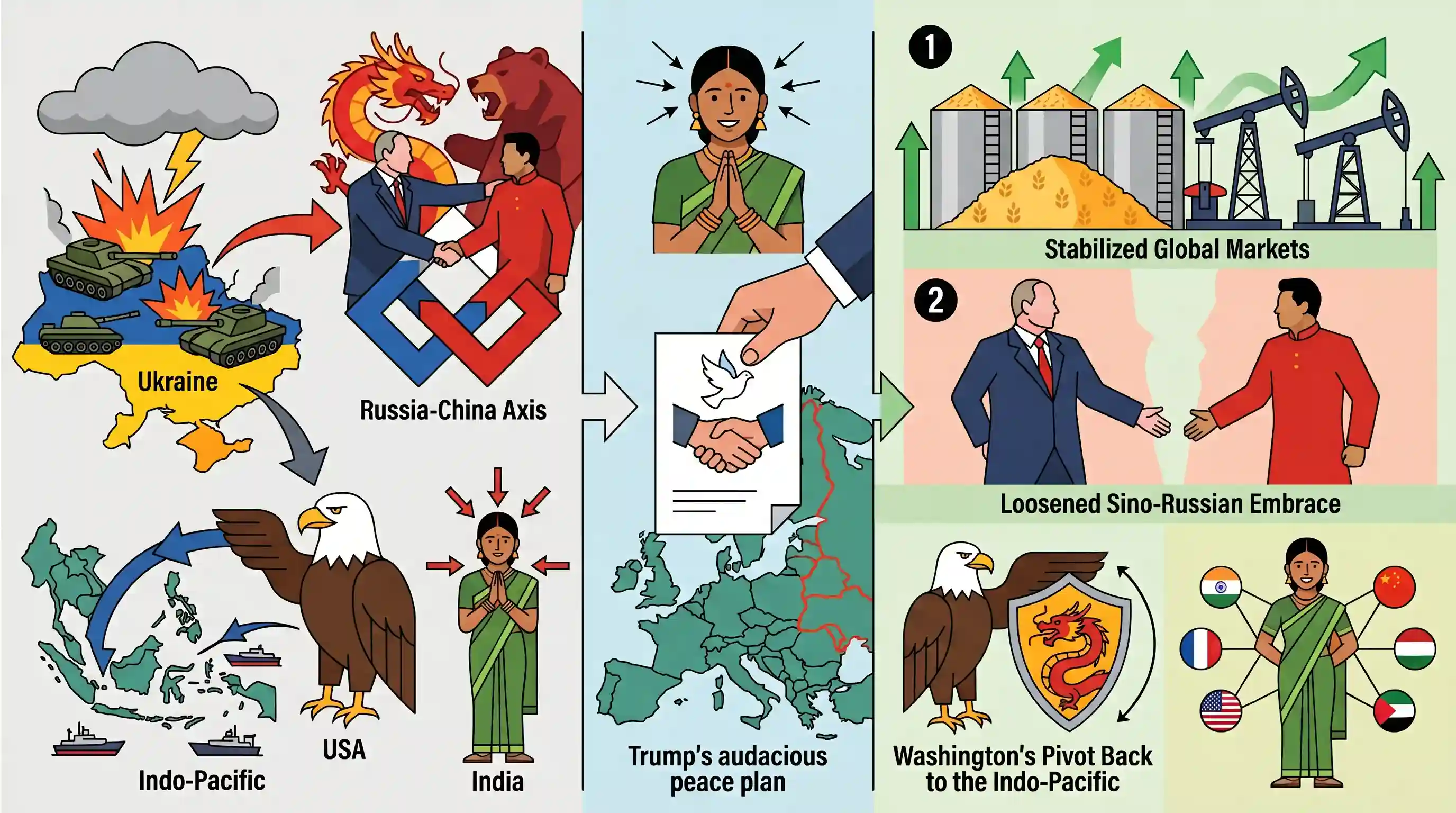
In his column, C Raja Mohan analyzes Donald Trump’s audacious peace plan for Ukraine, arguing that India has a significant stake in its success. The protracted Russia-Ukraine war has inadvertently strengthened the Russia-China axis and distracted the US from the Indo-Pacific, both of which are detrimental to India's strategic interests. A negotiated settlement would not only stabilize global energy and food markets but also loosen the Sino-Russian embrace and allow Washington to pivot its focus back to containing China in the Indo-Pacific. This outcome would alleviate Western pressure on India's ties with Moscow and perfectly align with New Delhi's long-term geopolitical calculus.
Key Points
- Trump’s peace plan involves forcing a negotiated settlement to end the Russia-Ukraine war, likely requiring difficult compromises from both sides.
- The ongoing European conflict has driven Russia into a closer strategic and economic embrace with China, which is highly problematic for India given its border tensions with Beijing.
- A successful peace deal could weaken the Sino-Russian axis by reducing Moscow's over-dependence on Beijing, restoring some strategic balance.
- Ending the war would stabilize global commodity markets (energy, food, fertilizer), easing inflationary pressures and alleviating Western pressure on India’s multi-aligned foreign policy.
- Crucially, peace in Europe allows the United States to redirect its military, economic, and diplomatic resources toward the Indo-Pacific to counter China, aligning perfectly with India’s core security interests.
Important Terms
Strategic Autonomy

India's policy of making independent foreign policy decisions based on national interest, without being constrained by external pressures or formal military alliances. It emphasizes flexibility and sovereign choice in global affairs.
UPSC context
GS Paper II: International Relations. Tests understanding of India's foundational foreign policy doctrine and its evolution in a multipolar world.
Indo-Pacific
A strategic maritime region stretching from the eastern coast of Africa to the Pacific, encompassing vital sea lanes. It is the primary theater for US-China competition and India's maritime security.
UPSC context
GS Paper II: International Relations. Crucial for questions on maritime security, QUAD, and the shifting center of global geopolitics.
Russia-China Axis
The deepening 'no-limits' strategic partnership between Moscow and Beijing, driven by shared opposition to Western dominance. This alignment complicates India's traditional defense ties with Russia while strengthening its primary rival.
UPSC context
GS Paper II: Effect of policies of developed nations. Tests analysis of how major power alignments impact India’s strategic security and defense.
NATO (North Atlantic Treaty Organization)
A 1949 intergovernmental military alliance of North American and European states committed to collective defense. Its potential eastward expansion into Ukraine is a central point of contention in the current conflict.
UPSC context
GS Paper II: International Institutions. Relevant for understanding European security architecture and its influence on global conflict dynamics.
Eurasian Geopolitics
The study of power dynamics, resource control, and territorial disputes across the vast landmass of Europe and Asia. It involves the interaction of major powers like Russia, China, and the EU.
UPSC context
GS Paper II: International Relations. Important for analyzing regional stability, connectivity projects like BRI, and India's continental interests.
Multi-alignment
A diplomatic strategy of engaging with multiple, often rival, major powers simultaneously to maximize national interest and avoid over-dependence on any single bloc. It is a modern manifestation of strategic autonomy.
UPSC context
GS Paper II: International Relations. Tests the ability to evaluate India's pragmatic engagement with the US, Russia, and China concurrently.
Prelims Trap
The Russia-China axis functions as a formal mutual defense alliance similar to NATO.
While termed a 'no-limits partnership', Moscow and Beijing do not share a formal mutual defense treaty obligating military intervention if the other is attacked.
Static Concepts Connected
What distinguishes Multi-alignment from traditional Non-Alignment?
- Core Principle: Non-alignment sought equidistance from Cold War blocs; multi-alignment seeks concurrent, issue-based partnerships to maximize national interest without ideological rigidities.
- Institutional Proof: India maintains simultaneous, active memberships in the US-led Quad as well as the China/Russia-led SCO and BRICS.
- Economic Application: Purchasing discounted Russian oil to manage domestic inflation while simultaneously increasing defense interoperability and critical tech partnerships with the US.
What are Ukraine's critical maritime and land borders?
- Land Borders: Ukraine shares land borders with Russia, Belarus, Poland, Slovakia, Hungary, Romania, and Moldova.
- Maritime Borders: It opens to the Black Sea and Sea of Azov in the south, which are crucial for global agricultural and fertilizer exports.
- Key Chokepoint: The Kerch Strait connects the Sea of Azov to the Black Sea, making it a heavily contested strategic bottleneck in the conflict.
Cross-Topic Patterns
Two-Front Risks & The US Pivot
US entanglement in Europe pulls naval and diplomatic resources away from the Indo-Pacific, creating a vacuum that China exploits along India's LAC and the broader South China Sea.
Supply Chains & Food Security
Geopolitics in the Black Sea directly affects global macroeconomic stability, linking IR directly to Indian agriculture via fertilizer supply and edible oil inflation.

Expect a GS2 Mains question linking the US Indo-Pacific pivot, the Russia-China axis, and India's multi-alignment strategy in 2026.
Linked PYQs · 3
Linked PYQs · 3
- 2024MainsGS2
‘The West is fostering India as an alternative to reduce dependence on China's supply chain and as a strategic ally to counter China's political and economic dominance.’ Explain this statement with examples.
- 2020MainsGS2
What is the significance of Indo-US defence deals over Indo-Russian defence deals? Discuss with reference to stability in the Indo-Pacific region.
- 2023PrelimsGS1
Consider the following countries: 1. Bulgaria 2. Czech Republic 3. Hungary 4. Latvia 5. Lithuania 6. Romania How many of the above-mentioned countries share a land border with Ukraine?
