Middle Powers: The Shift Towards Non-Western Global Mediation
Source:Indian Express ↗
Why It Matters
Highlights a major structural shift in global governance and international relations—specifically the rise of middle powers as active mediators. Highly relevant for GS2 Mains questions analyzing the changing global order, the declining efficacy of the UN, and India's evolving diplomatic role.
Summary
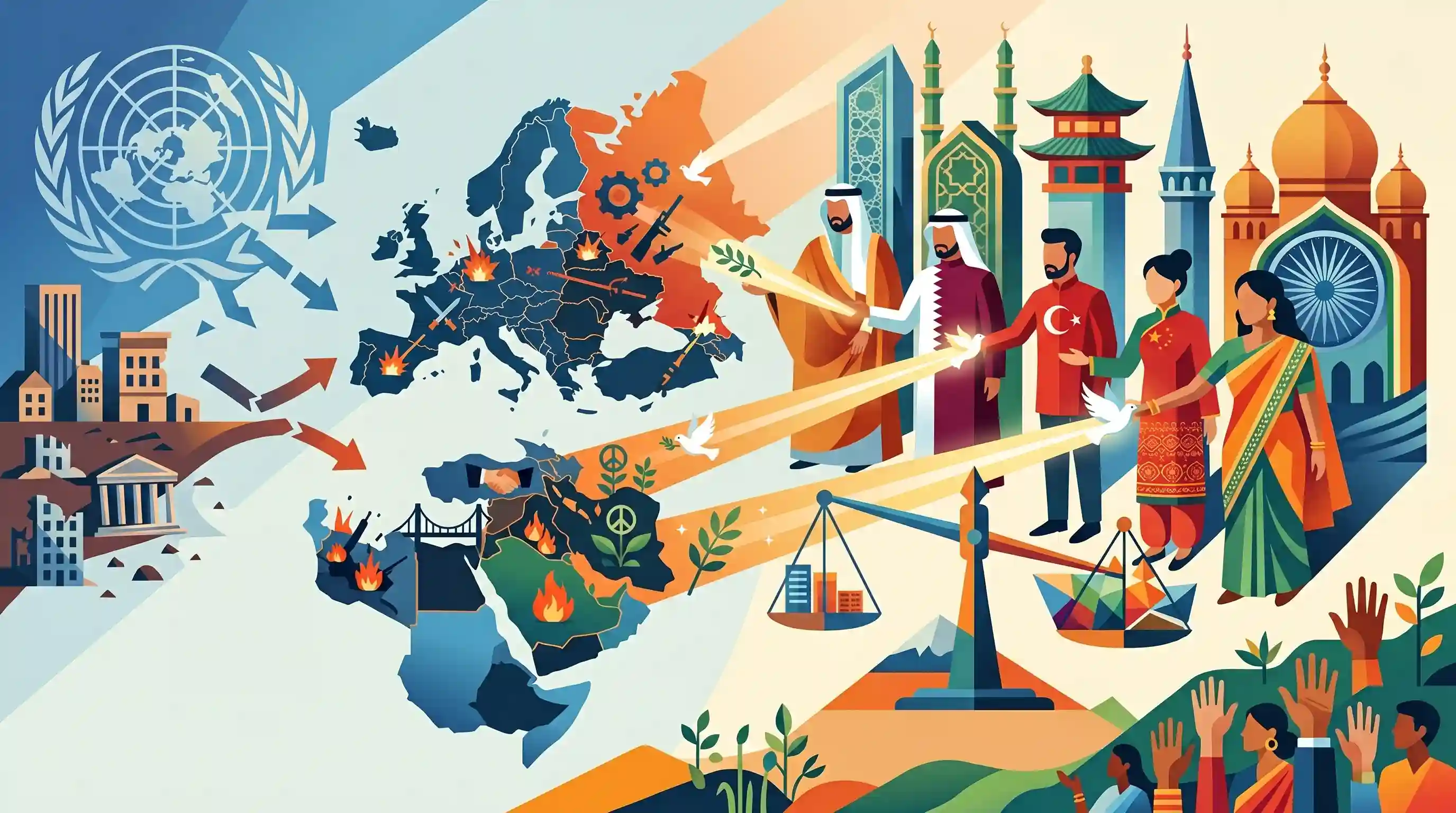
The article highlights a significant structural shift in global geopolitics: the emergence of non-Western and regional powers as active peacemakers and mediators in global conflicts. Traditionally, conflict mediation was dominated by Western nations or international organizations like the United Nations. However, nations like Saudi Arabia, Qatar, Turkey, China, and India are increasingly stepping in to negotiate ceasefires, prisoner swaps, and peace agreements, particularly evident in the Russia-Ukraine war and Middle East conflicts. This trend underscores the transition to a multipolar world order, the waning influence of Western hegemony, the ineffectiveness of a divided UN Security Council, and the growing strategic autonomy and diplomatic agency of the Global South.
Key Points
- Rise of Non-Western Mediators: Regional powers (Saudi Arabia, Qatar, Turkey) and emerging global powers (India, China) are increasingly brokering peace deals, prisoner exchanges, and safe passage agreements.
- Decline of Traditional Peacemakers: The West's monopoly on peace-building, previously led by the US and European nations like Norway and Switzerland, is visibly waning.
- Paralysis of the UN: The United Nations is increasingly marginalized in global conflict resolution due to deep polarization and veto gridlock within the UN Security Council.
- India's Strategic Role: India's balanced diplomatic stance allows it to act as a credible, independent mediator in international crises, reinforcing its stature in the emerging global order.
- Shift to Multipolarity: The trend reflects a structural shift toward a multipolar world order, where the Global South exercises greater strategic autonomy and leverages its own geopolitical capital to shape global stability.
Important Terms
Multipolarity

A global system where power is distributed among several influential states or blocs rather than dominated by one (unipolar) or two (bipolar) superpowers.
UPSC context
Tests understanding of changing world order and its impact on India's strategic space in GS Paper 2.
Global South
Developing and emerging nations in Africa, Asia, and Latin America that increasingly act as a collective voice for equitable global governance and neutral conflict mediation.
UPSC context
Relevant for GS Paper 2 topics on regional groupings and India's leadership role in South-South cooperation.
Strategic Autonomy
The capacity of a state to make sovereign foreign policy and security decisions based on national interests, free from external coercion or rigid alliance commitments.
UPSC context
A core pillar of Indian foreign policy tested under GS Paper 2 (International Relations) and Essay papers.
UN Security Council (UNSC)
A principal UN body tasked with maintaining international peace and security, holding the unique authority to issue binding resolutions, impose sanctions, and authorize force.
UPSC context
Crucial for GS Paper 2 questions on international institutions, global governance, and the demand for structural reforms.
Multi-alignment
A proactive diplomatic approach of engaging with multiple global power centers simultaneously on an issue-basis, evolving from the historical policy of non-alignment.
UPSC context
Tests the candidate's ability to analyze the evolution of India’s foreign policy in GS Paper 2.
Diplomatic Agency
The capacity and willingness of a state to take independent diplomatic initiatives and exert influence to shape international norms and resolve global conflicts.
UPSC context
Relevant for GS Paper 2 when discussing India's emerging role as a "global shaper" rather than a bystander.
Prelims Trap
"The International Organisation for Mediation is a specialized agency of the United Nations headquartered in Geneva."
It is actually a China-led initiative headquartered in Hong Kong, designed to bypass Western-dominated legal structures and institutionalize Global South mediation.
Static Concepts Connected
How does the UN Charter handle conflict resolution and why does the UNSC face gridlock?
- Chapter VI mandate: Outlines the "Pacific Settlement of Disputes," empowering the UN to use negotiation, enquiry, mediation, conciliation, and arbitration to resolve conflicts peacefully.
- Chapter VII powers: Allows the Security Council to determine threats to peace and take coercive measures, including economic sanctions or military force.
- Veto power gridlock: Under Article 27, the P5 nations hold veto power on substantive matters, leading to institutional paralysis when a P5 member is involved in or proxy to a conflict.
What defines a "Middle Power" in contemporary international relations?
- Systemic impact: While lacking superpower military dominance, they possess enough economic and diplomatic weight to alter regional balances and shape global governance structures.
- Behavioral traits: They frequently pursue multilateral solutions, embrace strategic compromise, and utilize "niche diplomacy" to act as credible mediators in conflicts.
- Strategic autonomy: They exercise independence from traditional superpower blocs, allowing them to engage with multiple rival factions simultaneously based on national interest.
Cross-Topic Patterns
From NAM to 'Vishwa Mitra' diplomacy
India is transitioning from ideological Non-Alignment (NAM) to pragmatic multi-alignment. Unlike NAM's passive distance from blocs, 'Vishwa Mitra' implies active, issue-based engagement and credible mediation across rival factions.
Gulf petrostates as strategic mediators
Gulf nations like Saudi Arabia and the UAE are leveraging their sovereign wealth and economic diversification to rebrand from mere US security dependents to independent diplomatic heavyweights and peace-brokers.

Expect Mains questions comparing India’s 'Vishwa Mitra' multi-alignment approach with China's institutionalized Global South mediation.
Linked PYQs · 3
Linked PYQs · 3
- 2025MainsGS2
"The reform process in the United Nations remains unresolved, because of the delicate imbalance of East and West and entanglement of the USA vs. Russo-Chinese alliance.” Examine and critically evaluate the East-West policy confrontations in this regard.
- 2019MainsGS2
‘The long-sustained image of India as a leader of the oppressed and marginalised nations has disappeared on account of its new found role in the emerging global order.’ Elaborate.
- 2025MainsGS2
"With the waning of globalization, post-Cold War world is becoming a site of sovereign nationalism.” Elucidate.
