US Strategic Shift and India's Foreign Policy Options in Asia
Source:Indian Express ↗
Why It Matters
Understanding the changing posture of the United States and the resulting geopolitical recalibration in Asia is crucial for analyzing India's foreign policy choices, its role in the Indo-Pacific, and strategies for counterbalancing China's dominance.
Summary
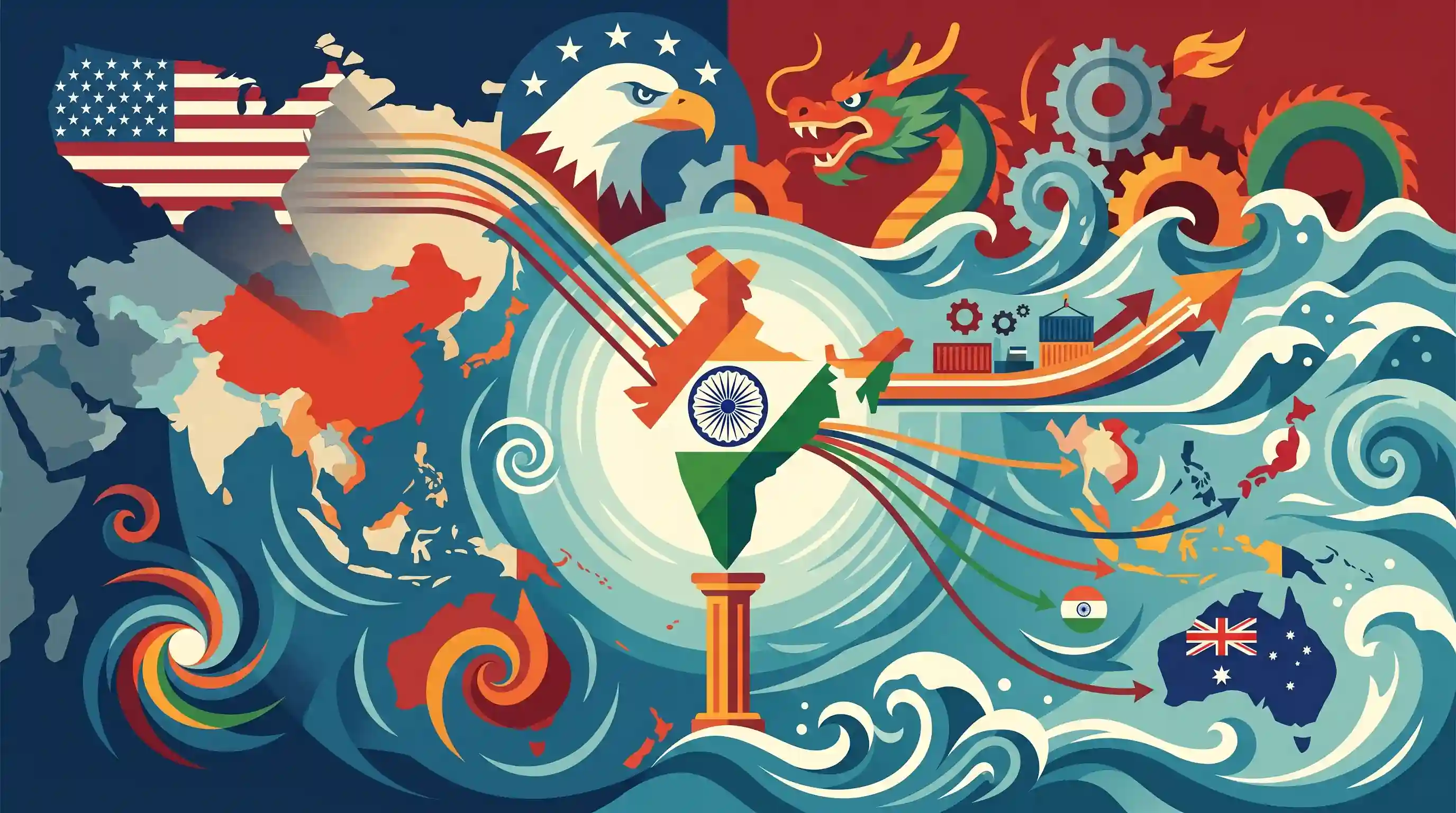
The article by C Raja Mohan explores the geopolitical ripple effects of a changing, more inward-looking United States on the Asian continent and outlines India's strategic imperatives. As the US recalibrates its global commitments and competition with China intensifies, Asian nations are experiencing significant strategic churn. For India, this evolving landscape demands a pragmatic path: extracting optimal value from its partnership with the US, establishing itself as a credible economic alternative to China, and reinforcing ties with Indo-Pacific middle powers to anchor regional stability while preserving its strategic autonomy.
Key Points
- The United States is undergoing domestic shifts, leading to a "New America" that leans towards protectionism and a more transactional, interest-driven foreign policy.
- This US posture induces strategic churn in Asia, compelling regional countries to recalibrate their security and economic strategies amidst the intensifying US-China rivalry.
- India must navigate this landscape by leveraging its strategic partnership with the US for technological and defense advancements while strictly maintaining its strategic autonomy.
- To stabilize the region, India needs to deepen alignments with other Asian middle powers and capitalize on its position as a supply chain alternative to China.
Important Terms
Quad (Quadrilateral Security Dialogue)

An informal strategic forum comprising India, the US, Japan, and Australia, dedicated to maintaining a "free, open, and inclusive" Indo-Pacific through cooperation on maritime security, technology, and health.
UPSC context
GS Paper II: International Relations. Tests understanding of regional groupings and India’s role in countering Chinese assertiveness.
Strategic Autonomy
India’s foreign policy pillar of making independent decisions based on national interest, avoiding formal military alliances while engaging multiple powers to maintain diplomatic flexibility.
UPSC context
GS Paper II: India’s Foreign Policy. Evaluates the evolution of non-alignment into pragmatic, multi-aligned diplomacy.
Indo-Pacific
A geostrategic construct viewing the Indian and Pacific Oceans as a single interconnected space, emphasizing maritime security, freedom of navigation, and rules-based order.
UPSC context
GS Paper II & III: International Relations and Security. Tests knowledge of the primary theater for modern great-power competition.
ASEAN Centrality
The recognition of the Association of Southeast Asian Nations (ASEAN) as the core driver and institutional hub for regional cooperation in the Indo-Pacific.
UPSC context
GS Paper II: Regional Groupings. Important for India’s "Act East" policy and regional stability frameworks.
Middle Powers
Countries with significant diplomatic and economic influence (e.g., Japan, South Korea, Australia) that act as regional stabilizers and potential partners for India in a multipolar world.
UPSC context
GS Paper II: Global Geopolitics. Tests the ability to analyze shifts toward multipolarity and diverse strategic partnerships.
Shangri-La Dialogue
Asia’s premier annual defense summit in Singapore where defense ministers and military chiefs discuss security challenges, mentioned as a site for US-Asia policy recalibration.
UPSC context
GS Paper II: International Events. Relevant for tracking regional defense diplomacy and security architectures.
Prelims Trap
The Quad framework acts as a formal mutual defense military alliance analogous to NATO in the Indo-Pacific region.
The Quad is exclusively a diplomatic and strategic minilateral dialogue. It has no mutual defense pact or treaty obligations, unlike NATO's Article 5.
Static Concepts Connected
How does India's 'Strategic Autonomy' differ from its historical 'Non-Alignment'?
- Non-Alignment (NAM): Maintained distance from Cold War blocs, emphasizing ideological neutrality and anti-imperialism.
- Strategic Autonomy: Involves issue-based alignments where India actively engages multiple, sometimes opposing, powers (e.g., US and Russia) to maximize national interests without formal military treaties.
- Minilateral Engagement: While NAM leaned towards non-participation in bloc structures, strategic autonomy embraces fluid minilateral groupings like Quad, I2U2, and SCO simultaneously.
What defines a 'Middle Power' in contemporary Indo-Pacific geopolitics?
- Definition: Sovereign states that are not superpowers but possess sufficient economic and diplomatic influence to shape regional architecture (e.g., Japan, Australia, South Korea).
- Behavior: They traditionally act as systemic stabilizers, preferring multilateralism, coalition-building, and norm-setting to mitigate superpower rivalry.
- India's Hedging: India actively partners with these powers to ensure a "multipolar Asia," preventing a unipolar hegemony by any single nation (specifically China) in the Indo-Pacific.
Cross-Topic Patterns
China Plus One + Strategic Supply Chains
India's domestic economic strategies (like PLI schemes) to attract "China Plus One" manufacturing directly complement its geopolitical alignment with Indo-Pacific middle powers to secure critical supply chains.
US Protectionism + WTO Crisis
A transactional, inward-looking US mirrors the broader crisis in the WTO's dispute settlement mechanism. This global protectionist wave forces India to rely more on bilateral FTAs (like UAE, Australia).

Expect a GS-II Mains question in 2026 assessing how an inward-looking US impacts India's "middle power" diplomacy in the Indo-Pacific.
Linked PYQs · 3
Linked PYQs · 3
- 2024MainsGS2
‘The West is fostering India as an alternative to reduce dependence on China's supply chain and as a strategic ally to counter China's political and economic dominance.’ Explain this statement with examples.
- 2020MainsGS2
What is the significance of Indo-US defence deals over Indo-Russian defence deals? Discuss with reference to stability in the Indo-Pacific region.
- 2019MainsGS2
‘What introduces friction into the ties between India and the United States is that Washington is still unable to find for India a position in its global strategy, which would satisfy India's national self-esteem and ambitions.’ Explain with suitable examples.
