India and US tech diplomacy and global AI governance models
Source:Indian Express ↗
Why It Matters
This article is crucial for UPSC aspirants as it bridges GS Paper 2 (International Relations) and GS Paper 3 (Science & Technology). The evolving geopolitics of emerging technologies (like AI and semiconductors) is increasingly replacing traditional strategic metrics. Understanding India's 'Tech Diplomacy' and its positioning as a leader of the Global South in contrast to US technological nationalism provides vital analytical points for Mains answers on global governance and bilateral relations.
Summary
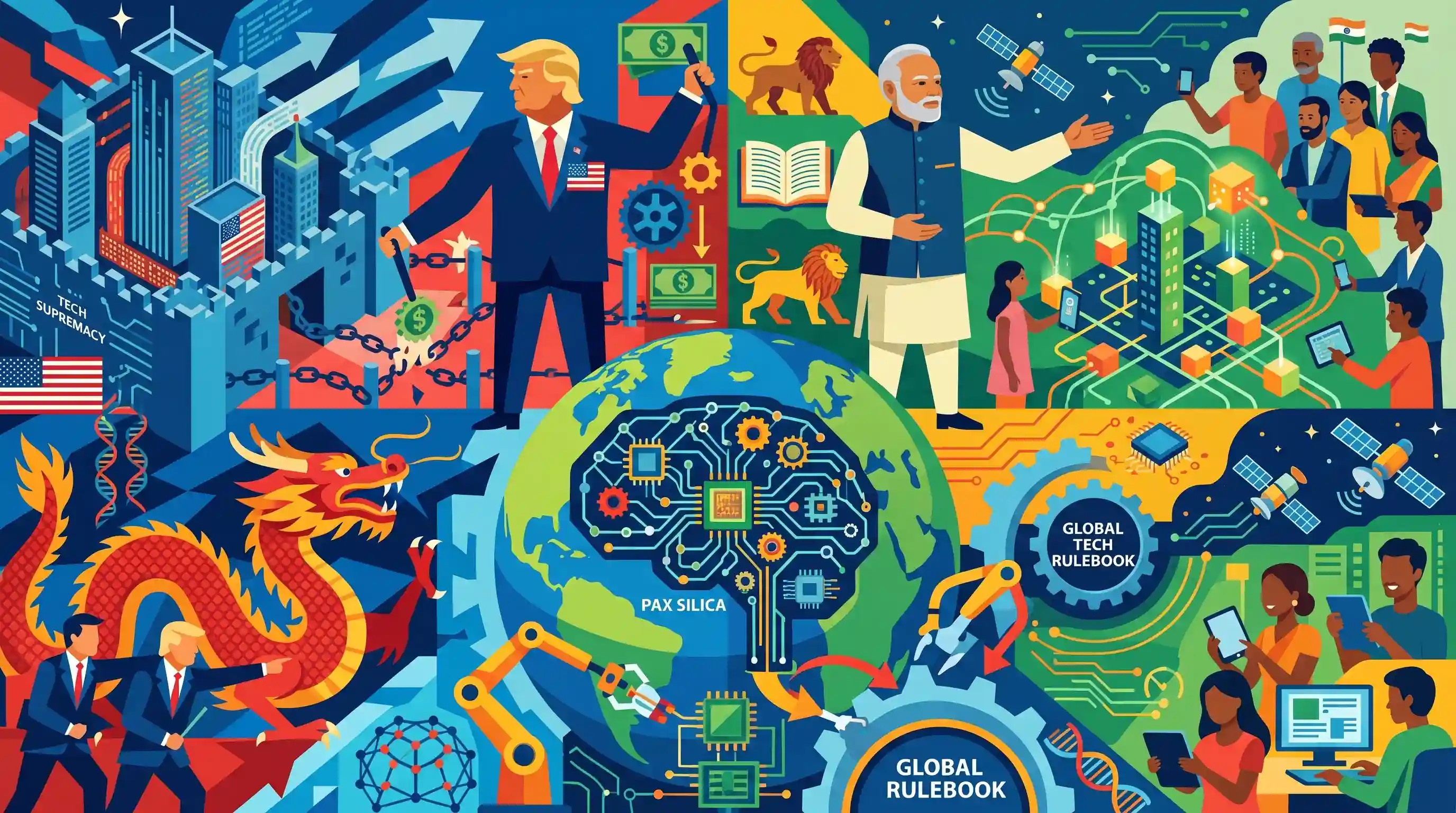
The article by C. Raja Mohan explores the emergence of 'Pax Silica', a new geopolitical order shaped by Artificial Intelligence and semiconductors, and how the US and India are steering global tech governance. While Donald Trump's approach focuses on 'America First' tech supremacy, deregulation, and countering China, Prime Minister Narendra Modi champions the 'Delhi Pivot', advocating for democratized AI, Digital Public Infrastructure (DPI), and inclusive technology for the Global South. Together, these divergent strategies are fundamentally rewriting the global rulebook on AI, illustrating how technology policy has become a central pillar of international relations and global diplomacy.
Key Points
- The global order is transitioning into an era of 'Pax Silica', where semiconductors and Artificial Intelligence determine geopolitical power and strategic autonomy.
- The US approach to AI, especially under Donald Trump, centers on technological supremacy, deregulation, 'America First' policies, and aggressive competition with geopolitical rivals like China.
- India's strategy, termed the 'Delhi Pivot', emphasizes inclusive growth, promoting 'AI for All', and leveraging Digital Public Infrastructure (DPI) to ensure the Global South benefits from the AI revolution.
- Despite their contrasting philosophies—US prioritizing dominance and corporate innovation versus India focusing on democratized access and equitable governance—both nations are instrumental in rewriting the global AI rulebook.
- The intersection of technology and foreign policy is deepening, making tech diplomacy a critical component of international relations and global governance architectures.
Important Terms
Pax Silica

A US-led initiative aimed at securing semiconductor and AI supply chains—from critical minerals to compute—to ensure technological supremacy and reduce dependence on China.
UPSC context
GS2/IR: Developed country policies affecting India; GS3: Science & Tech/Semiconductor geopolitics.
Digital Public Infrastructure (DPI)
A set of shared, interoperable digital platforms (e.g., Aadhaar, UPI) built on open standards to deliver population-scale public services and drive inclusive economic growth.
UPSC context
GS2/Governance: E-governance; GS3: Economy and India’s global leadership in digital public goods.
IndiaAI Mission
A ₹10,372 crore national initiative to build sovereign AI capacity through 10,000+ GPUs, indigenous foundational models, and a unified dataset platform for startups.
UPSC context
GS3/Science & Tech: Awareness in AI and national missions for technological sovereignty.
Global Partnership on Artificial Intelligence (GPAI)
An international multi-stakeholder alliance promoting human-centric and responsible AI development; India served as the Lead Chair in 2024.
UPSC context
GS2/IR: Global groupings involving India; International tech governance and regulatory norms.
Global South
Developing nations in Asia, Africa, and Latin America sharing histories of colonization; India positions itself as their primary advocate in global forums.
UPSC context
GS2/IR: India's strategic role as a representative of emerging and developing nations.
Prelims Trap
"Pax Silica refers to international agreements regulating silica sand mining and critical minerals."
'Pax Silica' is a geopolitical term describing an era where power is determined by control over semiconductors (silicon chips) and AI, not raw material mining.
Static Concepts Connected
What is the Global Partnership on Artificial Intelligence (GPAI)?
- Origin & Secretariat: Launched in 2020, it is an international initiative supported by a Secretariat hosted at the OECD in Paris.
- India's Role: India is a founding member of GPAI and recently assumed its Chair, using the platform to promote its inclusive 'AI for All' vision.
- Core Mandate: Aims to bridge the gap between theory and practice on AI by supporting cutting-edge research, applied activities, and human-centric AI governance.
What is the India-US Initiative on Critical and Emerging Technology (iCET)?
- NSC Led: It is uniquely spearheaded by the National Security Councils (NSC) of both India and the US, elevating technology to a supreme strategic and security priority.
- Focus Areas: Facilitates joint development and standard-setting in AI, quantum computing, semiconductors, 6G, space, and defense innovation.
- Strategic Objective: Aims to build open, secure, and accessible technology ecosystems, fundamentally reducing reliance on China's supply chains.
Cross-Topic Patterns
DPI as Digital Soft Power vs BRI
India's export of DPI (UPI, MOSIP) to the Global South is increasingly positioned in IR as a transparent, democratic digital alternative to China's debt-heavy Belt and Road Initiative (BRI) infrastructure.
Tech Diplomacy in Quad and G20
The 'Delhi Pivot' connects technology standard-setting with strategic groupings like the Quad and G20, illustrating how technology governance and supply-chain resilience are now core pillars of modern foreign policy architectures.

Expect a 2026 multi-statement Prelims question merging the iCET framework, India's GPAI leadership, and DPI exports to the Global South.
Linked PYQs · 3
Linked PYQs · 3
- 2023MainsGS3
Introduce the concept of Artificial Intelligence (AI). How does Al help clinical diagnosis? Do you perceive any threat to privacy of the individual in the use of Al in healthcare?
- 2025MainsGS2
India-Africa digital partnership is achieving mutual respect, co-development and long-term institutional partnerships. Elaborate.
- 2019MainsGS2
‘What introduces friction into the ties between India and the United States is that Washington is still unable to find for India a position in its global strategy, which would satisfy India's national self-esteem and ambitions.’ Explain with suitable examples.
