America First agenda shapes contemporary United States global strategy
Source:Indian Express ↗
Why It Matters
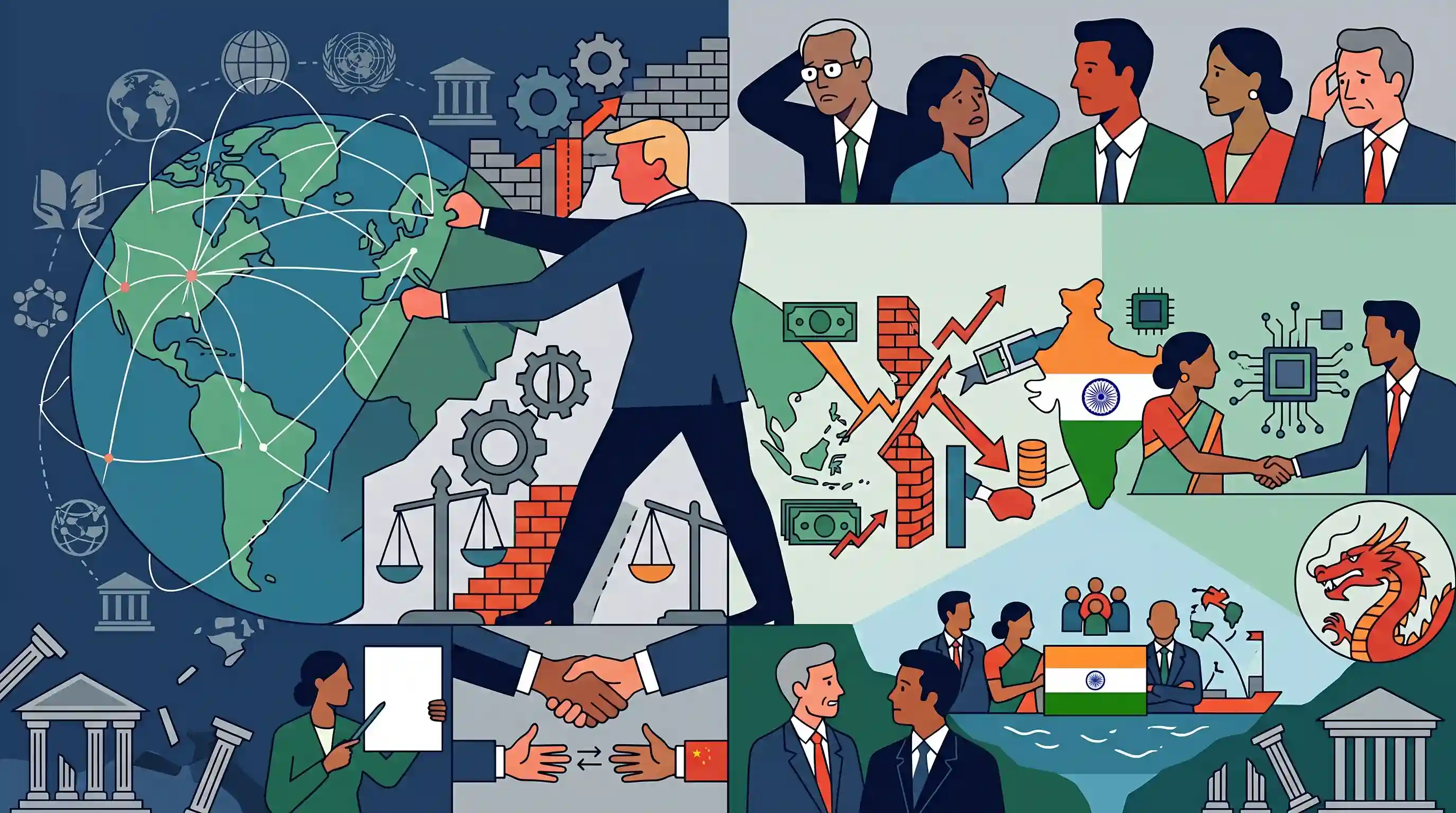
The structural shift in US foreign policy from liberal internationalism to 'America First' transactionalism profoundly impacts global geopolitics. For UPSC aspirants, analyzing this shift is essential to understand how India must recalibrate its diplomatic, economic, and strategic posture to protect its national interests and leverage new bilateral opportunities.
Summary
In this column, C. Raja Mohan argues that the 'Make America Great Again' (MAGA) framework is no longer an anomaly but the new consensus driving America’s global strategy. The United States is shifting away from its role as the anchor of liberal hegemony and globalization, leaning instead into economic protectionism, transactional bilateralism, and 'America First' nationalism. The article highlights that traditional allies and partners must adjust to a Washington that evaluates international commitments through a strict cost-benefit analysis. For India, this structural shift requires navigating trade frictions while capitalizing on convergent geopolitical interests, particularly concerning technological cooperation and balancing China in the Indo-Pacific.
Key Points
- The 'Make America Great Again' (MAGA) agenda has transitioned from a domestic political slogan to the structural foundation of America's contemporary global strategy, marking a departure from post-Cold War liberal internationalism.
- US foreign policy is increasingly defined by transactional diplomacy, economic nationalism, and a retreat from unfettered globalization, often prioritizing domestic industrial capacity over multilateral trade consensus.
- Traditional security alliances (such as NATO) are being recalibrated, with Washington demanding greater burden-sharing from its partners and evaluating relationships through a strict cost-benefit lens.
- For India, this shift means adapting to a more self-interested America. While values-based rhetoric may decline, opportunities exist for India to forge pragmatic defense and technology partnerships if it aligns with the US's strategic competition with China.
Important Terms
Make America Great Again (MAGA)

A populist political movement advocating for American nationalism, anti-globalism, and protectionism. It seeks to prioritize domestic interests over the international 'liberal hegemony' and globalist institutional commitments.
UPSC context
GS Paper II (IR); tests understanding of how major-power domestic political movements reshape global strategy and Indian foreign policy.
America First Doctrine
A foreign policy framework emphasizing U.S. national interests, economic self-sufficiency, and unilateralism. It involves a strategic shift away from multilateral globalism, international treaties, and traditional alliance structures.
UPSC context
GS Paper II (Policies of developed countries); tests analysis of shifts from multilateralism to protectionism affecting India's interests.
Transactional Bilateralism
A diplomatic approach prioritizing short-term, issue-specific 'deals' between two nations over rules-based multilateral systems. It treats international relations as commercial transactions rather than value-based long-term partnerships.
UPSC context
GS Paper II (International Relations); relevant for analyzing India-U.S. strategic and trade negotiations in a post-globalization era.
World Trade Organization (WTO)
An international body governing global trade rules. It faces an existential crisis due to rising protectionism and the paralysis of its Appellate Body for dispute settlement.
UPSC context
GS Paper II (International Institutions) & GS Paper III (Trade); tests knowledge of challenges to the global rules-based order.
NATO (North Atlantic Treaty Organization)
A collective defense alliance between North American and European states. It is under strain as the U.S. demands higher 'burden-sharing' and evaluates commitments through cost-benefit analysis.
UPSC context
GS Paper II (Global Groupings); tests understanding of evolving security architectures and implications for India's multi-alignment strategy.
Prelims Trap
The 'America First' doctrine represents a complete US return to isolationism and withdrawal from Asia.
Aspirants confuse transactionalism with isolationism. The US remains deeply engaged in the Indo-Pacific (e.g., Quad, iCET) to contain China, but solely on pragmatic, cost-benefit terms rather than values-based alliances.
Static Concepts Connected
What led to the paralysis of the WTO Dispute Settlement Mechanism?
- Appellate Body blockage: The US has systematically blocked the appointment of new judges to the Appellate Body since 2019, rendering the two-tier dispute resolution system defunct.
- National Security exceptions: Rising use of GATT Article XXI by the US to justify protectionist tariffs (e.g., on steel/aluminum) without WTO interference, claiming national security.
- Shift to bilateralism: A structural shift away from consensus-based multilateral rule-making toward unilateral market leverage and transactional bilateral trade deals.
What are the core focus areas of the India-US iCET framework?
- Strategic alignment: It shifts bilateral focus from contentious trade to geopolitical technology partnerships, elevating technology as a core tool of statecraft.
- Key domains: Focuses on joint development in AI, quantum computing, space exploration, 6G, and semiconductor supply chains to reduce dependence on China.
- Defense innovation: Integrates defense industrial ecosystems via INDUS-X, aiming for co-production of critical weapons platforms rather than mere buyer-seller dynamics.
Cross-Topic Patterns
Trade protectionism vs. Defense ties
India's 'Atmanirbhar Bharat' and the US 'America First' naturally clash on trade tariffs, yet both states bypass this friction via defense pacts (like iCET) to jointly counter China.
De-globalization and Multilateral decay
The US retreat from liberal hegemony accelerates the decline of institutions like the WTO, shifting the global economic order toward selective minilateralism and friend-shoring.

Expect a 2026 GS2 Mains question on how India must balance US transactional protectionism in trade with strategic defense convergence.
Linked PYQs · 4
Linked PYQs · 4
- 2019MainsGS2
‘What introduces friction into the ties between India and the United States is that Washington is still unable to find for India a position in its global strategy, which would satisfy India's national self-esteem and ambitions.’ Explain with suitable examples.
- 2020MainsGS2
What is the significance of Indo-US defence deals over Indo-Russian defence deals? Discuss with reference to stability in the Indo-Pacific region.
- 2023MainsGS2
‘The expansion and strengthening of NATO and a stronger US-Europe strategic partnership works well for India.’ What is your opinion about this statement ? Give reasons and examples to support your answer.
- 2025MainsGS2
"The reform process in the United Nations remains unresolved, because of the delicate imbalance of East and West and entanglement of the USA vs. Russo-Chinese alliance.” Examine and critically evaluate the East-West policy confrontations in this regard.
