Strategic Shift in India Regional Foreign Policy
Source:Indian Express ↗
Why It Matters
Understanding the shift in India's foreign policy priorities—from a localized conflict with Pakistan to managing a rising superpower (China) in the Indo-Pacific—is crucial for GS Paper 2 (International Relations). It provides a framework for analyzing India's engagement with the Quad, its Neighborhood First policy, and the strategic importance of maritime security.
Summary
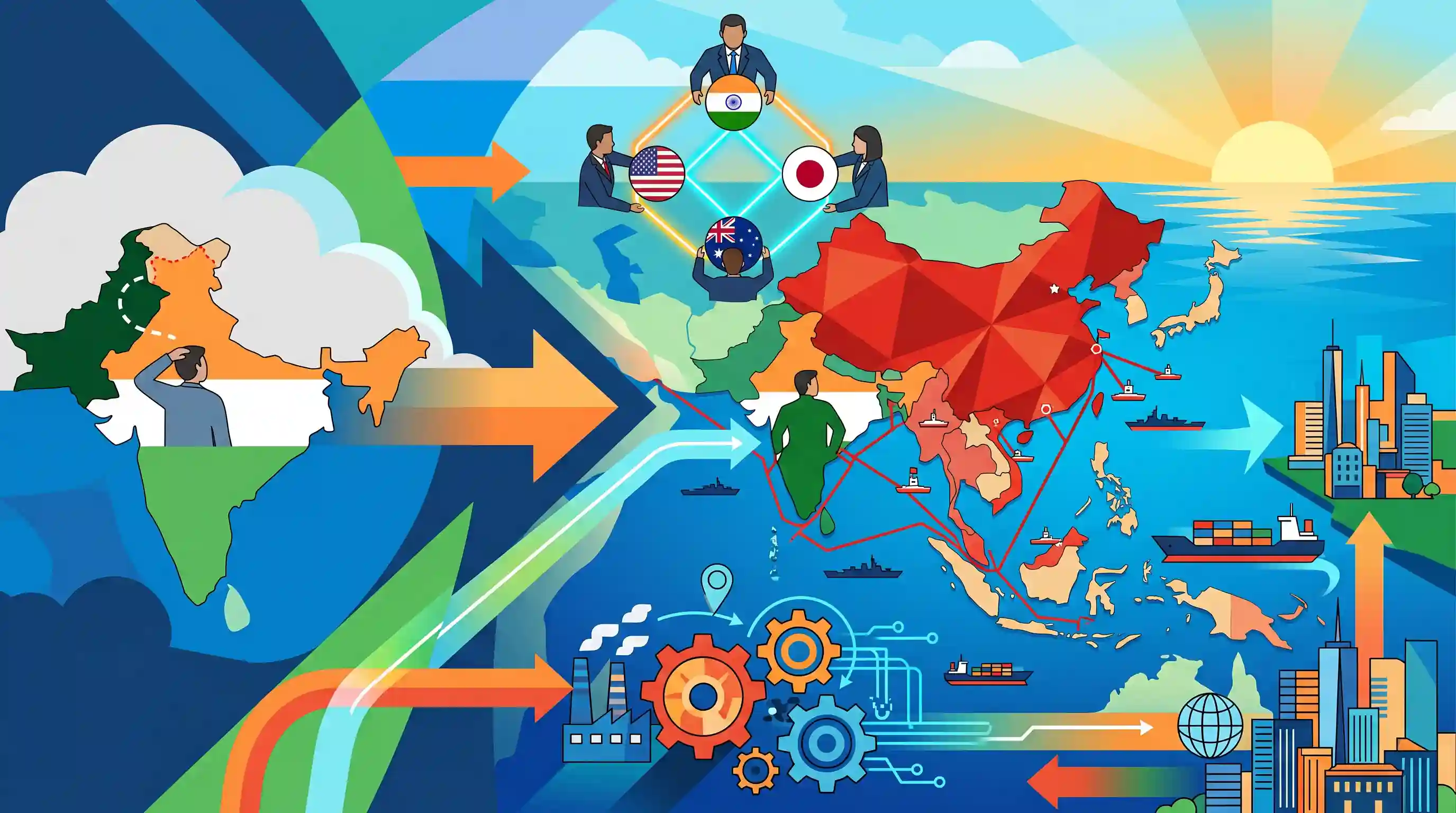
In this opinion piece, C Raja Mohan argues that India's strategic focus must transcend its historical preoccupation with Pakistan. The contemporary geopolitical landscape demands that India addresses the far more significant challenge posed by China's rise and its expanding footprint in South Asia and the Indian Ocean Region. To manage this challenge, India must shift from an exclusively continental security mindset to a maritime one, embracing the Indo-Pacific framework. By deepening its engagement with minilateral groupings like the Quad and fostering strategic and economic partnerships with the West, India can position itself as a viable alternative to China and secure its interests in the region.
Key Points
- India's strategic outlook must definitively pivot away from the historical 'India-Pakistan hyphenation' towards managing the larger geopolitical shifts in Asia.
- The principal strategic challenge for India has shifted from a continental threat (Pakistan) to a comprehensive continental and maritime challenge posed by an assertive China in South Asia and the Indian Ocean Region.
- India is increasingly relying on the Indo-Pacific construct and minilateral forums like the Quad to balance China's expanding political and economic footprint in the Global South.
- Deeper integration with Western supply chains and strategic alliances is essential for India to build its domestic capabilities and act as a credible alternative to China.
Important Terms
Quad (Quadrilateral Security Dialogue)

An informal strategic dialogue between India, the USA, Japan, and Australia aimed at ensuring a "free, open, and inclusive" Indo-Pacific region and countering regional hegemony.
UPSC context
GS Paper II (International Relations); tests understanding of global groupings and India’s role in regional security and balancing power.
SAGAR (Security and Growth for All in the Region)
India's strategic vision for the Indian Ocean Region (IOR), emphasizing maritime cooperation, security, and sustainable "blue economy" growth while positioning India as a net security provider.
UPSC context
GS Paper II; critical for topics on maritime security, India's neighborhood, and strategic outreach in the IOR.
Neighborhood First Policy
India’s foreign policy priority to strengthen relations with its immediate neighbors through enhanced connectivity, infrastructure development, and economic cooperation to ensure regional stability.
UPSC context
GS Paper II; fundamental to "India and its Neighborhood" and managing external influences like China in South Asia.
Indo-Pacific Framework
A geopolitical construct linking the Indian and Pacific Oceans, serving as a pivot for global trade and a focus for India's maritime security strategy.
UPSC context
GS Paper II; central to modern Indian foreign policy, maritime strategy, and regional power dynamics.
ASEAN (Association of Southeast Asian Nations)
A 10-member regional organization in Southeast Asia that serves as the central pillar of India's Act East Policy and its broader Indo-Pacific architecture.
UPSC context
GS Paper II; tests knowledge of regional groupings and India's economic and strategic integration with Southeast Asia.
Minilateralism
A diplomatic approach involving small, flexible, and issue-specific coalitions (like Quad or I2U2) designed to achieve focused outcomes more quickly than traditional large-scale multilateralism.
UPSC context
GS Paper II; highlights evolving trends in global diplomacy and India's shift toward agile strategic partnerships.
Prelims Trap
The Quad is a formal multilateral military alliance structured to contain China.
The Quad is an informal 'minilateral' strategic dialogue, not a formal multilateral treaty or a binding military alliance like NATO, despite its Indo-Pacific security focus.
Static Concepts Connected
What are the core pillars of India's SAGAR doctrine?
- Security provision: Acting as a 'Net Security Provider' in the Indian Ocean Region through capacity building, coastal radar chains, and joint patrols.
- Economic integration: Fostering sustainable regional development, connectivity, and 'Blue Economy' initiatives with island and littoral nations.
- Collective action: Resolving maritime disputes peacefully under UNCLOS and collectively combating non-state threats like piracy and illegal fishing.
How does Minilateralism differ from traditional Multilateralism?
- Membership scope: Minilaterals (e.g., Quad, I2U2) involve small, targeted groups rather than broad, universal memberships (e.g., UN, WTO).
- Flexibility: They are informal, issue-specific, and non-binding, allowing for faster consensus and bypassing institutional gridlocks or vetoes.
- Core objective: Often formed for ad-hoc strategic alignment or functional cooperation rather than establishing global legal regimes.
Cross-Topic Patterns
Indo-Pacific + Supply Chain Resilience
India's maritime pivot links defense to geoeconomics, leveraging the Quad and 'China-Plus-One' to build alternative, resilient supply chains away from Beijing's control.
String of Pearls vs SAGAR
China's continental and maritime encirclement (BRI/String of Pearls) directly forces India to counter-mobilize through the SAGAR doctrine and strategic island partnerships (Mauritius, Seychelles).

Mains 2026 will likely feature a question evaluating India's strategic transition from a continental focus to maritime minilateralism.
Linked PYQs · 3
Linked PYQs · 3
- 2024MainsGS2
‘The West is fostering India as an alternative to reduce dependence on China's supply chain and as a strategic ally to counter China's political and economic dominance.’ Explain this statement with examples.
- 2014MainsGS2
With respect to the South China sea, maritime territorial disputes and rising tension affirm the need for safeguarding maritime security to ensure freedom of navigation and over flight throughout the region. In this context, discuss the bilateral issues between India and China.
- 2020MainsGS2
What is the significance of Indo-US defence deals over Indo-Russian defence deals? Discuss with reference to stability in the Indo-Pacific region.
