India US Relations under Transactional Diplomacy
Source:Indian Express ↗
Why It Matters
It evaluates how India must calibrate its foreign policy in an era of rising sovereign nationalism and protectionism in Western democracies, marking a critical shift from shared-values diplomacy to transactional geopolitics and geo-economics.
Summary
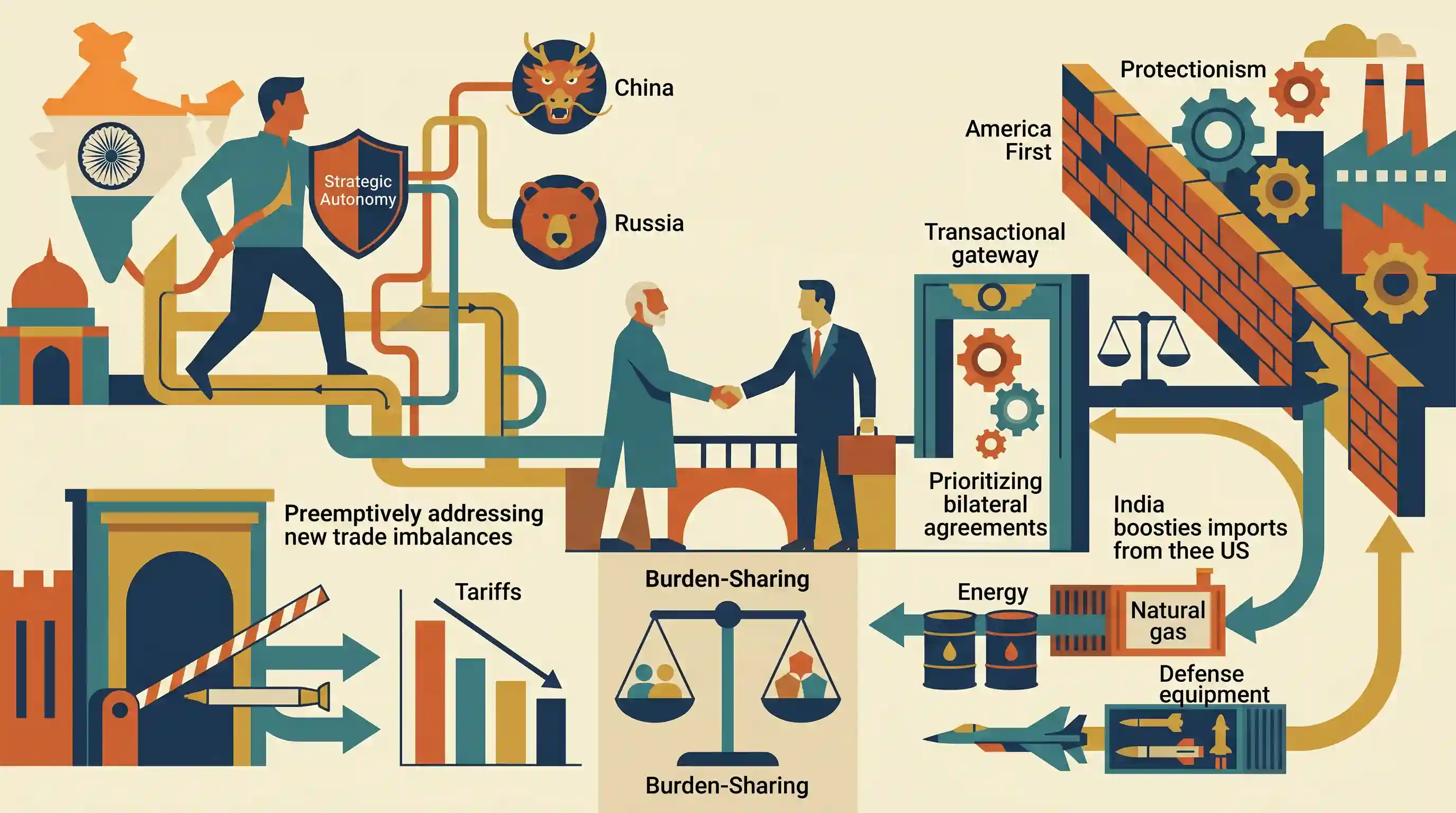
The article outlines strategic imperatives for India to insulate and advance its bilateral relationship with the United States under a potential Donald Trump presidency. It highlights the necessity for New Delhi to adapt to a highly transactional approach to foreign policy that prioritizes bilateral deals, economic nationalism, and burden-sharing over multilateral alliances and shared democratic values. To mitigate risks from 'America First' protectionism, India is advised to preemptively address trade imbalances, lower tariffs, and boost its imports of US energy and defense equipment. By leveraging its self-reliant defense posture, strong leader-to-leader rapport, and strategic autonomy, India can effectively navigate the volatility of US politics and capitalize on shifting American postures toward China and Russia.
Key Points
- Transactional Diplomacy: A Trump administration emphasizes direct give-and-take over abstract shared values, requiring India to frame negotiations around concrete economic or strategic concessions.
- Trade and Tariffs: Trump's focus on reducing US trade deficits and his 'America First' protectionism demand that India lower its tariff barriers or face punitive trade measures.
- Defense Burden Sharing: Unlike US treaty allies, India pays for its own defense and does not rely on American security guarantees, positioning it favorably—though increased US defense purchases can help balance the relationship.
- Geopolitical Navigation: Potential shifts in US policy, such as a transactional approach toward Russia or a hardened stance on China, offer India strategic leverage but require nimble diplomacy to maintain strategic autonomy.
- Personal Rapport: Fostering strong leader-to-leader relationships while deepening broader institutional and business ties is essential to insulating the partnership from political volatility.
Important Terms
America First

A nationalist policy prioritizing U.S. economic interests and sovereignty over international cooperation, often involving withdrawal from multilateral agreements and using tariffs to reduce trade deficits.
UPSC context
GS II: Effect of policies of developed countries on India's interests and strategic positioning.
Transactional Diplomacy
A pragmatic foreign policy approach focusing on immediate, concrete gains and "deals" (quid pro quo) rather than long-term ideological alliances or shared values.
UPSC context
GS II: Evolving diplomatic strategies and India’s adaptation to a realist, interest-based global order.
Strategic Autonomy
India’s core foreign policy principle of making independent decisions and pursuing national interests without being constrained by external powers or formal military alliances.
UPSC context
GS II: Fundamental pillar of India's multi-alignment and its relations with competing global powers.
NATO
A 32-member intergovernmental military alliance for collective defense between North American and European states; its shifts affect India’s Eurasian security and defense ties with Russia.
UPSC context
GS II: Regional and global groupings affecting India’s security architecture and defense procurement.
World Trade Organization (WTO)
The primary global body regulating international trade; currently facing challenges from unilateral tariffs and a paralyzed dispute settlement mechanism due to protectionist trends.
UPSC context
GS II & III: International institutions and issues related to trade, subsidies, and global economic governance.
Protectionism
Economic policy of restraining trade through methods like high tariffs and quotas to favor domestic industries, directly impacting India's export-oriented sectors.
UPSC context
GS III: Indian Economy and issues relating to planning, mobilization of resources, and international trade.
Prelims Trap
India receives mutual defense security guarantees from the US under its 'Major Defense Partner' status.
India is designated a 'Major Defense Partner' by the US, which enables high-level technology sharing. However, it is strictly NOT a mutual defense treaty ally like NATO members.
Static Concepts Connected
What defines India's "Major Defense Partner" (MDP) status with the US?
- Unique Designation: A unique designation granted in 2016 to elevate bilateral defense trade and technology transfer.
- Ally Parity: Puts India on par with the closest US allies for defense purchases without demanding a formal military alliance.
- Foundational Agreements: Operationalized through four pacts (LEMOA, COMCASA, BECA, GSOMIA) that facilitate interoperability and secure communications.
How does the WTO regulate tariff barriers and bilateral protectionism?
- MFN Principle: Members cannot normally discriminate between trading partners. Lowering a trade barrier for one country requires lowering it for all, barring FTAs.
- Bound Tariffs: Countries commit to maximum tariff ceilings at the WTO, ensuring predictability in international trade.
- Retaliatory Tariffs: Technically only permitted if authorized by the WTO's Dispute Settlement Body, though frequently abused unilaterally in recent trade wars.
Cross-Topic Patterns
US protectionism + Make in India
US 'America First' policies clash with India's 'Atmanirbhar Bharat' import substitution, increasing the likelihood of WTO disputes over local content requirements, PLI schemes, and tech tariffs.
Energy security + Trade diplomacy
Importing US crude and LNG serves dual purposes: diversifying India's energy basket away from the volatile Middle East while strategically narrowing the bilateral trade surplus to appease Washington.

Expect a GS2 Mains question evaluating how US 'transactional diplomacy' and protectionism challenge India’s strategic autonomy and trade.
Linked PYQs · 4
Linked PYQs · 4
- 2025MainsGS2
"With the waning of globalization, post-Cold War world is becoming a site of sovereign nationalism.” Elucidate.
- 2020MainsGS2
What is the significance of Indo-US defence deals over Indo-Russian defence deals? Discuss with reference to stability in the Indo-Pacific region.
- 2025MainsGS3
What are the challenges before the Indian economy when the world is moving away from free trade and multilateralism to protectionism and bilateralism? How can these challenges be met?
- 2018MainsGS3
How would the recent phenomena of protectionism and currency manipulations in world trade affect macroeconomic stability of India?
