Internal Political Polarization in Western Democracies
Source:Indian Express ↗
Why It Matters
Understanding the internal political dynamics of Western powers is crucial for UPSC aspirants, as it directly impacts global stability, the future of globalization, and India's strategic foreign policy maneuvers in a transitioning world order.
Summary
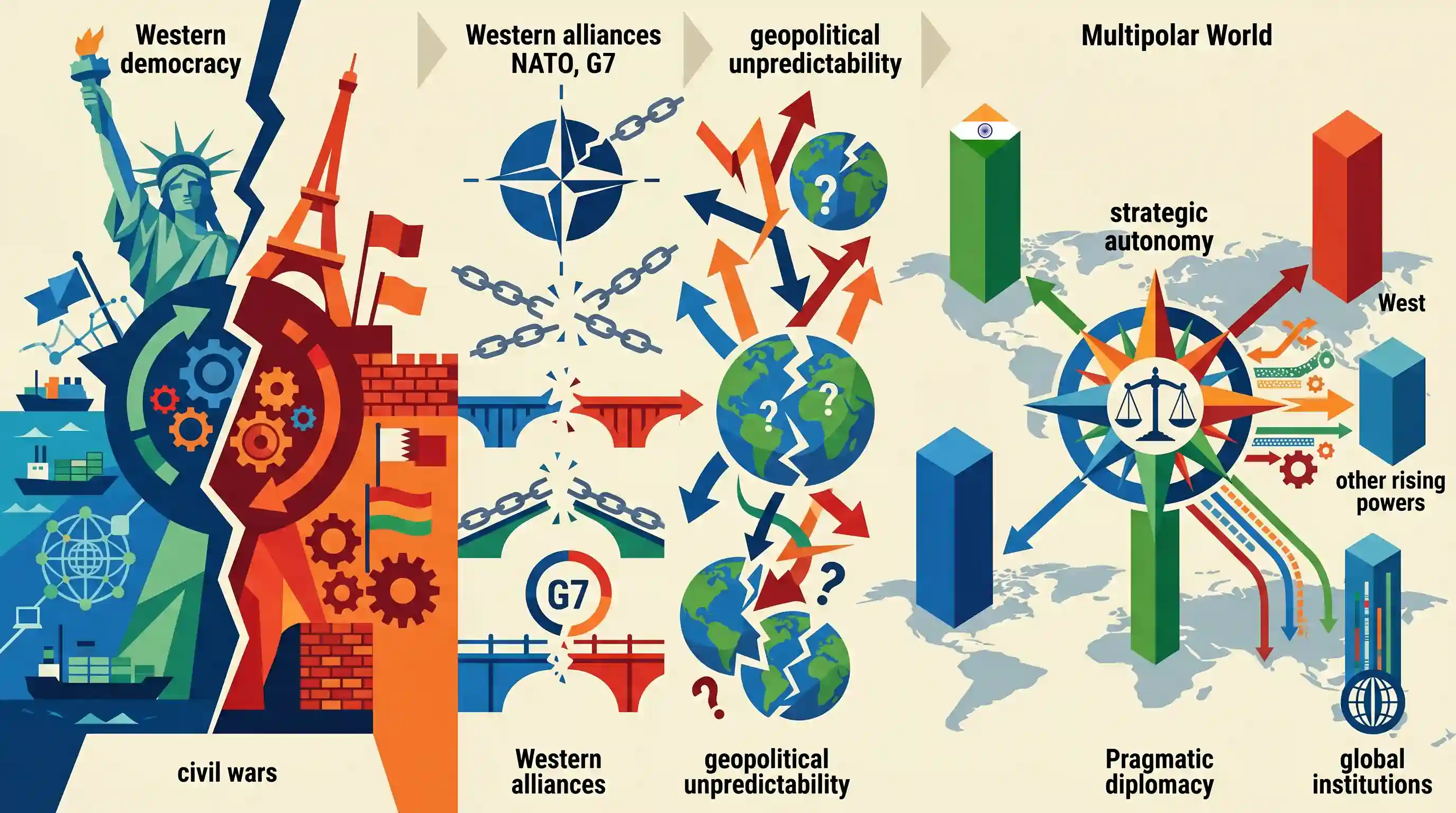
In 'The West's civil wars', C Raja Mohan analyzes the severe domestic political polarisation currently fracturing Western democracies. He argues that ideological divides within the US and European nations are driving them toward inward-looking sovereign nationalism and disrupting their historical consensus on foreign policy. This internal friction undermines the cohesiveness of Western alliances like NATO and creates geopolitical unpredictability. For India, the changing dynamics mean that navigating global geopolitics will require heightened strategic autonomy, pragmatic diplomacy, and a careful recalibration of its engagements with Western partners in a multipolar world.
Key Points
- Deep political polarisation in Western democracies (US and European nations) is functioning as an ideological 'civil war', diverting focus towards domestic frictions.
- This internal polarization weakens the traditional consensus on foreign policy, leading to unpredictable international engagements and a rise in sovereign nationalism.
- The cohesiveness of key Western alliances, such as NATO and the broader US-Europe strategic partnership, is being tested by these domestic political shifts.
- For India, a divided and inward-looking West necessitates a more pragmatic, multi-aligned diplomatic strategy to secure its interests in an increasingly fragmented global order.
Important Terms
NATO

An intergovernmental military alliance between 32 North American and European countries, based on the principle of collective defense (Article 5) where an attack on one is an attack on all.
UPSC context
GS II (International Relations); important for understanding global security architectures and their impact on India's strategic environment.
European Union (EU)
A supranational political and economic union of 27 member states located primarily in Europe, characterized by a single market and common policies on trade, agriculture, and regional development.
UPSC context
GS II (Regional Groupings); tests knowledge of deep regional integration and India-Europe strategic and economic partnerships.
Strategic Autonomy
A state's ability to pursue its national interests and adopt independent foreign policy or defense decisions without being constrained by external pressures or rigid alliance obligations.
UPSC context
GS II (India's Foreign Policy); a core principle for India when navigating great-power rivalries and global transitions.
Multipolarity
A distribution of global power where three or more nation-states or "poles" possess significant influence, reducing the dominance of any single power or duo.
UPSC context
GS II (International Relations); examines shifting power dynamics and India's aspiration to be a leading pole in a multipolar world.
Sovereign Nationalism
An ideological approach prioritizing national sovereignty, domestic political identity, and inward-looking policies over liberal internationalism, global consensus, and supranational institutional commitments.
UPSC context
GS II (Effect of Policies of Developed Countries); tests impact of domestic Western political shifts on global order and India.
Pragmatic Diplomacy
A realistic foreign policy approach driven by practical national interests and situational factors rather than strict ideological adherence or moralistic frameworks.
UPSC context
GS II (International Relations); relevant for analyzing India's "multi-alignment" strategy and issue-based global partnerships.
Prelims Trap
India's response to Western fragmentation is a return to traditional non-alignment.
India's strategy is 'multi-alignment'—actively engaging competing powers (e.g., Quad and SCO simultaneously) based on mutual interests, rather than passively maintaining equidistance.
Static Concepts Connected
How does Strategic Autonomy differ from traditional Non-Alignment?
- Non-Alignment: A Cold War strategy fundamentally focused on keeping equidistance from major military blocs to avoid proxy conflicts.
- Strategic Autonomy: An active, issue-based partnership strategy allowing India to engage with competing global powers while retaining independent decision-making.
- Multi-alignment: The practical application of strategic autonomy, actively participating in diverse, often contradictory groupings like Quad and SCO.
What are the geopolitical implications of Sovereign Nationalism?
- Inward focus: Prioritizes domestic economic and cultural protectionism over global integration, slowing down globalization and free trade.
- Alliance strain: Creates friction within historical security frameworks like NATO, as member states prioritize national politics over collective defense.
- Multilateral gridlock: Stalls reforms in international institutions (UN, WTO) as polarized nations struggle to reach multilateral consensus.
Cross-Topic Patterns
Sovereign nationalism + Protectionist trade
Political polarization in the West directly drives economic protectionism (e.g., US Inflation Reduction Act, EU's CBAM), forcing India to aggressively pursue alternative FTAs.
Western fragmentation + Global South leadership
As Western nations look inward and scale back multilateral commitments, a vacuum is created that India is filling by asserting leadership of the Global South via G20 and BRICS.

Expect a 2026 Mains question analyzing how 'Western domestic polarization' accelerates India's shift from non-alignment to multi-alignment.
Linked PYQs · 3
Linked PYQs · 3
- 2025MainsGS2
"With the waning of globalization, post-Cold War world is becoming a site of sovereign nationalism.” Elucidate.
- 2023MainsGS2
‘The expansion and strengthening of NATO and a stronger US-Europe strategic partnership works well for India.’ What is your opinion about this statement ? Give reasons and examples to support your answer.
- 2025MainsGS2
"The reform process in the United Nations remains unresolved, because of the delicate imbalance of East and West and entanglement of the USA vs. Russo-Chinese alliance.” Examine and critically evaluate the East-West policy confrontations in this regard.
