Emergence of Indo-Europe Strategic Axis in Multipolar Order
Source:Indian Express ↗
Why It Matters
Understanding the shifting paradigms in India's foreign policy, specifically the conceptualization of 'Indo-Europe' and deepening ties with Germany, is critical for GS2 Mains. It highlights India's strategic autonomy and its proactive role in navigating a multipolar global order amid uncertainties in US-Europe relations and the ongoing Russia-Ukraine conflict.
Summary
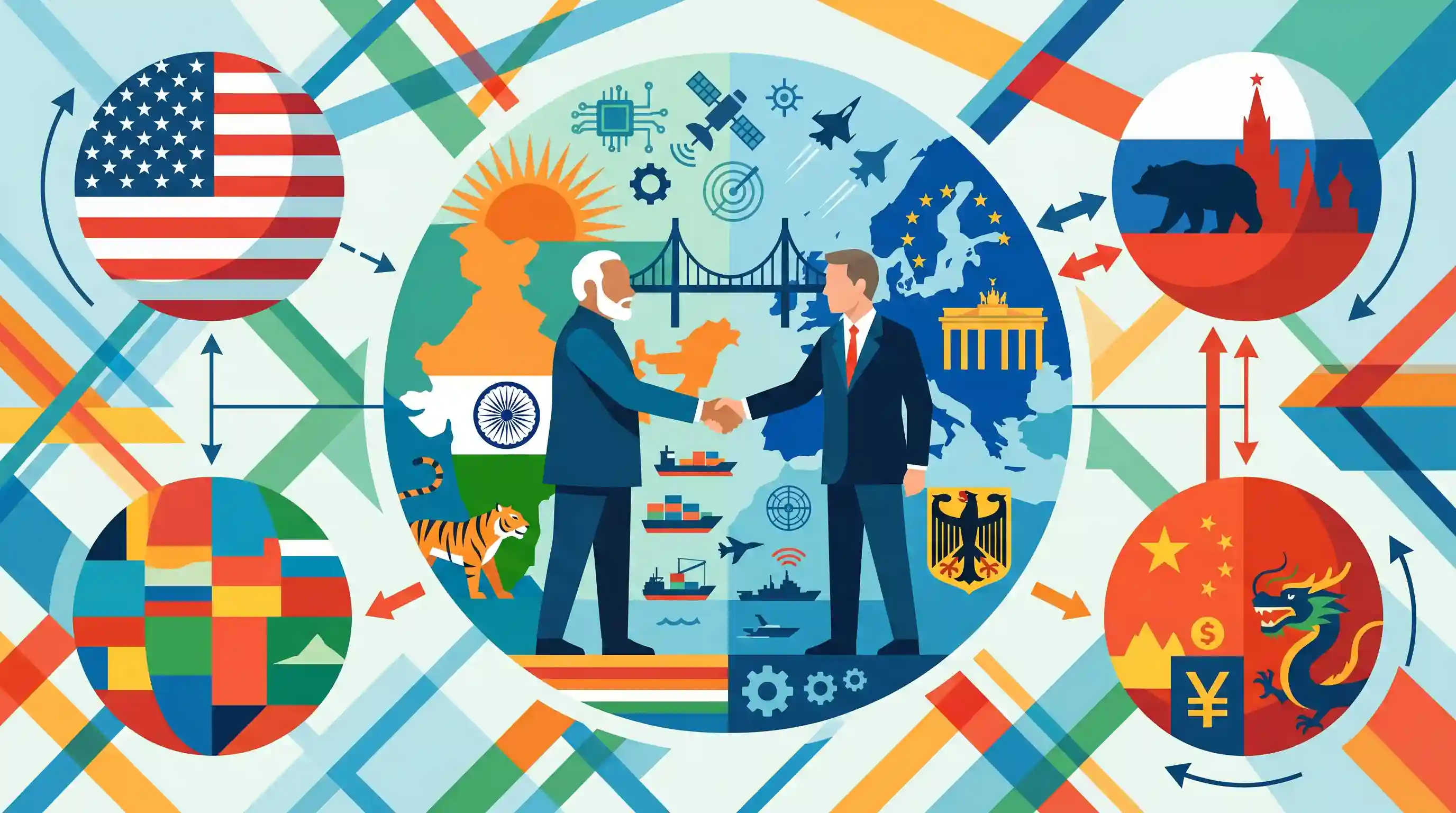
In light of changing global power structures, C. Raja Mohan discusses the emergence of 'Indo-Europe' as a new strategic geography, driven by growing security and economic convergence between India and major European powers. PM Narendra Modi's proactive engagement with Germany's likely future Chancellor, Friedrich Merz, reflects India's intent to deepen its strategic partnership with Berlin. As Europe faces uncertainties regarding US defense commitments and the challenges posed by Russia and China, it is increasingly viewing India as an indispensable partner in the Indo-Pacific. Simultaneously, India's foreign policy has evolved to engage with Europe as an independent strategic pole, prioritizing collaborative efforts in defense, technology, and economic resilience in an increasingly multipolar world order.
Key Points
- The phrase 'Indo-Europe' suggests a new strategic geography recognizing the deepening geopolitical, economic, and security integration between India and Europe.
- PM Narendra Modi's engagement with Friedrich Merz, Germany's presumed next Chancellor, underscores the prioritization of the Indo-German strategic partnership.
- Driven by changing global dynamics, such as concerns over US commitments (e.g., 'America First' policies) and the Russia-China axis, European nations are increasingly looking toward India as a stable, major democratic partner.
- India is reciprocating this interest by treating Europe as an independent and crucial pole in a multipolar world, rather than solely approaching it through the lens of US or Russian dynamics.
- Potential areas of enhanced Indo-German cooperation include defense manufacturing, critical and emerging technologies, supply chain resilience, and green energy transitions.
Important Terms
European Union (EU)

A political and economic union of 27 member states, serving as India's largest trading partner and a key 'strategic partner' in technology and climate action.
UPSC context
GS Paper II: Bilateral/Regional Groupings. Tests understanding of India-EU FTA negotiations and strategic convergence in the Indo-Pacific.
NATO
A 32-member intergovernmental military alliance based on collective defense (Article 5). India maintains a political dialogue without seeking formal membership.
UPSC context
GS Paper II: International Relations. Tests India's balancing act between Western security architectures and its traditional strategic autonomy.
Indo-Europe
A strategic concept describing the growing security and economic interdependence between India and European powers, particularly Germany and France.
UPSC context
GS Paper II: Global Geopolitics. Tests ability to analyze new strategic geographies and India's 'Look West' policy evolution.
Multipolar World Order
A global system where power is distributed among multiple states or blocs (e.g., US, China, India, EU), preventing any single nation's hegemony.
UPSC context
GS Paper II: International Relations. Core concept for discussing India’s aim to become a 'leading power' and its multi-alignment strategy.
Strategic Autonomy
A state's ability to pursue national interests and foreign policy independently, without becoming a formal part of any military alliance.
UPSC context
GS Paper II: Indian Foreign Policy. Fundamental principle tested regarding India’s relations with Russia, the US, and now Europe.
Indo-Pacific
A biogeographic region of Earth's seas, increasingly viewed as a single strategic space where India and Europe collaborate to ensure maritime security.
UPSC context
GS Paper II: Regional Interest. Focuses on freedom of navigation, supply chain resilience, and countering regional assertiveness.
Prelims Trap
"Indo-Europe is a newly formalized inter-governmental defense alliance."
'Indo-Europe' is an emerging geopolitical construct and strategic geography used by analysts to describe growing convergence, not a formal treaty organization or security alliance.
Static Concepts Connected
What is the Inter-Governmental Consultations (IGC) mechanism?
- Cabinet-level dialogue: A comprehensive framework where the top leaders and their cabinet ministers meet simultaneously to review all aspects of bilateral ties.
- Selective partnerships: India holds IGC-level summits with only a few highly trusted strategic partners, with Germany being one of the earliest and most prominent.
What defines 'Strategic Autonomy' in contemporary Indian foreign policy?
- Multi-alignment: A shift from passive non-alignment to proactive multi-alignment, building issue-based partnerships without committing to formal military alliances.
- Independent poles: Engaging globally by recognizing independent geopolitical poles (like Europe) rather than viewing relations solely through a US-centric or Russia-centric lens.
Cross-Topic Patterns
Trade pacing strategic convergence
While defense and strategic dialogues under 'Indo-Europe' accelerate, the stalled India-EU Broad-based Trade and Investment Agreement (BTIA) remains a critical bottleneck requiring resolution for true multipolar integration.
Green Hydrogen as a geopolitical tool
The Indo-German Green Hydrogen Roadmap reflects a broader trend where Europe uses climate partnerships to decouple its energy and critical mineral reliance from the Russia-China axis.

Expect a GS2 Mains question assessing the rise of 'Indo-Europe' as a new strategic geography in India's multi-aligned foreign policy.
Linked PYQs · 2
Linked PYQs · 2
- 2023MainsGS2
‘The expansion and strengthening of NATO and a stronger US-Europe strategic partnership works well for India.’ What is your opinion about this statement ? Give reasons and examples to support your answer.
- 2019MainsGS2
‘The long-sustained image of India as a leader of the oppressed and marginalised nations has disappeared on account of its new found role in the emerging global order.’ Elaborate.
