Geopolitical Implications of Shifting United States Policy on India
Source:Indian Express ↗
Why It Matters
The shifting geopolitical alignments among major powers like the US, Russia, and China directly impact India's strategic autonomy, defense partnerships, and global positioning. This is highly relevant for the International Relations segment of UPSC Mains GS Paper 2.
Summary
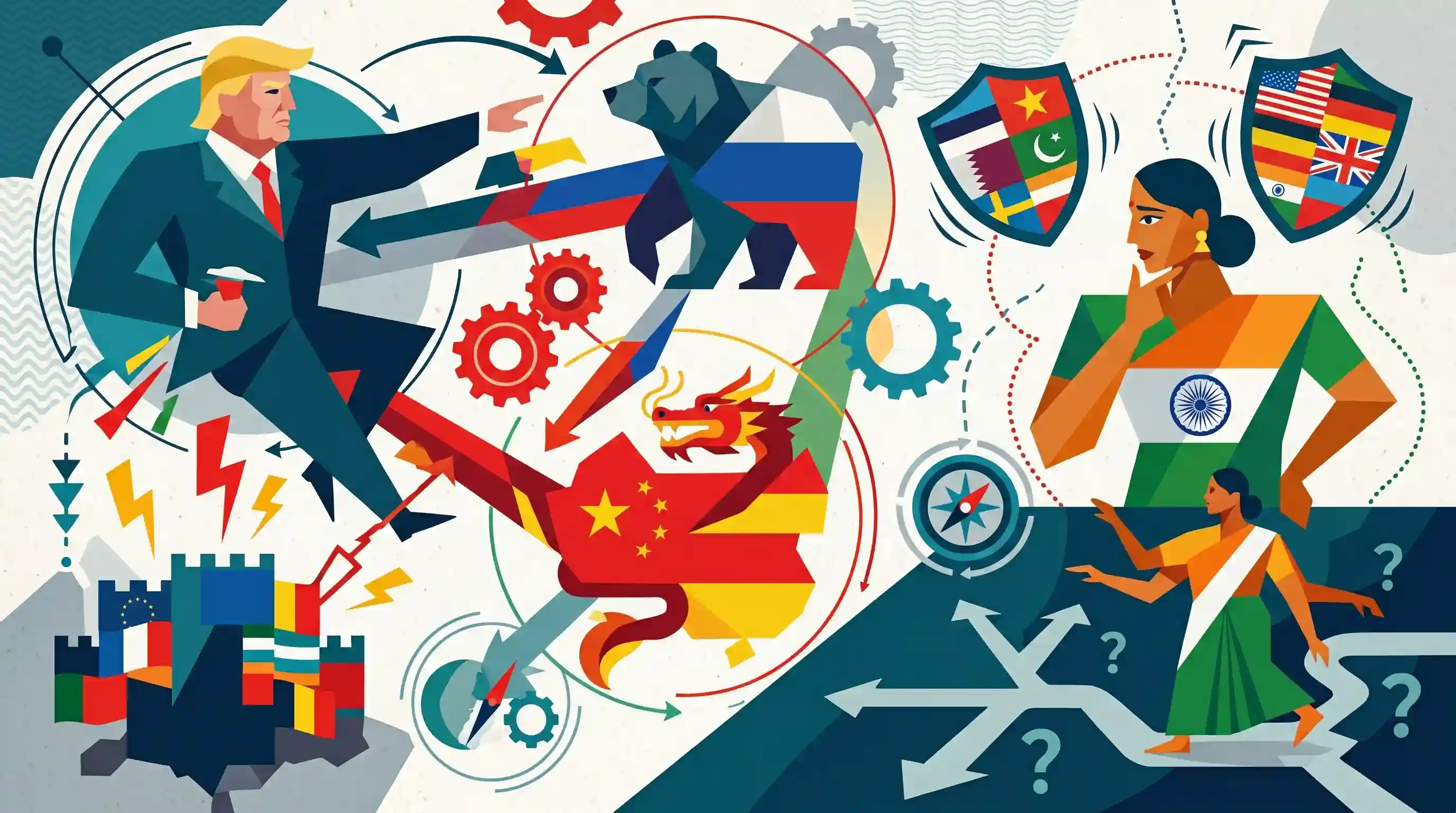
Foreign policy analyst C Raja Mohan examines the geopolitical implications of a potential shift in US foreign policy under Donald Trump, specifically his outreach to Russia and China. The article highlights that such a strategic realignment in the US-Russia-China triangle would present complex challenges for India. It emphasizes the need for New Delhi to exercise caution and strategic agility, as these changes would not only affect India's bilateral partnerships but also disrupt European security dynamics and transatlantic relations.
Key Points
- Potential shifts in US foreign policy under Donald Trump, including outreach to Russia and China, could alter the global geopolitical balance.
- India must navigate the evolving US-Russia-China triangle with caution, ensuring its strategic autonomy and balancing its partnerships.
- Realignments between Washington and Moscow or Beijing would have significant repercussions for Europe, potentially affecting NATO and transatlantic security.
- New Delhi needs to remain agile and prepare for unpredictable policy changes from major powers to safeguard its national interests in a multipolar order.
Important Terms
Strategic Autonomy

The foundational principle of India’s foreign policy, ensuring independent decision-making without joining military alliances or becoming a junior partner to any superpower.
UPSC context
GS Paper 2: International Relations. Tests understanding of India's non-aligned roots and its modern evolution in a multipolar world.
US-Russia-China Triangle
The shifting power dynamics between Washington, Moscow, and Beijing, where changes in one bilateral relationship significantly impact the strategic calculations of the other two players.
UPSC context
GS Paper 2: Global Geopolitics. Evaluates the candidate's ability to analyze how major power realignments affect India's national interest.
Strategic Agility
A diplomatic approach emphasizing flexibility and rapid adaptation to shifting global alliances, allowing a nation to engage multiple partners simultaneously to maximize national interest.
UPSC context
GS Paper 2: Foreign Policy. Tests the ability to discuss contemporary Indian diplomacy beyond traditional non-alignment frameworks.
NATO
A 32-member political and military alliance between North American and European countries, established in 1949 to ensure collective defense against external threats.
UPSC context
GS Paper 2: Groupings & Agreements. Relevant for analyzing transatlantic security and the impact of Western policy shifts on India.
European Union (EU)
A political and economic union of 27 member states located primarily in Europe, acting as a significant global trade bloc and a strategic 'swing state' in geopolitics.
UPSC context
GS Paper 2: Effect of policies of developed countries. Focuses on India-EU trade, technology cooperation, and strategic diversification.
Reverse Kissinger
A strategic maneuver where the US seeks to woo Russia to detach it from China, mirroring Henry Kissinger’s 1970s outreach to China to isolate the Soviet Union.
UPSC context
GS Paper 2: International Relations. Tests knowledge of historical strategic concepts and their application to modern great-power competition.
Prelims Trap
"India advocates for the expansion of NATO into the Indo-Pacific region to contain China."
India explicitly rejects the "NATO-ization" of the Indo-Pacific, relying instead on ad-hoc coalitions like the Quad while retaining its strategic autonomy.
Static Concepts Connected
What distinguishes Multi-Alignment from traditional Non-Alignment in India's foreign policy?
- Non-Alignment: Historically focused on maintaining equal distance from Cold War superpower blocs, emphasizing anti-colonial solidarity and neutrality.
- Multi-Alignment: Actively partnering with multiple, often competing, major powers simultaneously (e.g., US, Russia) for issue-based, mutual strategic interests.
- Military Blocs: Both frameworks explicitly avoid signing formal, binding military treaties, though multi-alignment embraces extensive defense and technology cooperation.
What are the core mechanisms of NATO's collective defense?
- Article 5: Enshrined in Article 5; an armed attack against one member is considered an attack against all, requiring a collective response.
- Geographic Limit: The treaty's defense obligations are strictly limited to attacks occurring in Europe, North America, or the North Atlantic north of the Tropic of Cancer.
- Consensus Principle: All NATO decisions, including invoking collective defense, are made by consensus among all member states.
Cross-Topic Patterns
European Strategic Autonomy + Indo-Pacific
As the US pivots or adopts isolationist policies, Europe's drive for independent 'Strategic Autonomy' creates openings for India to deepen bilateral naval and defense ties with France and Germany in the Indian Ocean.
US Isolationism + BRICS De-dollarization
Unpredictable US foreign policy and shifts in the US-Russia dynamic often accelerate discussions within the Global South and BRICS on alternate payment systems and de-dollarization to insulate from shocks.

Expect a Mains GS2 question on how a US retreat from European security and its Russia-China outreach reshapes India's multi-alignment.
Linked PYQs · 3
Linked PYQs · 3
- 2025MainsGS2
"The reform process in the United Nations remains unresolved, because of the delicate imbalance of East and West and entanglement of the USA vs. Russo-Chinese alliance.” Examine and critically evaluate the East-West policy confrontations in this regard.
- 2023MainsGS2
‘The expansion and strengthening of NATO and a stronger US-Europe strategic partnership works well for India.’ What is your opinion about this statement ? Give reasons and examples to support your answer.
- 2021MainsGS2
“The USA is facing an existential threat in the form of a China, that is much more challenging than the erstwhile Soviet Union.” Explain.
