Evolving Geopolitical Dynamics and India Strategic Autonomy Dilemma
Source:Indian Express ↗
Why It Matters
This analysis is crucial for understanding the contemporary shift in India's foreign policy. It highlights why the traditional reliance on Russia is diminishing and why strategic partnerships with the West (like the Quad) are essential for countering China's rise, directly addressing core themes in GS-2 International Relations.
Summary
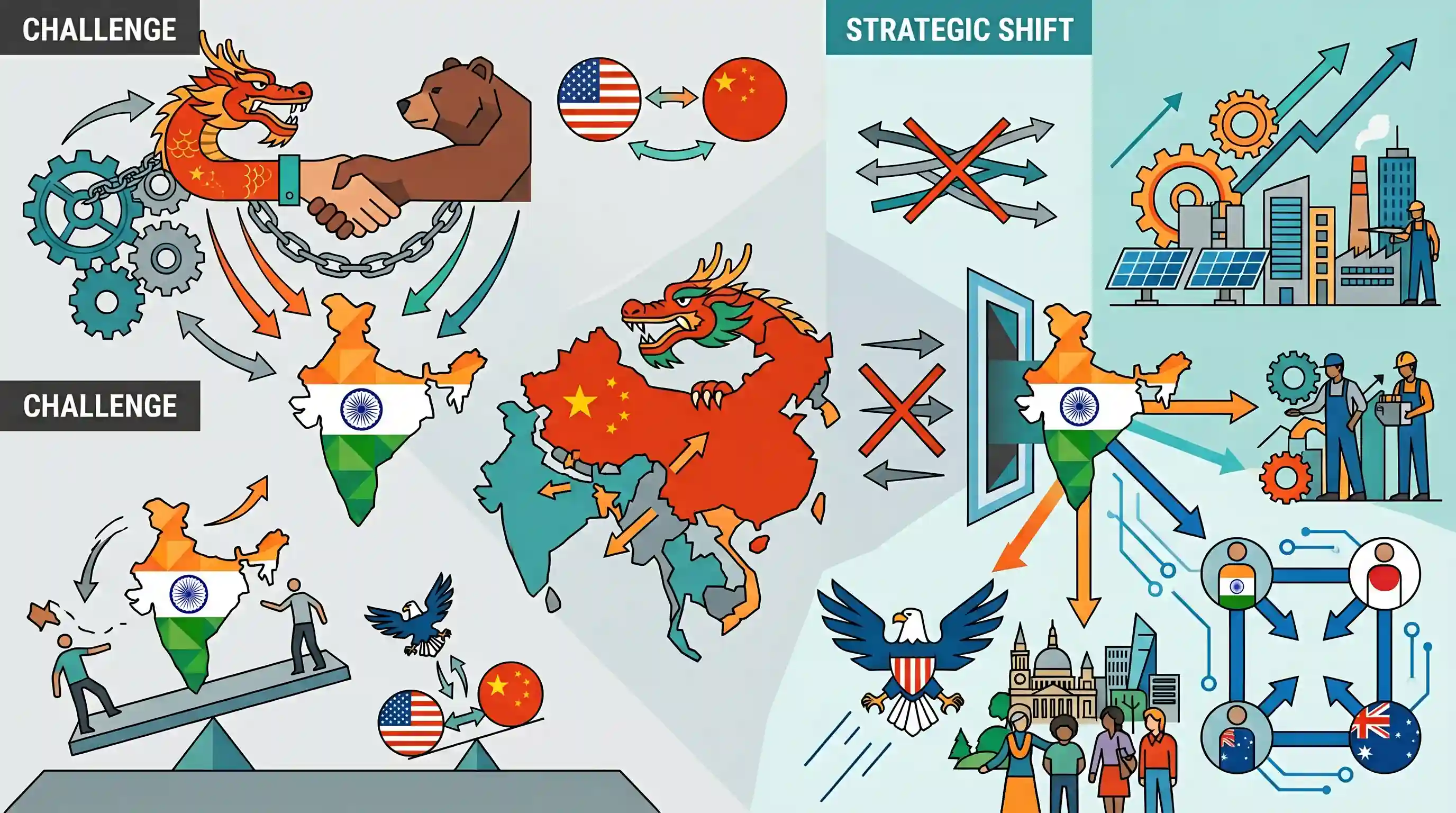
The article examines the shifting global power dynamics—specifically the strengthening Sino-Russian axis and potential US-China stabilisation—and their implications for India's traditional doctrine of "strategic autonomy." Historically, India relied on Russia to balance power in Eurasia while maintaining a distance from the West. However, with Russia aligning closely with China, New Delhi must reassess its strategy. The author argues that managing the multi-faceted challenge posed by an assertive China must be India's paramount objective. Consequently, India's strategic autonomy must evolve beyond anti-Western non-alignment towards a pragmatic approach: aggressively building internal capabilities and fostering deeper strategic and economic partnerships with the US, Europe, and frameworks like the Quad.
Key Points
- The tightening alignment between Russia and China, alongside the US seeking stabilised relations with Beijing under Donald Trump, fundamentally alters the geopolitical calculus for India.
- India's traditional 'strategic autonomy' relied on maintaining distance from the West while leaning on Russia for balance; this is no longer viable given Moscow's junior partnership with Beijing.
- The primary strategic challenge for New Delhi is an assertive China, marked by ongoing border disputes, expanding regional influence, and a stark trade deficit exceeding $110 billion.
- To effectively counter Chinese dominance, India must pursue internal capacity-building while deepening strategic and economic cooperation with Western nations and alliances like the Quad.
- India's economic integration with the West dwarfs its ties to the Sino-Russian axis, illustrated by the fact that India exports more to the Netherlands than to China and Russia combined.
Important Terms
Strategic Autonomy

India's ability to pursue national interests and make sovereign foreign policy decisions without being structurally dependent on or constrained by any external power or alliance.
UPSC context
GS Paper 2 (IR). Tests understanding of India's decisional independence in a shifting multipolar world order.
Non-alignment
A Cold War-era policy of maintaining distance from competing superpower blocs to preserve sovereignty; the historical precursor to modern Indian strategic autonomy.
UPSC context
GS Paper 2 (IR). Essential for tracing foreign policy evolution from Nehruvian ideals to pragmatic realism.
Quad
An informal strategic partnership between India, USA, Japan, and Australia aimed at ensuring a free, open, and inclusive Indo-Pacific and rules-based order.
UPSC context
GS Paper 2/3. Tests knowledge of plurilateral groupings and India’s strategy to counterbalance Chinese assertiveness.
Sino-Russian Axis
The deepening strategic alliance between China and Russia that challenges Western dominance, forcing India to reassess its traditional reliance on Moscow.
UPSC context
GS Paper 2 (IR). Tests analysis of Eurasian power shifts and their impact on India's strategic calculations.
Multi-alignment
A pragmatic foreign policy involving simultaneous engagement with multiple major powers through issue-based partnerships to maximize national interest and strategic flexibility.
UPSC context
GS Paper 2 (IR). Key for understanding contemporary Indian diplomacy beyond traditional neutral stances.
Internal Capabilities
The domestic economic, technological, and military strength that serves as the material foundation for a state to exercise credible and effective strategic autonomy.
UPSC context
GS Paper 2/3. Links Atmanirbhar Bharat (self-reliance) with India's global influence and diplomatic leverage.
Prelims Trap
Strategic autonomy mandates equal distancing from all major powers.
Modern strategic autonomy is about multi-alignment and maximizing national interest through issue-based partnerships (e.g., Quad), not Cold War-era equal distancing or avoidance of strategic blocs.
Static Concepts Connected
How does 'Strategic Autonomy' differ from Cold War-era 'Non-Alignment'?
- Core objective: NAM sought distance from bipolar blocs, whereas strategic autonomy seeks active, simultaneous engagement with multiple poles.
- Nature of alliances: NAM avoided strategic security groupings, while strategic autonomy permits issue-based coalitions like the Quad.
What drives India's massive structural trade deficit with China?
- Import dependency: Heavy reliance on Chinese active pharmaceutical ingredients (APIs), telecom hardware, and machinery for domestic manufacturing.
- Export limitations: India primarily exports low-value raw materials (ores, cotton) to China while importing high-value finished goods.
Cross-Topic Patterns
Sino-Russian axis vs Maritime pivot
As Moscow aligns with Beijing, India's traditional continental leverage in Eurasia (SCO, BRICS) weakens, accelerating a strategic pivot toward Indo-Pacific maritime coalitions like the Quad.
Trade as a geopolitical vulnerability
The $110B deficit with China isn't just an economic issue; it forces India to launch PLI schemes and pursue friendshoring with Western partners for critical technologies.

Expect a GS2 Mains question evaluating India's transition from non-alignment to multi-alignment amid the Sino-Russian 'no limits' pact.
Linked PYQs · 5
Linked PYQs · 5
- 2024MainsGS2
‘The West is fostering India as an alternative to reduce dependence on China's supply chain and as a strategic ally to counter China's political and economic dominance.’ Explain this statement with examples.
- 2020MainsGS2
What is the significance of Indo-US defence deals over Indo-Russian defence deals? Discuss with reference to stability in the Indo-Pacific region.
- 2020MainsGS2
Quadrilateral Security Dialogue (Quad)' is transforming itself into a trade bloc from a military alliance, in present times - Discuss.
- 2019MainsGS2
‘What introduces friction into the ties between India and the United States is that Washington is still unable to find for India a position in its global strategy, which would satisfy India's national self-esteem and ambitions.’ Explain with suitable examples.
- 2012MainsGS2
Do you think that China's emergence as one of the largest trading partners of India has adversely affected the settlement of the outstanding border problem?
