Joseph Vijay assumes office as Tamil Nadu Chief Minister
Source:Indian Express ↗
Why It Matters
The article is highly relevant for understanding state-level political transitions and coalition dynamics in India. It also highlights the persistent policy dilemma between offering populist welfare schemes (like free electricity) and maintaining state fiscal health, a recurring theme in GS2 and GS3. Furthermore, the focus on localized anti-drug mechanisms ties into broader internal security challenges.
Summary
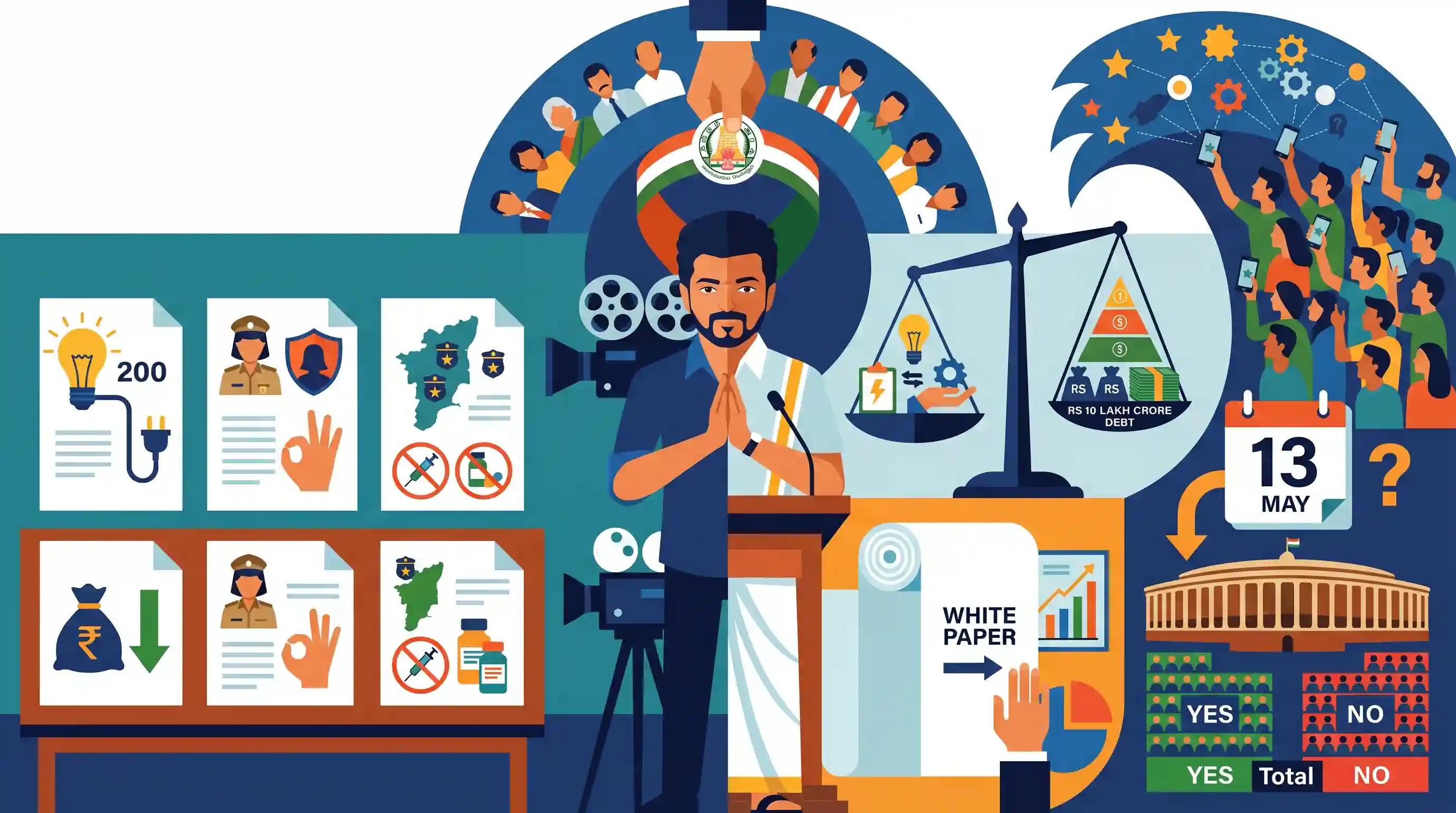
Actor-turned-politician C Joseph Vijay was sworn in as the Chief Minister of Tamil Nadu, heading a multi-party coalition. On his first day, he signed key policy directives implementing 200 units of free electricity, establishing a special force for women's safety, and launching a statewide anti-drug mechanism. Balancing populist measures with fiscal concerns, he promised a white paper on the state's Rs 10 lakh crore debt. His government, which marks a transition toward fan-driven digital politics, will face a mandatory floor test before May 13 to prove its majority in the Assembly.
Key Points
- Actor-turned-politician C Joseph Vijay assumed office as the Chief Minister of Tamil Nadu, leading a coalition government supported by Congress and Left parties.
- His first official actions included clearing files for 200 units of free electricity, a dedicated women’s safety force with a helpline, and a statewide anti-drug mechanism.
- He promised fiscal transparency by pledging a white paper on the state's estimated Rs 10 lakh crore debt inherited from the previous DMK government.
- The Chief Minister is required to prove his majority via a floor test in the 234-member Assembly before May 13.
- The political victory highlights a shift in the state from traditional cadre-based organizing to a fan-driven digital mobilization culture.
Important Terms
Tamilaga Vettri Kazhagam (TVK)

A regional political party in Tamil Nadu founded in 2024 by actor C. Joseph Vijay. It advocates for social justice, secularism, and youth empowerment, aiming to disrupt the state's traditional two-party Dravidian dominance.
UPSC context
GS Paper II: Functions and responsibilities of the Union and the States, particularly regarding regional political parties and state-level leadership transitions.
Dravida Munnetra Kazhagam (DMK)
A major Dravidian party founded in 1949 by C. N. Annadurai. It champions social equality, state autonomy, and linguistic pride, famously ending Congress rule in Tamil Nadu in 1967.
UPSC context
GS Paper II: Evolution of the Indian party system and the role of regionalism in federalism.
Viduthalai Chiruthaigal Katchi (VCK)
A Dravidian party focused on Dalit rights and Tamil nationalism, led by Thol. Thirumavalavan. In 2025, it became the first Dalit-founded party in Tamil Nadu to receive official State Party status.
UPSC context
GS Paper II: Social Justice and representation of vulnerable sections in the legislative process.
Indian Union Muslim League (IUML)
A political party established in 1948 to represent the interests of the Muslim community in India. It is a recognized state party in Kerala and maintains a significant presence in Tamil Nadu.
UPSC context
GS Paper II: Secularism and the role of minority-interest parties in a multi-party democracy.
Communist Party of India (Marxist) (CPI-M)
A major left-wing national party that split from the CPI in 1964. It follows Marxist-Leninist ideology and frequently enters into state-level alliances in Tamil Nadu to support pro-worker and pro-peasant policies.
UPSC context
GS Paper II: Ideological spectrum of political parties and their impact on state policy and coalition politics.
Floor Test (Vote of Confidence)
A constitutional procedure where a government must prove its majority support in the Legislative Assembly. It is often mandated by the Governor following a fractured mandate or leadership change.
UPSC context
GS Paper II: Role of the Governor and the functioning of the State Legislature under Article 164.
Prelims Trap
States have absolute autonomy to raise domestic market loans as long as they stay within their FRBM Act limits.
Under Article 293(3), states must obtain the Centre's prior consent to raise any loan if they have any outstanding loans owed to the Government of India.
Static Concepts Connected
How is a Chief Minister's majority constitutionally tested?
- S.R. Bommai guidelines: The Supreme Court (1994) mandated that a floor test in the Assembly is the sole constitutional method to determine whether a government holds a majority.
- Governor's power: The Governor can summon the House under Article 174 to direct the CM to prove their majority if objective reasons suggest they lost it.
- Composite floor test: Used when multiple claimants stake government formation. The legislature votes simultaneously to determine which coalition or leader commands the confidence of the House.
What limits a State Government's borrowing capacity?
- Article 293: States can only borrow within the territory of India. They cannot raise external sovereign debt directly; such loans are routed through the Centre.
- Central consent: If a state owes outstanding loans to the Centre, it requires prior consent from the Government of India to raise any new borrowing.
- FRBM targets: State fiscal responsibility laws cap the fiscal deficit as a percentage of Gross State Domestic Product (GSDP), which structurally limits annual borrowing.
Cross-Topic Patterns
Welfare populism & DISCOM health
Promises of free electricity strain state exchequers and worsen the Average Cost of Supply and Average Revenue Realized (ACS-ARR) gap for already heavily indebted power distribution companies (DISCOMs).
Shadow campaigning via fan networks
The transition to digital fan-driven politics challenges Election Commission expenditure limits, as decentralized online mobilization makes it increasingly difficult to track unrecorded campaign financing and shadow ads.

Expect a multi-statement Prelims question linking Article 293 state borrowing constraints with the impact of welfare freebies on DISCOMs.
Linked PYQs · 4
Linked PYQs · 4
- 2025MainsGS3
Explain how the Fiscal Health Index (FHI) can be used as a tool for assessing the fiscal performance of states in India. In what way would it encourage the states to adopt prudent and sustainable fiscal policies?
- 2024MainsGS3
Explain how narco-terrorism has emerged as a serious threat across the country. Suggest suitable measures to counter narco-terrorism.
- 2023MainsGS2
Discuss the role of Presiding Officers of state legislatures in maintaining order and impartiality in conducting legislative work and in facilitating best democratic practices.
- 2021MainsGS2
“Though women in post-Independent India have excelled in various fields, the social attitude towards women and feminist movement has been patriarchal." Apart from women education and women empowerment schemes, what interventions can help change this milieu?
