Integration of artificial intelligence in education systems
Source:The Hindu ↗
Why It Matters
The policy move underscores India's approach to creating public digital goods (DPI) for education and reflects a strategic pursuit of 'AI-sovereignty' to ensure technologies are indigenously built and culturally relevant.
Summary
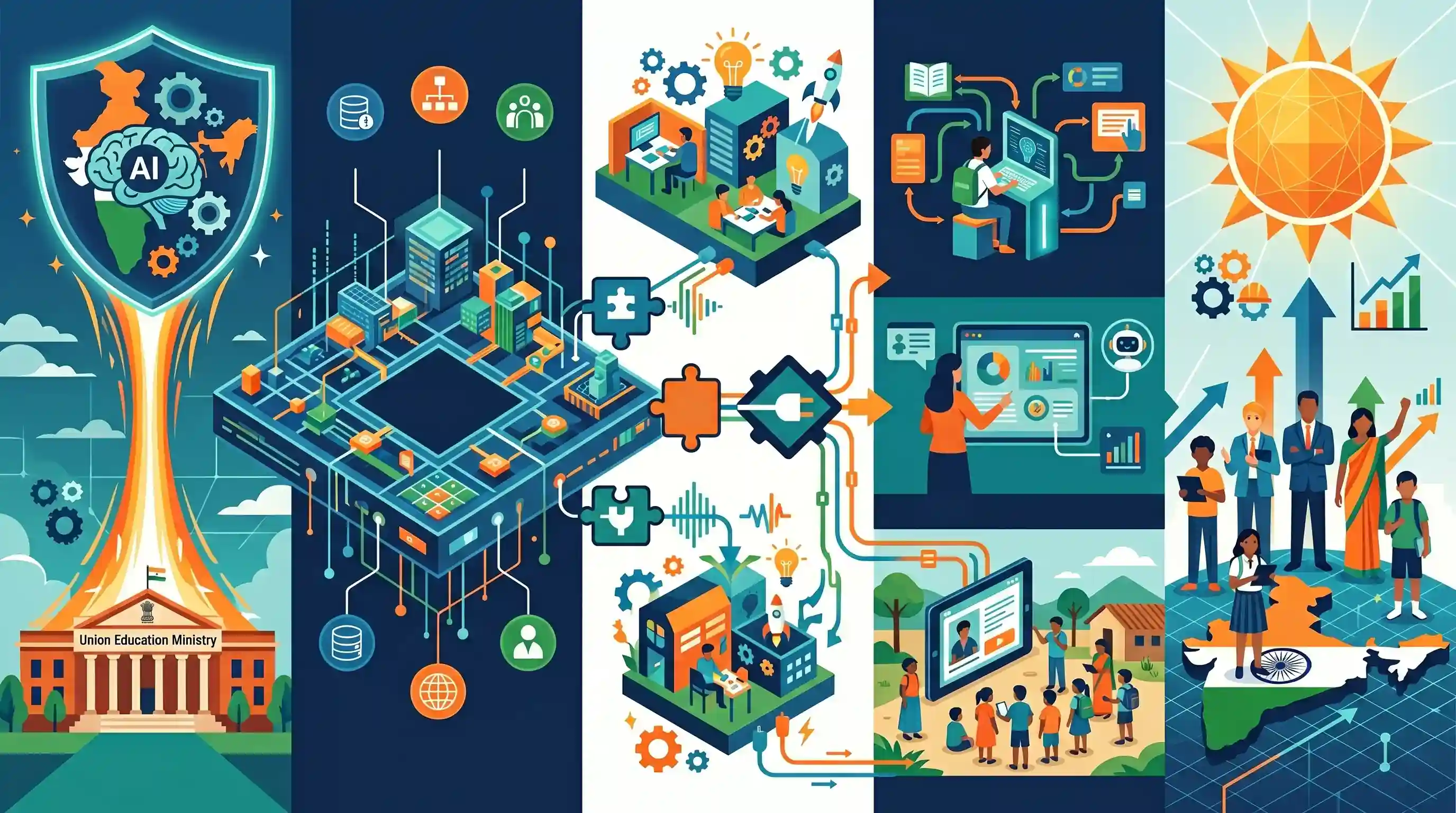
The Union Education Ministry plans to structurally integrate Artificial Intelligence into all levels of education by the next academic year, prioritizing "AI-sovereignty" and homegrown digital solutions. As part of this vision, the government is set to launch "Bodhan AI," a Digital Public Infrastructure (DPI) that will provide reliable APIs for ed-tech startups to develop customized AI applications. These AI tools will focus on personalized learning, teacher capacity building, and remote content delivery, aligning with India's broader national skilling and digital empowerment objectives.
Key Points
- The Union Education Ministry aims to integrate AI into teaching and learning from kindergarten to research levels by the next academic year.
- The government will launch 'Bodhan AI', a Digital Public Infrastructure (DPI) providing APIs for ed-tech startups to build education-focused AI models.
- The initiative emphasizes 'AI-sovereignty', promoting indigenous technology development tailored to Indian languages and values.
- AI tools will be used for teacher capacity building, preparing personalized lesson plans, and delivering content to students in remote regions.
- Ed-tech startups showcased AI-tutor models capable of personalized attention, solving live doubts, and evaluating subjective answers.
Important Terms
Bodhan AI

A non-profit initiative developed by the Centre of Excellence in AI for Education at IIT Madras to build AI-enabled Digital Public Infrastructure for the Indian education system.
UPSC context
GS-II (Education/E-Governance) and GS-III (S&T). Tests knowledge of indigenous AI frameworks and institutional roles in education technology.
Bharat EduAI Stack
An open-source, interoperable digital public infrastructure (DPI) designed to embed AI applications—like personalized tutors and teacher assistants—across all levels of Indian education.
UPSC context
GS-III (S&T/Infrastructure). Tests understanding of India's 'Stack' model applied to the education sector for digital public services.
AI Sovereignty
A nation's capacity to independently develop, govern, and control its AI infrastructure, models, and data, reducing strategic dependency on foreign proprietary platforms.
UPSC context
GS-III (S&T/Security). Tests critical analysis of strategic autonomy, data localization, and technological self-reliance in the global AI race.
Digital Public Infrastructure (DPI)
Open-source, interoperable digital blocks (e.g., Aadhaar, UPI) that enable public and private sectors to provide essential services at a national scale.
UPSC context
GS-II/III (Governance/Economy). A recurring theme testing the evolution of India's digital governance and public service delivery models.
Arivihan
An indigenous AI-first ed-tech startup providing automated, interactive, and affordable vernacular tutoring, cited as an example of localized innovation in the Bharat Bodhan AI initiative.
UPSC context
GS-III (S&T/Innovation). Tests awareness of the startup ecosystem and real-world applications of AI for socio-economic empowerment.
Prelims Trap
Bodhan AI is a proprietary government chatbot developed by NCERT to directly teach students.
Bodhan AI is an open-source Digital Public Infrastructure (DPI) providing APIs for ed-tech startups to build scalable tools, not a closed, standalone government chatbot.
Static Concepts Connected
What constitutes Digital Public Infrastructure (DPI) in the Indian context?
- Definition: Open-source, interoperable digital frameworks (e.g., India Stack) enabling seamless public and private service delivery.
- Core layers: Typically comprises three layers: identity (Aadhaar), payments (UPI), and secure data exchange (Account Aggregator framework).
- Ecosystem approach: DPIs foster innovation by allowing private startups to plug into government-backed foundational APIs, lowering the barrier to entry.
What is 'AI Sovereignty'?
- Meaning: A nation's capability to build, govern, and regulate AI systems using domestic server infrastructure, datasets, and localized algorithms.
- Significance: Prevents foreign tech monopolies, safeguards data privacy, and ensures AI models reflect indigenous languages and cultural values.
Cross-Topic Patterns
DPI beyond Fintech: Health & Education
India's DPI strategy is shifting from identity (Aadhaar) and payments (UPI) to human development, seen previously in health (ABDM) and now in education via Bodhan AI.
Bhashini + Bodhan AI integration
The push for AI in Indian languages connects directly to the National Language Translation Mission (Bhashini), which provides the foundational localized datasets for these indigenous ed-tech LLMs.

Expect a 2026 prelims question pairing 'Bodhan AI' with 'Bhashini' and 'India Stack' to test understanding of India's DPI ecosystem.
Linked PYQs · 4
Linked PYQs · 4
- 2023MainsGS3
Introduce the concept of Artificial Intelligence (AI). How does Al help clinical diagnosis? Do you perceive any threat to privacy of the individual in the use of Al in healthcare?
- 2023MainsGS3
What is the status of digitalization in the Indian economy? Examine the problems faced in this regard and suggest improvements.
- 2024MainsGS2
e-governance is not just about the routine application of digital technology in service delivery process. It is as much about multifarious interactions for ensuring transparency and accountability. In this context evaluate the role of the 'Interactive Service Model' of e-governance.
- 2025MainsGS2
e-governance projects have a built-in bias towards technology and back-end integration than user-centric designs. Examine.
