India expands QR code drug traceability to combat counterfeit meds
Source:The Hindu ↗
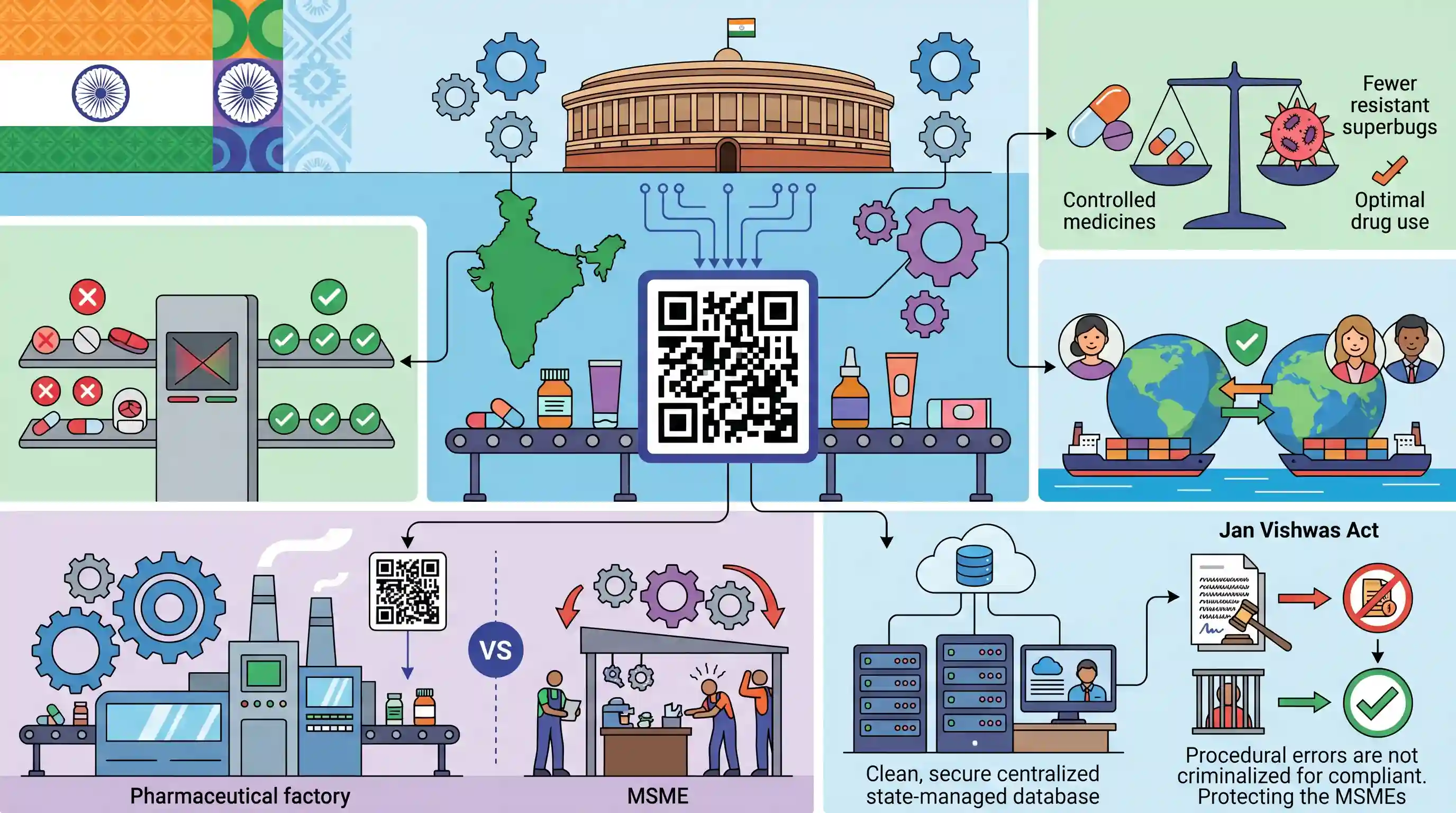
Why It Matters
The pharmaceutical sector is critical to India's economy and global standing ('pharmacy of the world'). This article connects the regulatory framework for drug traceability to broader issues like MSME compliance burdens, antimicrobial resistance, and international trade concerns, making it highly relevant for GS2 (Health/Governance) and GS3 (Economy/Science).
Summary
India's Health Ministry is expanding the QR code-based drug traceability framework across all therapeutic classes under Schedule H2. While this digital mandate is crucial to combating counterfeit drugs, curbing antimicrobial resistance (AMR), and restoring international confidence in Indian pharmaceuticals, it imposes a significant compliance burden on MSMEs. Successful implementation requires a centralized state-managed database and the protection provided by the Jan Vishwas Act 2026 to ensure minor procedural errors are not criminalized.
Key Points
- The Health Ministry expanded Schedule H2 to mandate QR codes or barcodes on all therapeutic classes of drugs, improving traceability from active pharmaceutical ingredients (APIs) to the final product.
- The digital tracking framework aims to combat counterfeit and substandard medicines, which are major contributors to India's high antimicrobial resistance (AMR) rates.
- International regulators like the US FDA and EMA have raised concerns over the quality control of Indian drug exports (e.g., contaminated cough syrups), making traceability a strategic trade necessity.
- The Jan Vishwas Act 2026 helps by distinguishing between minor procedural lapses in traceability and substantial safety non-compliance, easing fears of criminal prosecution.
- Implementation challenges include the financial and IT strain on MSME pharmaceutical manufacturers, and the need for a centralized, state-managed database to protect sensitive prescription data.
Important Terms
Schedule H2

A specific category under India's Drugs Rules, 1945, requiring pharmaceutical packaging to feature QR codes or barcodes to ensure end-to-end traceability and prevent the distribution of counterfeit medicines.
UPSC context
GS-II (Health Governance/Digital Health). Relates to regulatory mechanisms for pharmaceutical safety and supply chain integrity.
Jan Vishwas Act, 2023
A legislative act aimed at improving 'Ease of Doing Business' by decriminalizing minor and procedural offenses across 42 laws, including the Drugs and Cosmetics Act, 1940.
UPSC context
GS-II/III (Governance/Economy). Crucial for questions on regulatory reform, ease of doing business, and administrative efficiency.
Antimicrobial Resistance (AMR)
A condition where bacteria and other pathogens evolve to resist medicines, rendering standard treatments ineffective; traceability helps curb this by monitoring the sale and misuse of antimicrobials.
UPSC context
GS-II (Public Health) and GS-III (Science & Technology). Essential for understanding global health threats and 'One Health' strategies.
Central Drugs Standard Control Organisation (CDSCO)
India's national pharmaceutical regulator responsible for drug approvals, standard-setting, and quality control under the Ministry of Health and Family Welfare.
UPSC context
GS-II (Statutory/Regulatory Bodies). Key for topics involving pharmaceutical exports, drug safety, and medical device regulation.
US Food and Drug Administration (US FDA)
The United States federal agency that regulates the safety and efficacy of pharmaceutical products; its standards (cGMP) are vital benchmarks for Indian drug exporters.
UPSC context
GS-II (International Trade/Bilateral Relations). Important for India's role as the 'Pharmacy of the World' and export compliance challenges.
MSMEs (Pharmaceutical Sector)
Small-scale industrial units that form the backbone of Indian manufacturing; in the pharma sector, they face significant financial hurdles in adopting advanced digital compliance systems.
UPSC context
GS-III (Economy/Industrial Policy). Tests understanding of industry-specific challenges and government support for small-scale manufacturers.
Prelims Trap
"The Jan Vishwas Act decriminalizes the manufacturing of substandard drugs to promote MSME formalization."
The Act only replaces imprisonment with civil penalties for minor procedural or reporting lapses. Substantive safety violations like manufacturing spurious or substandard drugs remain strict criminal offenses.
Static Concepts Connected
How do counterfeit and substandard drugs accelerate Antimicrobial Resistance (AMR)?
- Sub-therapeutic doses: Substandard drugs often contain lower-than-required Active Pharmaceutical Ingredients (APIs), which fail to eradicate the targeted pathogen completely.
- Selection pressure: Microbes exposed to weak doses survive and mutate, genetically adapting to resist the drug in the future.
- Community transmission: Prolonged infectious periods in patients using ineffective counterfeits allow resistant microbial strains to multiply and spread through the community.
What is the core regulatory mechanism of the Jan Vishwas Act?
- Decriminalizing minor offenses: It removes prison sentences for minor, procedural defaults across multiple legislations, replacing them with monetary penalties to prevent harassment.
- Trust-based governance: It shifts the state regulatory approach from command-and-control to trust-based, explicitly aiming to improve the ease of doing business for MSMEs.
- Periodic penalty revision: The Act mandates an automatic 10% increase in the minimum amount of fines and penalties every three years.
Cross-Topic Patterns
Non-Tariff Barriers & Pharma Exports
Without robust digital traceability, Indian drug exports risk being blocked by US FDA/EMA using quality control as a non-tariff barrier, directly threatening India's 'Pharmacy of the World' status.
AMR & The One Health Approach
While human counterfeit drugs drive AMR via selection pressure, UPSC frequently pairs this with the One Health concept, emphasizing the concurrent role of veterinary and agricultural antibiotic misuse.

Expect a 2026 Prelims question linking Schedule H2 traceability, AMR selection pressure from substandard APIs, and Jan Vishwas Act limits.
Linked PYQs · 3
Linked PYQs · 3
- 2014MainsGS3
Can overuse and free availability of antibiotics without Doctor's prescription, be contributors to the emergence of drug-resistant diseases in India? What are the available mechanisms for monitoring and control? Critically discuss the various issues involved.
- 2023MainsGS3
Faster economic growth requires increased share of the manufacturing sector in GDP, particularly of MSMEs. Comment on the present policies of the Government in this regard.
- 2024MainsGS2
In a crucial domain like the public healthcare system the Indian State should play a vital role to contain the adverse impact of marketisation of the system. Suggest some measures through which the State can enhance the reach of public healthcare at the grassroots level.
