Brazil vaccine trials safety concerns for Indian dengue vaccine
Source:The Hindu ↗
Why It Matters
Dengue poses a massive recurring public health burden in India. Understanding the scientific mechanisms of vaccines (like live-attenuated vectors), phenomena like Antibody-Dependent Enhancement (ADE), and the clinical trial process is directly relevant to GS Paper 3 (Science and Technology) and GS Paper 2 (Health).
Summary
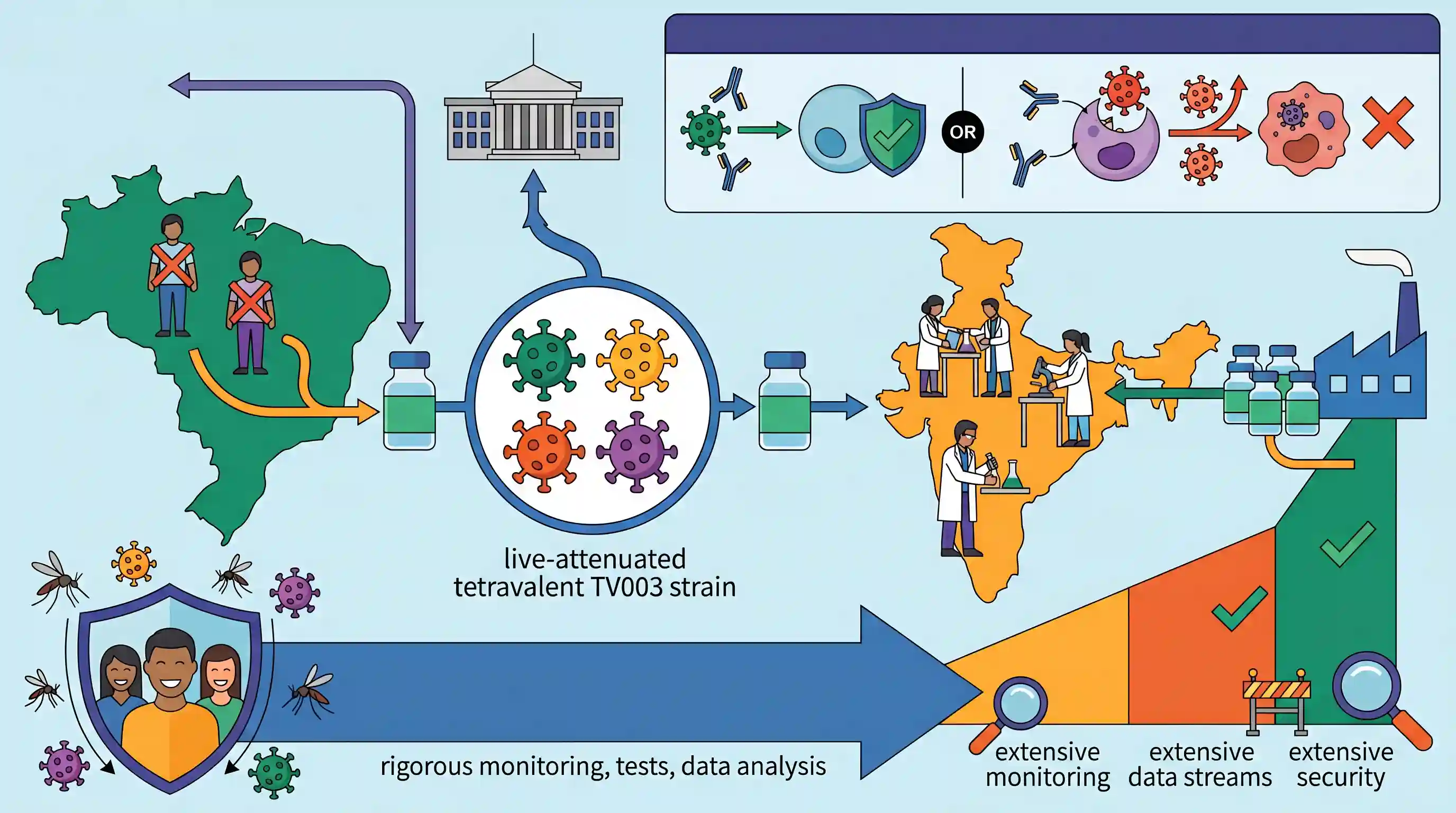
The recent deaths of two volunteers in Brazil following the administration of the Butantan-DV dengue vaccine have triggered safety concerns for India's upcoming dengue vaccine, DengiAll. Both vaccines utilize the same live-attenuated tetravalent TV003 strain developed by the US National Institutes of Health (NIH). In India, manufacturers such as Indian Immunologicals Limited (IIL) and Panacea Biotec are conducting clinical trials for this vaccine. The safety scare highlights the complex immunological challenges of creating a dengue vaccine—most notably Antibody-Dependent Enhancement (ADE)—and underscores the critical necessity of rigorous safety monitoring and exhaustive Phase 3 clinical trials before introducing the vaccine to combat India's endemic dengue burden.
Key Points
- Safety concerns have emerged for DengiAll, India's indigenous dengue vaccine candidate, following two deaths associated with clinical trials of the Butantan-DV vaccine in Brazil.
- Both DengiAll (under trial by Indian Immunologicals Limited and Panacea Biotec) and Butantan-DV are based on the same live-attenuated tetravalent TV003 strain developed by the US National Institutes of Health (NIH).
- Developing a successful dengue vaccine is exceptionally challenging due to Antibody-Dependent Enhancement (ADE), where antibodies from a previous infection or vaccination can make a subsequent infection by a different serotype more severe.
- The Brazilian incident emphasizes the need for stringent Phase 3 clinical trials and long-term monitoring in India to guarantee safety and multi-serotype efficacy before public rollout.
Important Terms
DengiAll

India's indigenous, live-attenuated tetravalent dengue vaccine developed by Panacea Biotec and ICMR using NIH technology; currently in Phase 3 clinical trials.
UPSC context
GS 3 (S&T); tests knowledge of indigenous medical innovations and public health interventions for endemic diseases.
Butantan-DV
Brazil’s single-dose dengue vaccine developed by the Butantan Institute; recently suspended as a precaution following two reported deaths during its rollout.
UPSC context
GS 2 (Health); illustrates international safety protocols and challenges of global vaccine trials and regulatory oversight.
Antibody-Dependent Enhancement (ADE)
An immunological phenomenon where existing antibodies fail to neutralize a virus and instead facilitate its entry into cells, potentially worsening infection severity.
UPSC context
GS 3 (Biotechnology); crucial for understanding technical hurdles and safety risks in viral vaccine development.
Panacea Biotec
An Indian biopharmaceutical company leading the development and Phase 3 clinical trials of the DengiAll vaccine in partnership with the ICMR.
UPSC context
GS 3 (S&T); represents the role of domestic private-sector collaboration in achieving 'Atmanirbhar' in healthcare.
National Institutes of Health (NIH)
The primary U.S. government agency for biomedical research; it developed the TV003 strain used in dengue vaccines worldwide.
UPSC context
GS 2 (Health/IR); highlights the significance of global technology transfers in medical research and development.
Butantan Institute
A leading Brazilian public research center and vaccine producer responsible for developing Butantan-DV and managing its safety investigations.
UPSC context
GS 3 (Biotechnology); provides a comparative case study for vaccine safety monitoring in the Global South.
Indian Immunologicals Limited (IIL)
A major Indian vaccine manufacturer and NDDB subsidiary also developing a dengue vaccine candidate using the licensed NIH TV003 strain.
UPSC context
GS 3 (S&T); tests awareness of multiple domestic players in the vaccine ecosystem and biotechnology diversification.
Prelims Trap
Recovery from a dengue infection provides lifelong immunity against all four dengue virus serotypes.
Immunity is strictly serotype-specific. A subsequent infection by a different serotype often leads to a much more severe disease due to Antibody-Dependent Enhancement (ADE).
Static Concepts Connected
What is Antibody-Dependent Enhancement (ADE) in viral infections?
- Sub-optimal Binding: Pre-existing antibodies from a past infection or vaccine bind to a new virus variant but fail to completely neutralize it.
- Enhanced Entry: Instead of clearing the virus, the antibody-virus complex helps the pathogen enter immune cells (like macrophages) more efficiently.
- Aggravated Disease: The virus replicates aggressively inside the immune cells, leading to a hyper-inflammatory response and severe clinical symptoms (e.g., severe dengue).
What are the core characteristics of Live-Attenuated Vaccines?
- Weakened Pathogen: They use a whole, living pathogen that has been genetically weakened in a lab so it cannot cause severe disease in healthy people.
- Strong Immunity: Because they closely mimic a natural infection, they typically elicit a robust cellular and antibody immune response, often requiring fewer doses.
- Inherent Risks: They pose a slight risk of reverting to a virulent form and are generally contraindicated for immunocompromised individuals.
Cross-Topic Patterns
Climate Change & Vector Expansion
Rising global temperatures and altered monsoon patterns are expanding the habitat of Aedes mosquitoes, pushing dengue into previously unaffected temperate zones and high-altitude regions.
Global Tech Transfer & Vaccine Security
DengiAll's reliance on the US NIH TV003 strain highlights how international licensing and technology transfer remain crucial for accelerating India's indigenous vaccine manufacturing capabilities.

Expect a multi-statement Prelims question comparing vaccine platforms (live-attenuated) and the ADE phenomenon in multi-serotype viruses.
Linked PYQs · 4
Linked PYQs · 4
- 2017PrelimsGS1
Consider the following statements: 1. In tropical regions, Zika virus disease is transmitted by the same mosquito that transmits dengue. 2. Sexual transmission of Zika virus disease is possible. Which of the statements given above is/are correct?
- 2023PrelimsGS1
'Wolbachia method' is sometimes talked about with reference to which one of the following?
- 2021PrelimsGS1
With reference to recent developments regarding 'Recombinant Vector Vaccines', consider the following statements : 1. Genetic engineering is applied in the development of these vaccines. 2. Bacteria and viruses are used as vectors. Which of the statements given above is/are correct?
- 2022MainsGS3
What is the basic principle behind vaccine development ? How do vaccines work? What approaches were adopted by the Indian vaccine manufacturers to produce COVID-19 vaccines ?
