Online Gaming Companies Challenge New Law in Supreme Court
Source:The Hindu ↗
Why It Matters
This issue bridges constitutional law, governance, and internal security, making it highly relevant for UPSC. It touches upon fundamental rights (Articles 14, 19), the constitutional division of powers between Centre and States, the Supreme Court's jurisdiction, and contemporary internal security threats like money laundering and terror financing via emerging digital platforms.
Summary
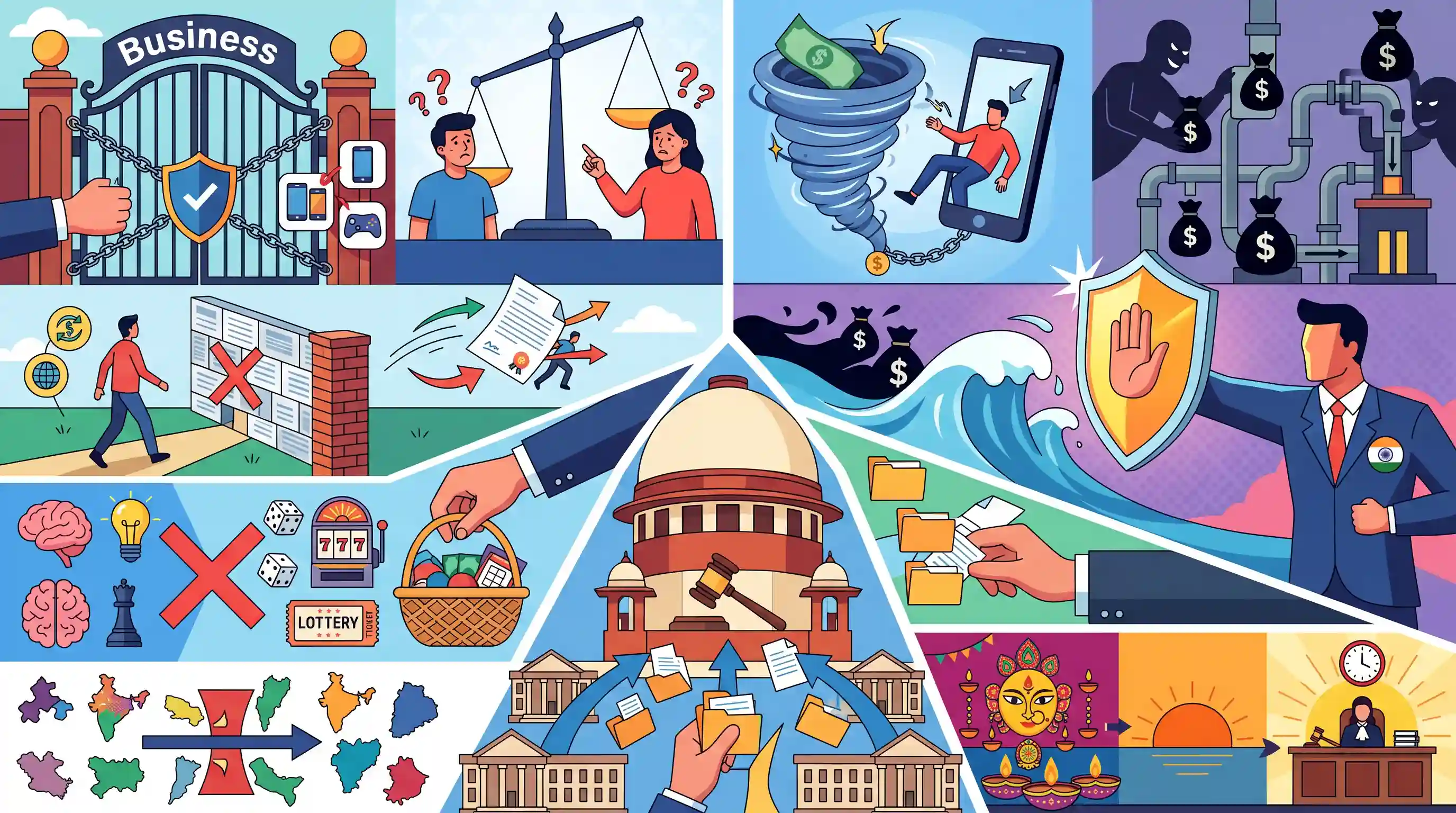
Online gaming companies have petitioned the Supreme Court seeking interim relief against the recently enacted Promotion and Regulation of Online Gaming Act, 2025, which bans real money games, related banking, and ads. The petitioners argue the law forces business closures, infringes on their fundamental rights under Articles 14 and 19, breaches federalism, and conflates games of skill with games of chance. Conversely, the government defends the legislation as essential for preventing addiction, financial losses, money laundering, and terror financing. To avoid conflicting rulings, the Centre has requested the Supreme Court to transfer existing petitions from various High Courts to itself. The Court has scheduled the hearing for after the Dussehra break.
Key Points
- Online gaming companies have approached the Supreme Court against the Promotion and Regulation of Online Gaming Act, 2025, claiming it has forced them to shut down their businesses.
- The Act completely bans real money games, associated banking services, and advertisements.
- The government argues the ban is crucial to curb risks like addiction, financial ruin, money laundering, and terror financing facilitated by these platforms.
- The Centre requested the Supreme Court to transfer all related petitions from various High Courts to itself to ensure an authoritative constitutional ruling and avoid contradictory judgments.
- Petitioners contend the law violates fundamental rights (Articles 14 and 19), federalism, and ignores the jurisprudential distinction between games of skill and games of chance.
Important Terms
Promotion and Regulation of Online Gaming Act, 2025

A 2025 federal law banning online real-money games (regardless of skill) while promoting e-sports and social gaming. It penalizes offering, advertising, or facilitating financial transactions for prohibited games.
UPSC context
GS Paper 2 (Government Policies). Tests understanding of digital economy regulation, central-state legislative competence, and socio-economic interventions.
Game of Skill vs. Game of Chance
A judicial test distinguishing activities where success depends on expertise (skill) from those determined by luck (chance). Traditionally, skill-based games are considered protected trade, while chance-based ones are gambling.
UPSC context
GS Paper 2 (Judiciary). Crucial for understanding constitutional protections for businesses and legal precedents on gambling/betting.
Article 19(1)(g)
A Fundamental Right under the Indian Constitution granting citizens the freedom to practice any profession or carry on any occupation, trade, or business, subject to reasonable restrictions.
UPSC context
GS Paper 2 (Fundamental Rights). Key in cases where state regulations are challenged for infringing upon economic liberties and business rights.
Article 139A
Constitutional provision allowing the Supreme Court to transfer cases from High Courts to itself if they involve substantially the same questions of law of general importance.
UPSC context
GS Paper 2 (Judiciary). Relevant to the Supreme Court's jurisdiction and power to ensure uniform application of central laws.
Money Laundering
The process of making illegally obtained funds appear legitimate. The government cites this, alongside terror financing and addiction, as a primary justification for banning online money games.
UPSC context
GS Paper 3 (Internal Security). Tests awareness of non-traditional security threats and the role of digital platforms in financial crimes.
Real Money Games (RMG)
Online platforms where users pay entry fees or wager stakes to win monetary rewards. The 2025 Act specifically targets this sector for a blanket ban.
UPSC context
GS Paper 3 (Economy/IT). Relevant to the growth of India's digital sector and the regulatory challenges of high-stakes internet activities.
Prelims Trap
"Betting and online gambling fall under the Concurrent List, allowing both Centre and States to legislate."
Betting and gambling are strictly in the State List (Entry 34). Central regulations typically rely on IT/telecom entries or residuary powers, which fuels federalism disputes.
Static Concepts Connected
What is Article 139A regarding the transfer of cases?
- Constitutional basis: Article 139A allows the Supreme Court to withdraw pending cases from one or more High Courts that involve identical and substantial questions of law.
- Initiating authority: The Supreme Court can act suo motu, or upon an application by the Attorney General of India or any party to the case.
- Primary objective: It ensures a single, authoritative constitutional ruling by the apex court and prevents contradictory judgments across different state High Courts.
How does constitutional law treat games of skill versus games of chance?
- Game of skill: Where success depends predominantly on knowledge, training, and experience, it is a legitimate business protected under Article 19(1)(g) (freedom of profession).
- Game of chance: Where outcomes depend primarily on luck, it is classified as gambling. It lacks Article 19 protection and can be completely prohibited by the state.
Cross-Topic Patterns
Gaming platforms as laundering vectors
Unregulated real-money platforms often bypass FEMA and PMLA via offshore crypto wallets and mule accounts, elevating online gaming from a social issue to a core GS3 internal security threat.
Tech regulation vs. State Lists
The Centre regulates digital platforms using the IT Act (Union List) while States claim jurisdiction via "betting and gambling" (State List), causing repeated legislative competence disputes.

Expect a 2026 Prelims question linking Article 139A (transfer of cases) with Schedule VII entries on 'betting and gambling' or IT regulation.
Linked PYQs · 5
Linked PYQs · 5
- 2021MainsGS3
Discuss how emerging technologies and globalisation contribute to money laundering. Elaborate measures to tackle the problem of money laundering both at national and international levels.
- 2020MainsGS3
Discuss different types of cyber crimes and measures required to be taken to fight the menace.
- 2017MainsGS3
The scourge of terrorism is a grave challenge to national security. What solutions do you suggest to curb this growing menace? What are the major sources of terrorist funding?
- 2024MainsGS2
Explain the reasons for the growth of public interest litigation in India. As a result of it, has the Indian Supreme Court emerged as the world's most powerful judiciary ?
- 2019MainsGS2
From the resolution of contentious issues regarding distribution of legislative powers by the courts, 'Principle of Federal Supremacy' and 'Harmonious Construction' have emerged. Explain.
