Crude oil price surge and macroeconomic impacts on India
Source:Indian Express ↗
Why It Matters
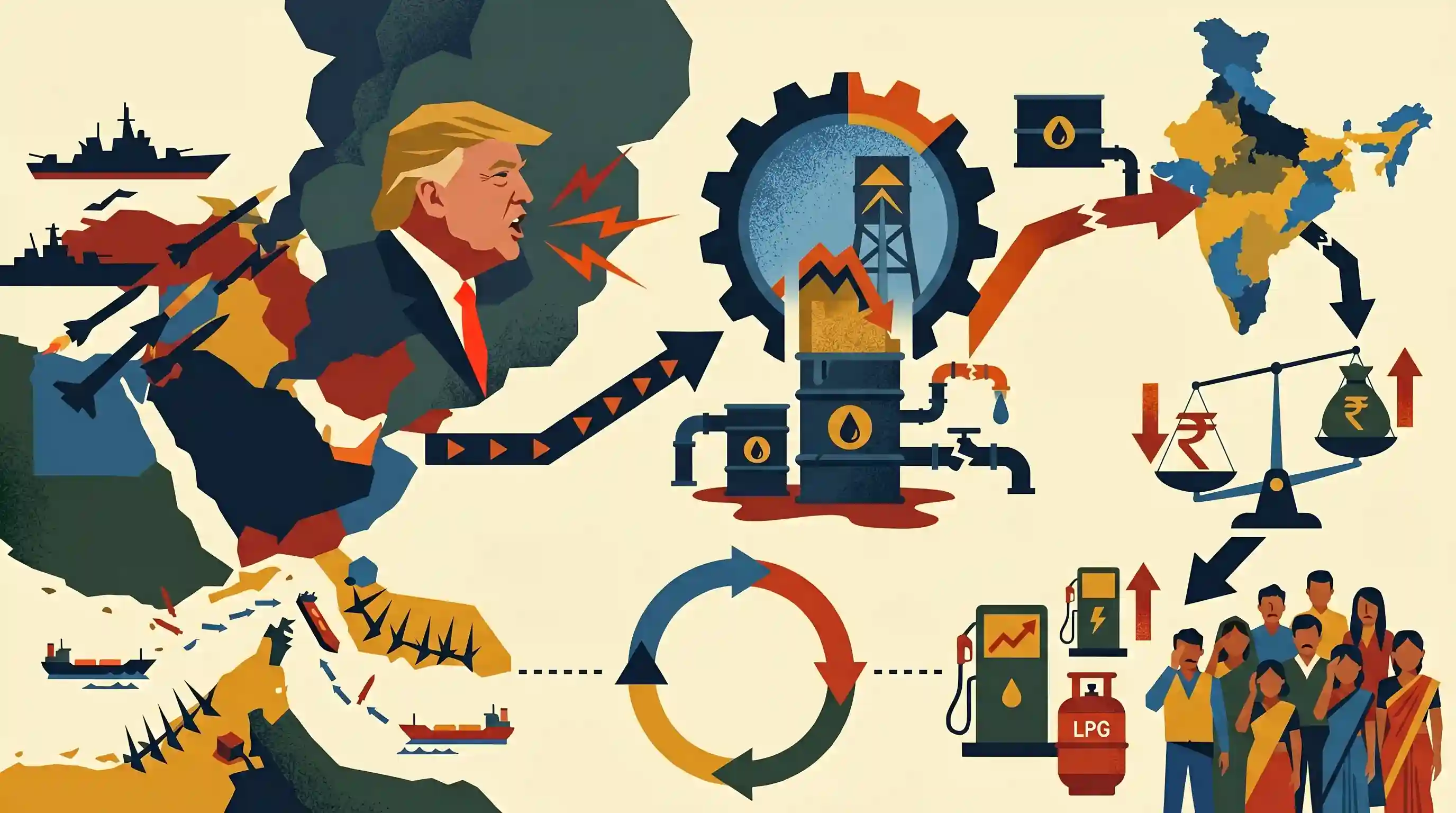
The article provides a textbook real-world example of how geopolitical tensions in the Middle East directly impact India's macroeconomic stability through the transmission channels of crude oil prices, exchange rate depreciation, and imported inflation. This is highly relevant for GS-2 (IR/Energy Diplomacy) and GS-3 (Economy/Inflation).
Summary
Global oil prices experienced a sharp 7% surge, with Brent crude reaching $108 per barrel, following US President Donald Trump's remarks indicating potential military operations against Iran. This geopolitical escalation raises severe concerns over the security of energy supplies routed through the Strait of Hormuz. For India, which is heavily dependent on crude oil imports, this spike translates into significant macroeconomic risks. The Indian rupee faced high volatility against the US dollar, and the rising import bill threatens to elevate domestic fuel prices (petrol, diesel, and LPG) and stoke broader inflation. The developments underscore the intricate link between Middle Eastern geopolitics, global energy security, and India's domestic economic stability.
Key Points
- Brent crude prices spiked 7% to $108 per barrel following US President Donald Trump's remarks hinting at continued military operations in Iran.
- The geopolitical tensions threaten to disrupt global oil supplies through the Strait of Hormuz, a critical maritime chokepoint.
- The crude price surge negatively impacted the Indian economy, causing the Rupee to experience significant volatility and initially touch a low of 95.21 against the US dollar.
- Rising global crude prices and currency depreciation increase India's import bill, adding upward pressure on domestic petrol, diesel, and LPG prices, and exacerbating inflation.
- The situation highlights India's macroeconomic vulnerability to Middle Eastern geopolitical instability and the critical need to bolster energy security.
Important Terms
Brent Crude

A major global price benchmark for sweet light crude oil sourced from the North Sea, used to price two-thirds of the world's internationally traded oil.
UPSC context
GS Paper 3 (Economy); tests understanding of global energy pricing benchmarks and their impact on India's import bill and inflation.
Strait of Hormuz
A strategic maritime chokepoint between Oman and Iran connecting the Persian Gulf to the Arabian Sea; it facilitates roughly one-fifth of global oil consumption.
UPSC context
GS Paper 2 (International Relations) & GS Paper 1 (Geography); relates to maritime security, energy lifelines, and Middle East geopolitics.
Energy Security
The uninterrupted availability of energy sources at an affordable price, encompassing physical availability, economic accessibility, and long-term sustainability.
UPSC context
GS Paper 3 (Infrastructure/Energy); crucial for India's strategic autonomy and domestic economic stability given its high import dependency.
US Federal Reserve
The central banking system of the United States; its monetary policy decisions influence global liquidity, capital flows (FPI), and the USD-INR exchange rate.
UPSC context
GS Paper 3 (Economy); tests knowledge of global financial transmission and how foreign monetary policy affects India's macroeconomic indicators.
Macroeconomic Stability
An economic state characterized by low volatility in key indicators like GDP growth, inflation, and exchange rates, minimizing vulnerability to external shocks.
UPSC context
GS Paper 3 (Economy); central to discussions on fiscal prudence, inflation targeting, and resilience against global energy price shocks.
Current Account Deficit (CAD)
A measure of trade where the value of goods and services imported exceeds those exported; in India, it is highly sensitive to crude oil prices.
UPSC context
GS Paper 3 (Economy); critical for assessing the external sector's health and the impact of rising oil import bills on foreign reserves.
Prelims Trap
"A depreciating Rupee helps control domestic inflation by reducing the demand for imports."
While depreciation reduces demand for elastic imports, India's crude oil demand is highly inelastic. A weaker rupee directly causes 'imported inflation' by increasing domestic fuel costs.
Static Concepts Connected
How do global crude price shocks impact India's macroeconomic stability?
- Imported Inflation: Rising fuel import costs cascade into higher domestic transportation and manufacturing expenses, stoking retail and wholesale inflation.
- CAD Widening: A ballooning oil import bill directly widens the Current Account Deficit (CAD), straining foreign exchange reserves.
- Rupee Depreciation: Increased demand for US Dollars to pay for costly oil puts downward pressure on the Rupee, perpetuating a vicious cycle of depreciation.
What is the strategic geography of the Strait of Hormuz?
- Location: It is a narrow maritime chokepoint linking the Persian Gulf to the Gulf of Oman and the Arabian Sea.
- Trade Volume: It facilitates roughly 20% of global oil trade, making it irreplaceable for the energy security of major Asian economies like India.
- Vulnerability: Highly susceptible to naval blockades or geopolitical posturing by regional powers, with few viable overland pipeline alternatives.
Cross-Topic Patterns
Geopolitics + Strategic Petroleum Reserves
Supply risks in the Strait of Hormuz spotlight India's ISPRL projects (e.g., Padur, Chandikhol) designed to provide a strategic cushion against acute supply disruptions.
Imported Inflation + RBI Forex Intervention
Sudden crude spikes forcing Rupee depreciation often trigger the RBI to sell dollars, linking global geopolitics directly to domestic monetary interventions and forex reserves management.

Expect a 2026 Prelims question mapping Middle East chokepoints alongside the macroeconomic mechanics of imported inflation and the CAD.
Linked PYQs · 4
Linked PYQs · 4
- 2025MainsGS2
"Energy security constitutes the dominant kingpin of India's foreign policy, and is linked with India's overarching influence in Middle Eastern countries.” How would you integrate energy security with India's foreign policy trajectories in the coming years?
- 2017MainsGS2
The question of India's Energy Security constitutes the most important part of India's economic progress. Analyze India's energy policy cooperation with West Asian countries.
- 2018MainsGS3
How would the recent phenomena of protectionism and currency manipulations in world trade affect macroeconomic stability of India?
- 2024PrelimsGS1
Consider the following statements : Statement-I : Sumed pipeline is a strategic route for Persian Gulf oil and natural gas shipments to Europe. Statement-II : Sumed pipeline connects the Red Sea with the Mediterranean Sea. Which one of the following is correct in respect of the above statements?
