Burevestnik Missile Alters Strategic Deterrence and Arms Race
Source:Indian Express ↗
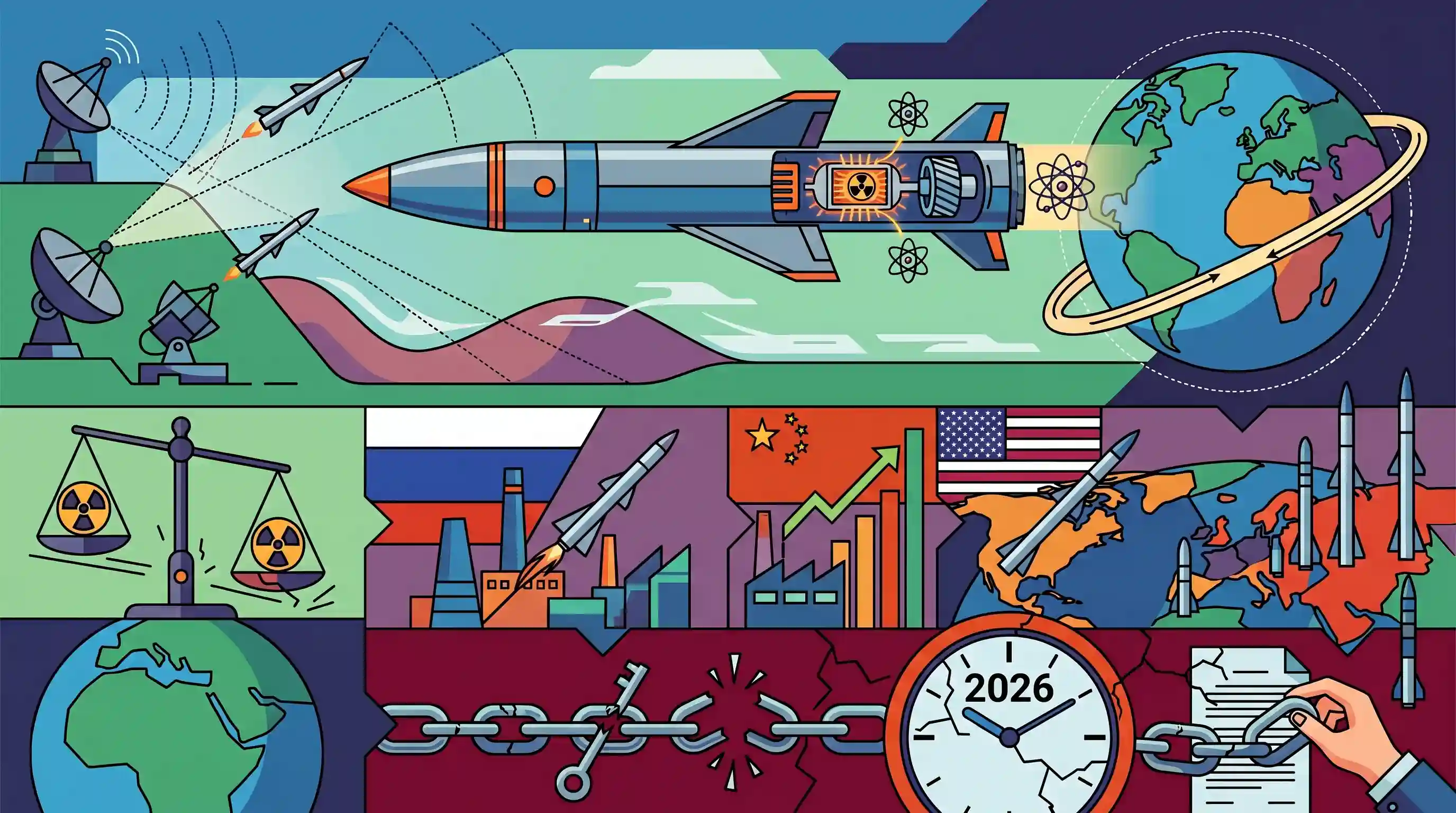
Why It Matters
The integration of nuclear propulsion into cruise missiles alters the landscape of missile defense and strategic deterrence. This is highly relevant for GS3 (Indigenization of technology and developing new technology in defence) and GS2 (Bilateral, regional and global groupings and agreements involving India and/or affecting India's interests).
Summary
Russia's development of the Burevestnik missile, a nuclear-powered cruise missile, represents a major leap in strategic defense technology. By integrating a miniaturized nuclear reactor for propulsion, the missile boasts a virtually unlimited range and low-altitude flight capabilities, enabling it to evade conventional radar detection and interceptor systems. This development disrupts traditional nuclear deterrence dynamics, raising concerns about a renewed global arms race. Furthermore, it complicates international security frameworks, presenting a critical challenge for arms control negotiations as the New START treaty between the US and Russia approaches its 2026 expiration.
Key Points
- The Burevestnik (SSC-X-9 Skyfall) is an experimental Russian nuclear-powered cruise missile capable of carrying nuclear warheads.
- Unlike conventionally powered cruise missiles, its nuclear propulsion system theoretically grants it an unlimited range.
- The missile is designed to fly at low altitudes, evading traditional early-warning radars and bypassing existing US missile defense shields.
- The weapon's development sparks fears of a renewed nuclear arms race and complicates the global deterrence architecture.
- It poses significant challenges for future arms control frameworks, particularly as the bilateral New START treaty between the US and Russia expires in 2026.
Important Terms
9M730 Burevestnik

An experimental Russian intercontinental-range cruise missile (NATO: SSC-X-9 Skyfall) featuring a miniature nuclear reactor for propulsion, enabling virtually unlimited range and low-altitude flight to evade missile defense systems.
UPSC context
GS-III (Defense Technology) and GS-II (International Relations); tests understanding of emerging strategic weapon systems and global stability.
New START Treaty
The last major bilateral arms control agreement between the US and Russia, which capped deployed strategic nuclear warheads and delivery systems until its expiration in February 2026.
UPSC context
GS-II (International Relations/Global Groupings); tests knowledge of nuclear non-proliferation frameworks and contemporary arms control challenges.
Nuclear Deterrence
A military doctrine where the threat of catastrophic retaliation prevents an adversary from launching an attack, fundamentally relying on the concept of Mutually Assured Destruction (MAD).
UPSC context
GS-II (IR) and GS-III (Security); essential for analyzing India's "Credible Minimum Deterrence" and global nuclear politics.
NATO
An intergovernmental military alliance of 32 member states committed to collective defense (Article 5), serving as the primary security counterweight to Russian strategic military developments.
UPSC context
GS-II (International Organizations); tests understanding of geopolitical alliances and their impact on global security dynamics.
Nuclear-powered Cruise Missile
A missile using a compact nuclear reactor to superheat intake air for propulsion, allowing it to loiter indefinitely and bypass high-altitude ballistic missile defenses.
UPSC context
GS-III (Science & Technology); focuses on disruptive propulsion technologies and their implications for modern defense architectures.
Prelims Trap
Burevestnik achieves its unlimited range by functioning as a multi-stage Intercontinental Ballistic Missile (ICBM).
Burevestnik is a cruise missile, not a ballistic missile. It achieves theoretically unlimited range via a miniaturized nuclear reactor providing continuous thrust, not via multi-stage rockets.
Static Concepts Connected
What distinguishes a cruise missile from a ballistic missile?
- Flight Path: Ballistic missiles follow a parabolic, unpowered exo-atmospheric trajectory. Cruise missiles are continuously powered and guided entirely within the Earth's atmosphere.
- Propulsion: Cruise missiles typically use air-breathing jet engines (ramjet/turbofan). Ballistic missiles rely on rocket motors, carrying both fuel and oxidizer.
- Altitude & Detection: Cruise missiles fly at very low, terrain-hugging altitudes to evade radar detection, whereas ballistic missiles re-enter the atmosphere from space.
What are the core pillars of the New START Treaty?
- Bilateral Framework: It is the last remaining major nuclear arms reduction treaty between the USA and Russia, originally signed in 2010.
- Limits Imposed: It strictly caps deployed strategic nuclear warheads to 1,550 and deployed delivery vehicles (ICBMs, SLBMs, heavy bombers) to 700.
- Current Status: Russia formally suspended participation in 2023, though caps are still broadly observed. The treaty legally expires in February 2026.
Cross-Topic Patterns
Nuclear Propulsion vs Nuclear Warheads
UPSC tests conceptual clarity between nuclear-armed (payload) and nuclear-powered (propulsion). Burevestnik's uniqueness is its reactor-based propulsion, much like the power source of an SSBN submarine.
Erosion of Global Arms Control
The collapse of the INF Treaty, Russia's suspension of New START, and the emergence of unregulated, novel delivery systems heighten the risks of a vertical arms race among P5 nations.

New START's 2026 expiry and nuclear propulsion tech make strategic delivery systems a prime multi-statement target for Prelims.
Linked PYQs · 2
Linked PYQs · 2
- 2023PrelimsGS1
Consider the following statements: 1. Ballistic missiles are jet-propelled at subsonic speeds throughout their flights, while cruise missiles are rocket-powered only in the initial phase of flight. 2. Agni-V is a medium-range supersonic cruise missile, while BrahMos is a solid-fuelled intercontinental ballistic missile. Which of the statements given above is/are correct?
- 2011PrelimsGS1
The "New START" treaty was in the news. What is this treaty?
