India Rejects Western Sanctions and Tariff Pressure on Oil Trade
Source:The Hindu ↗
Why It Matters
Highlights the growing friction between India and Western powers over secondary sanctions and trade policies, emphasizing India's commitment to strategic autonomy and energy security amidst global conflicts.
Summary
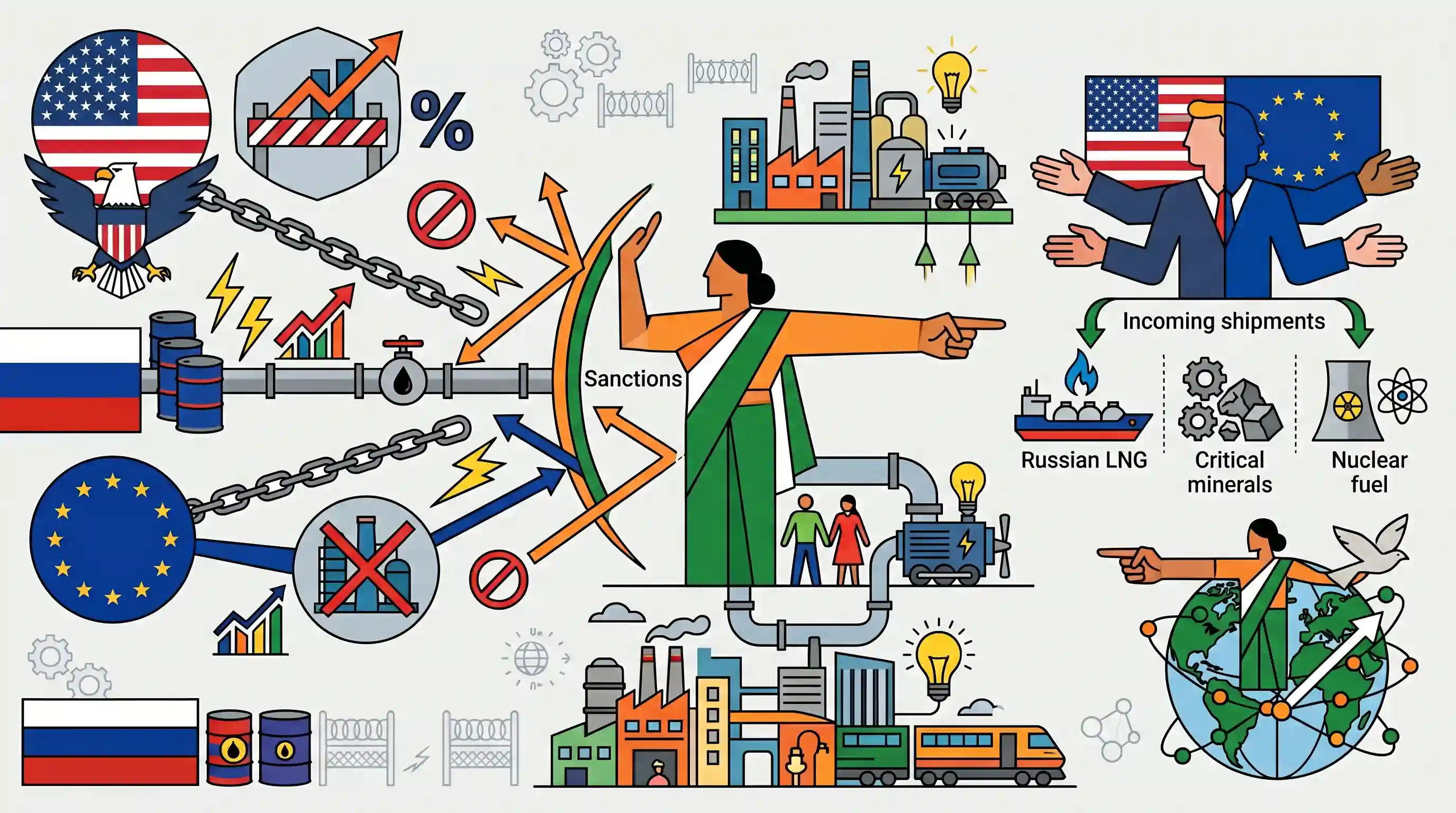
The Indian Ministry of External Affairs strongly responded to the United States and the European Union over recent tariffs and sanctions targeting India's trade in Russian oil. Dismissing the punitive measures—which include a US tariff hike above 25% and EU secondary sanctions on Indian refiners like the Vadinar facility—as 'unjustified and unreasonable,' New Delhi emphasized that purchasing Russian oil remains a 'vital national compulsion' to ensure economic and energy security. India criticized Western hypocrisy, pointing out ongoing US and EU imports of Russian LNG, critical minerals, and nuclear fuel. The pushback reflects India's broader frustration with aggressive US stances on issues like trade, immigration, and BRICS membership, ultimately underscoring that India's strategic autonomy and sovereign choice of partners are non-negotiable.
Key Points
- The Indian MEA pushed back against US and EU sanctions and tariffs targeting India for importing and processing Russian oil.
- The US announced penalty tariffs exceeding 25% on India, and the EU sanctioned the partially Russian-owned Vadinar refinery alongside other secondary sanctions.
- India defended its Russian oil purchases as a 'vital national compulsion' required to safeguard national interests and energy security.
- The MEA highlighted Western hypocrisy, noting that the US and EU continue to import Russian LNG, critical minerals, and nuclear fuel.
- Tensions with the US also extend to immigration, trade talks (agriculture and dairy), Pakistan, and India's role in BRICS.
- India reaffirmed its strategic autonomy, stating that its sovereignty and foreign policy choices cannot be dictated by other nations.
Important Terms
Strategic Autonomy

The ability of a nation to pursue independent foreign policy and security decisions based on national interest without aligning permanently with any major power bloc.
UPSC context
GS Paper II (International Relations). Core doctrine defining India's balancing act between the US, Russia, and China.
Secondary Sanctions
Extraterritorial measures targeting third-party entities (like Indian refiners) trading with a sanctioned nation, aimed at enforcing global compliance with the sanctioning country's policies.
UPSC context
GS Paper II (Global Groupings & Agreements). Critical for understanding the impact of US/EU laws on India’s sovereign trade.
Operation Sindoor
India's 2025 military response to the Pahalgam terror attack, marking a shift toward direct retaliatory action and assertive diplomatic outreach to safeguard national interests.
UPSC context
GS Paper III (Internal Security). Tests knowledge of India's evolving counter-terrorism posture and its diplomatic implications.
Vadinar Facility
A major refinery in Gujarat, owned by Nayara Energy, which became a focal point of EU secondary sanctions due to its Russian (Rosneft) investment.
UPSC context
GS Paper III (Energy/Economy). Illustrates the intersection of foreign investment, energy infrastructure, and geopolitical risk.
Energy Security
The condition of having reliable and affordable access to energy sources; India's primary justification for maintaining diverse energy partnerships, including with Russia.
UPSC context
GS Paper III (Infrastructure: Energy). A key driver of India's foreign policy and economic stability.
European Union (EU)
An intergovernmental organization of 27 European countries that implements joint trade policies and sanctions, often impacting non-member nations like India.
UPSC context
GS Paper II (Global Groupings). Focuses on EU-India trade relations and regulatory friction.
BRICS
An acronym for the emerging economies of Brazil, Russia, India, China, and South Africa (expanded in 2024) that promotes a multipolar world order.
UPSC context
GS Paper II (International Groups). Essential for understanding India's role in South-South cooperation and alternative financial systems.
Ministry of External Affairs (MEA)
The nodal government agency responsible for formulating and executing India's foreign policy and representing the country in international forums.
UPSC context
GS Paper II (Structure and Functioning of the Executive). The primary actor in diplomatic negotiations and crisis management.
Prelims Trap
Secondary sanctions imposed by the US and EU are legally binding on third-party countries under international law.
Secondary sanctions are unilateral, extraterritorial measures by individual nations/blocs (US/EU). India officially does not recognize them, complying only with UN Security Council resolutions.
Static Concepts Connected
What are secondary sanctions and how do they function?
- Mechanism: Primary sanctions block direct trade. Secondary sanctions threaten third-party entities (like Indian refiners) with penalties to force compliance with the primary sanctions.
- Extraterritoriality: They apply domestic laws (US/EU) outside their borders, relying on the sanctioning entity's dominance in global financial systems like SWIFT or the US dollar.
- India's Stance: India formally rejects unilateral sanctions, maintaining that it is legally bound only by sanctions mandated by the United Nations Security Council.
What defines India's policy of Strategic Autonomy?
- Issue-based alignments: India pursues multi-directional engagements and issue-based alignments driven by national interest, rather than committing to rigid, Cold War-style military alliances.
- Evolution from NAM: Unlike traditional Non-Alignment which often implied staying aloof, strategic autonomy involves proactive, concurrent partnerships with competing powers (e.g., Quad and BRICS).
- Sovereign choice: Retaining the sovereign right to choose partners, notably securing energy or defense needs (Russian oil, S-400) despite pressure from Western partners.
Cross-Topic Patterns
Energy Security vs Global Geopolitics
Securing affordable Russian oil to manage domestic inflation directly conflicts with Western strategic goals, highlighting the recurring tension between India's geo-economics and global geopolitics.
WTO norms and unilateral trade tariffs
US tariff hikes and punitive trade measures challenge WTO rules, linking bilateral diplomatic disputes to the broader crisis in multilateral trade governance and dispute resolution.

Expect a Mains question linking India's 'strategic autonomy' to its navigation of unilateral secondary sanctions and energy needs.
Linked PYQs · 2
Linked PYQs · 2
- 2019MainsGS2
‘What introduces friction into the ties between India and the United States is that Washington is still unable to find for India a position in its global strategy, which would satisfy India's national self-esteem and ambitions.’ Explain with suitable examples.
- 2025MainsGS2
"Energy security constitutes the dominant kingpin of India's foreign policy, and is linked with India's overarching influence in Middle Eastern countries.” How would you integrate energy security with India's foreign policy trajectories in the coming years?
