Delhi Ahmedabad Bullet Train Corridor Extension to Udaipur
Source:udaipurtimes ↗
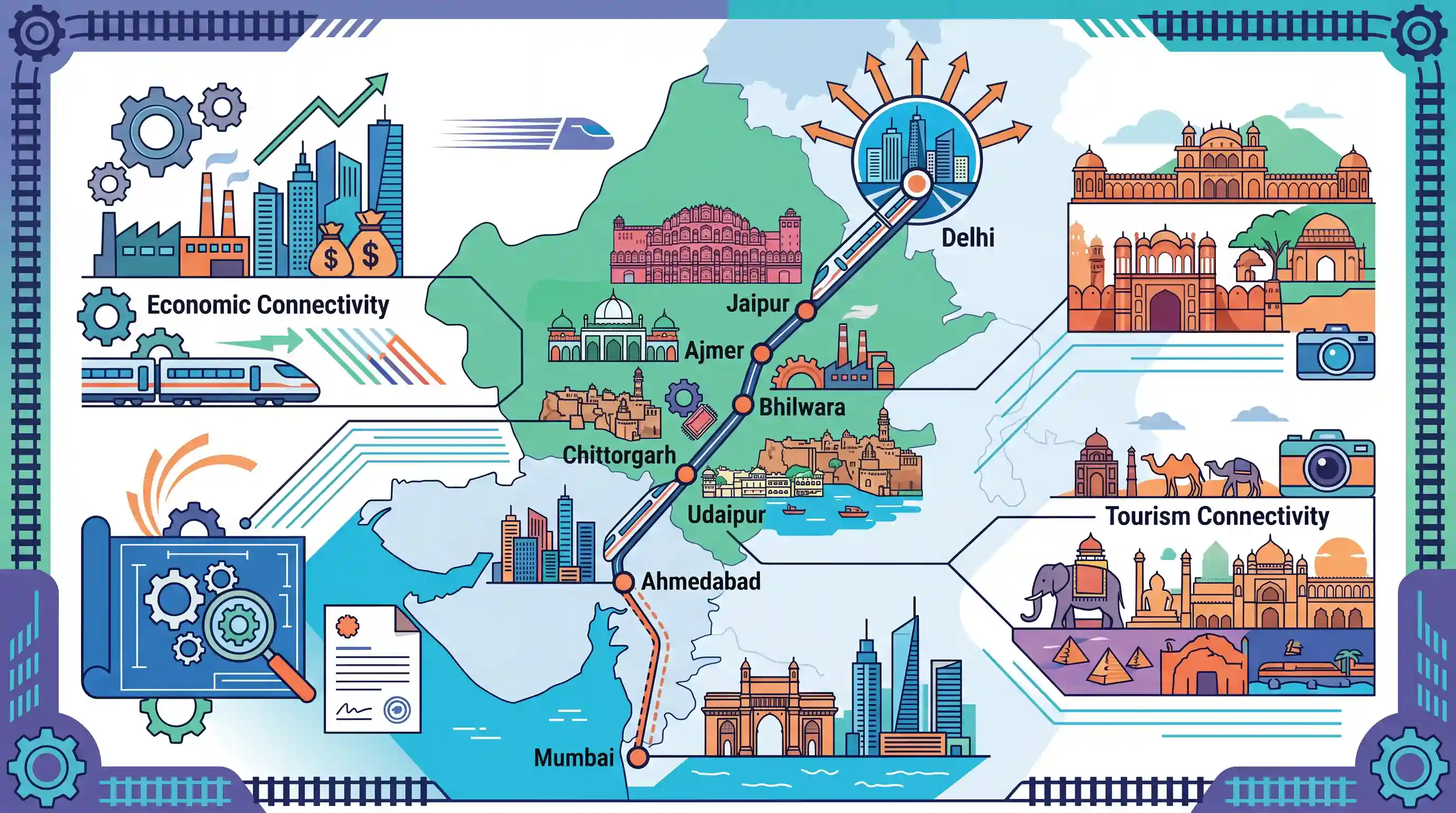
Why It Matters
This project is highly significant for transport infrastructure, tourism, and economic integration in western India. For RPSC RAS, detailed knowledge of transport corridors, their routes, stations in Rajasthan, and general infrastructure trends is critically important, similar to past questions on major national corridors.
Summary
The Central Government is planning to integrate Udaipur into the high-speed rail network through the proposed Delhi-Jaipur-Udaipur-Ahmedabad Bullet Train Corridor. Spanning approximately 886 kilometers, this corridor will connect key industrial, urban, and tourism centers of Rajasthan (such as Jaipur, Ajmer, Bhilwara, Chittorgarh, and Udaipur) with Delhi, Haryana, and Gujarat. The project's Detailed Project Report (DPR) is prepared and awaiting final approval. This corridor will eventually link up with the under-construction Mumbai-Ahmedabad high-speed rail line, creating a high-speed network between Delhi and Mumbai. This initiative is part of a broader vision to establish Delhi as a central high-speed rail hub with connections extending in four major directions.
Key Points
- The Central Government has prepared a Detailed Project Report (DPR) to establish New Delhi as the primary Bullet Train hub in India, linking major regions through high-speed rail corridors.
- The Delhi-Jaipur-Udaipur-Ahmedabad Bullet Train Corridor is proposed to span approximately 886 kilometers, connecting crucial locations in Delhi, Haryana, Rajasthan, and Gujarat.
- Proposed stations on this corridor include Dwarka, Bijwasan, Gurugram, Manesar, Rewari, Neemrana, Jaipur, Ajmer, Bhilwara, Chittorgarh, Udaipur, and Ahmedabad.
- The corridor will eventually merge with the under-construction Mumbai-Ahmedabad Bullet Train line, establishing high-speed rail connectivity between Delhi and Mumbai.
- In addition to this route, three other bullet train corridors extending from Delhi are planned: Delhi-Lucknow-Varanasi, Delhi-Varanasi-Siliguri, and Delhi-Amritsar-Jammu.
- The DPR for the Delhi-Jaipur-Udaipur-Ahmedabad corridor is completed and currently awaits cabinet/administrative approval.
Important Terms
Mumbai-Ahmedabad Bullet Train Corridor

India's premier 508-km under-construction high-speed rail corridor connecting Mumbai and Ahmedabad, built using Japanese Shinkansen technology and standard ballastless J-Slab track system to run at operational speeds of 320 km/h.
UPSC context
GS Paper III (Infrastructure: Railways), testing technological partnership, indigenization of high-speed rail, and economic impact of transit corridors.
Delhi-Jaipur-Udaipur-Ahmedabad Bullet Train Corridor
A proposed 886-km high-speed rail network connecting Delhi to Ahmedabad through Rajasthan's economic and tourism hubs like Jaipur and Udaipur, eventually joining the Mumbai-Ahmedabad line to complete a Delhi-Mumbai spine.
UPSC context
GS Paper III (Infrastructure) and GS Paper I (Geography), assessing regional tourism, industrial development, and North-West corridor connectivity.
Delhi-Lucknow-Varanasi Bullet Train Corridor
An 813–865 km proposed high-speed rail corridor aimed at linking major economic, political, and cultural hubs of Uttar Pradesh with a spur line to Ayodhya, reducing Delhi-Varanasi travel to under four hours.
UPSC context
GS Paper III (Infrastructure) and GS Paper I (Indian Geography), examining regional connectivity and rapid transport in populous states.
Delhi-Varanasi-Siliguri Bullet Train Corridor
A proposed 1,705-km corridor planned to connect Delhi with West Bengal's Siliguri via Patna, serving as India's longest high-speed rail line and integrating northern and eastern India with potential extensions to Guwahati.
UPSC context
GS Paper III (Infrastructure) and GS Paper II (Strategic Connectivity), focusing on integration with the Northeast and the Siliguri Corridor.
Delhi-Amritsar-Jammu Bullet Train Corridor
A proposed 450–500 km high-speed rail link connecting New Delhi to Amritsar and Jammu via Chandigarh, aimed at boosting trade, economic development, and tourism in the border regions.
UPSC context
GS Paper III (Infrastructure) and GS Paper I (Regional Geography), assessing connectivity in border-adjacent states and northern tourism.
Indian Railways
A state-owned statutory body under the Ministry of Railways that operates the world's fourth-largest national railway system, facilitating massive passenger and freight movement across the country.
UPSC context
GS Paper III (Infrastructure & Economy), evaluating public sector transport modernization, safety reforms, and financial viability.
Prelims Trap
National High Speed Rail Corporation Limited (NHSRCL) is a statutory body with 100% equity owned by the Union Ministry of Railways.
NHSRCL is a Special Purpose Vehicle (SPV) incorporated under the Companies Act, 2013, with joint equity participation from the Centre and participating State Governments.
Static Concepts Connected
What is the Diamond Quadrilateral Project of Indian Railways?
- Primary objective: To establish a high-speed rail network connecting India's four major metro cities: Delhi, Mumbai, Chennai, and Kolkata.
- Speed and design: Targets train operations at speeds of 300-350 km/h, paralleling the existing Golden Quadrilateral highway network.
- Implementation: Managed under the National High Speed Rail Corporation Limited (NHSRCL) through feasibility studies and international collaborations.
What is the J-Slab ballastless track technology?
- Structural composition: Consists of pre-cast concrete slabs, cement asphalt mortar (CAM) layer, and a reinforced concrete track bed.
- Performance advantages: Provides high stability, low maintenance, and prevents ballast flying, crucial for trains running over 300 km/h.
- Technological origin: Adopted directly from Japan's Shinkansen high-speed rail system for India's bullet train corridors.
Cross-Topic Patterns
HSR funding & Indo-Pacific geopolitics
Japan’s concessional JICA loans for Indian HSR anchor the bilateral Special Strategic Partnership, offering a high-technology, transparent alternative to China's infrastructure financing in South Asia.
Transit-Oriented Development along HSR
Integrating tier-2 tourism and industrial hubs like Udaipur via high-speed rail deconcentrates mega-urban growth, driving balanced regional economic development through Transit-Oriented Development.

Prelims 2026 may test HSR technologies (J-Slab ballastless tracks) and joint-equity SPV structures (NHSRCL) under infrastructure.
Linked PYQs · 2
Linked PYQs · 2
- 2023RPSC_PRELIMSGS1
The East-West Corridor connects ___ .
- 2021RPSC_PRELIMSGS1
'Green Energy Corridor' – Through which of the following districts will it pass in Rajasthan?
